

More news on this day
Qatar Airways is accelerating its post-pandemic growth strategy in 2026, unveiling fresh capacity across Saudi Arabia alongside expanded access to New York and other key global gateways in a bid to cement its role as a dominant long-haul connector.
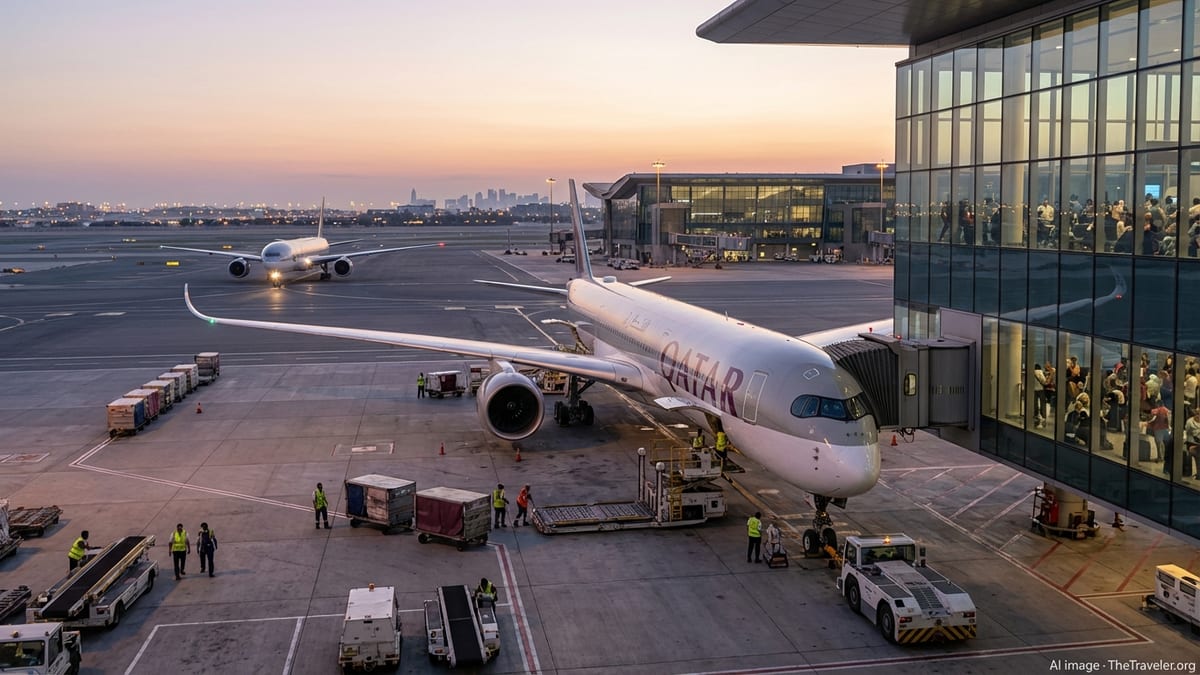
New Hail Service Extends Qatar Airways’ Saudi Footprint
From January 5, 2026, Qatar Airways will begin three weekly flights between Doha and Hail, marking the northern Saudi city as the carrier’s 13th destination in the Kingdom. The new route, operated via Hamad International Airport, is designed to plug Hail directly into a global network of more than 170 destinations and reflects rising demand for both domestic and international links into Saudi Arabia’s interior.
The launch follows a sustained ramp-up in the Saudi market, including earlier additions of Abha, NEOM and Red Sea International Airport to the Doha-based airline’s map. Together, these routes feed into Riyadh’s wider push to disperse tourism and business traffic beyond the country’s traditional gateways, while giving local residents faster one-stop access to Europe, Asia, Africa and the Americas.
Industry analysts say Hail’s inclusion underlines Qatar Airways’ strategy of targeting secondary cities that are central to Saudi Arabia’s Vision 2030 tourism agenda. By combining relatively small but fast-growing regional markets with its high-frequency Doha hub, the airline can sustain year-round operations and quickly pivot capacity to meet shifts in demand.
More Capacity for Jeddah and Riyadh as Demand Surges
Alongside the Hail launch, Qatar Airways is moving to daily seven-times-a-day operations for both Jeddah and Riyadh in early 2026, lifting its total weekly flights to Saudi Arabia above 150. The step-up is aimed at smoothing peak morning and evening banks at Doha, creating shorter connection times for religious, leisure and corporate travellers transiting to long-haul services.
Jeddah’s added frequencies are particularly geared to the growing year-round flow of pilgrims and religious visitors heading to nearby holy sites. Airlines serving Jeddah have increasingly shifted from purely seasonal capacity spikes around major religious periods toward more consistent schedules that reflect ongoing infrastructure expansion in western Saudi Arabia.
In Riyadh, the extra daily rotation is expected to appeal to government, energy and financial sectors whose travel has rebounded sharply. More flights give high-yield passengers better timing options into Europe, North America and Asia, while also supporting cargo flows linked to the Kingdom’s rapid project build-out.
Deepening Access to New York JFK and the Wider US Market
While Qatar Airways’ own operations into the United States are centered on major gateways such as New York, Chicago and the West Coast, 2026 will see the Doha-based carrier lean more heavily on partnerships to extend its reach. A recent expansion of codeshares with International Airlines Group brands Aer Lingus and Level has already placed the Qatar Airways code on additional transatlantic services from Europe into New York JFK, Boston, Los Angeles and other cities.
For passengers departing from new and growing stations such as Hail, Jeddah and Riyadh, this means a wider menu of one-stop or two-stop options into the US beyond Qatar Airways’ own nonstop Doha–US services. Travellers can route via Doha and on to partner-operated flights from Dublin or Barcelona into New York JFK, with itineraries ticketed and marketed under the Qatar Airways code.
Industry observers note that this strategy aligns with Qatar Airways’ broader approach in North America, where tight slot constraints and airport redevelopment projects at hubs like JFK make indirect growth via alliances more efficient than adding large numbers of new own-metal flights. For travellers, the result is a more seamless booking and baggage experience combined with increased schedule choice across both sides of the Atlantic.
Premium Upgrades and Superjumbo Deployments Reshape the Experience
Qatar Airways is complementing its network expansion with notable product moves on high-demand routes. In early 2026 the airline is deploying its Airbus A380 on the Doha–Singapore corridor for the first time, bringing first-class suites and expanded premium capacity to one of its busiest Asian markets. The superjumbo is also scheduled on routes to Bangkok, London Heathrow, Paris and Sydney during the same period, underscoring the carrier’s confidence in long-haul premium demand.
Although the A380 will not be deployed on Saudi or US routes in the near term, the broader investment in premium cabins, lounges and onboard service is central to how Qatar Airways intends to differentiate its offer from regional and global rivals. Travellers connecting from cities such as Hail, Jeddah and Riyadh into long-haul flights benefit from upgraded lounge access at Hamad International Airport and increasingly consistent cabin products across the fleet.
These enhancements arrive as the airline fine-tunes capacity elsewhere, including selective reductions on certain European routes in 2026 to free aircraft for stronger markets. The overall effect is a sharper focus on corridors where premium traffic and connecting flows remain resilient, a category that includes both Saudi Arabia and the US.
Strategic Positioning in a Competitive Gulf Landscape
The 2026 schedule moves come as Gulf carriers intensify competition for transfer traffic between Europe, Asia, Africa and the Americas. Emirates and Etihad continue to build out their own networks and partnerships, while Saudi Arabia’s national and start-up carriers are investing heavily to capture more international flows through Riyadh and Jeddah.
By deepening its presence in Saudi Arabia while simultaneously strengthening access to New York and other US markets through alliances, Qatar Airways is betting that its hub-and-spoke model via Doha still offers a compelling blend of connectivity and service quality. The airline’s repeated recognition in global awards and the continued expansion of Hamad International Airport support that positioning.
For travellers, the practical impact of the 2026 changes will be visible in shorter connection times, more city pairs bookable on a single ticket and increased choice in cabin products, particularly on long-haul sectors. As new airports and terminals open in both Saudi Arabia and New York over the coming years, carriers like Qatar Airways are racing to secure their share of the next wave of global air travel growth.