

More news on this day
An Airbus A380 operated by Qatar Airways took off from Doha for London Heathrow on March 7, marking the airline’s first post-crisis passenger departure and a symbolic breakthrough in efforts to evacuate thousands of travelers stranded by the unprecedented shutdown of Middle East airspace.
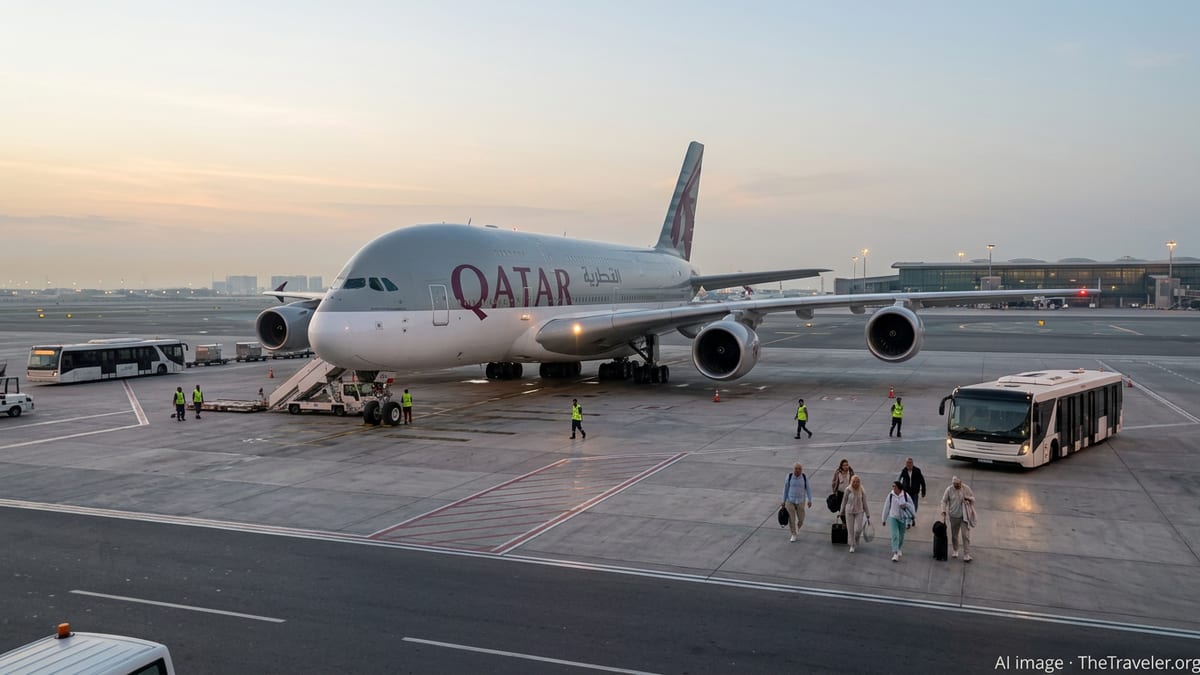
First A380 Departure Signals Partial Reopening
The Qatar Civil Aviation Authority confirmed on Saturday that it had authorized a tightly controlled safe corridor through Qatari airspace, enabling a limited wave of repatriation services from Hamad International Airport. Flight-tracking data showed a Qatar Airways A380 bound for Heathrow as the first commercial passenger aircraft to depart Doha since airspace was abruptly closed on February 28 amid escalating regional tensions.
The departure is being treated within the aviation industry as a historic relief operation rather than a return to normal schedules. Capacity remains sharply restricted, with only a handful of long-haul flights cleared to operate on designated contingency routes while regional skies are still subject to military activity and evolving security assessments.
Officials in Doha stressed that the easing applies solely to evacuation-style flights and essential cargo, not to regular commercial operations. Airlines, air traffic controllers and military authorities are coordinating closely on each individual movement to minimize risk and ensure that aircraft can transit safely through the constrained corridor.
The Heathrow service is part of a small cluster of European-bound flights operating under the special authorization, alongside rotations to Paris, Madrid, Rome and Frankfurt. Aviation analysts said the selection reflects both demand patterns and the need to prioritize major hubs where onward connectivity can be arranged quickly for displaced passengers.
Stranded Passengers Finally Start Moving
For passengers who have spent days confined to airport hotels or temporary accommodation around Doha, the first A380 departure offered the clearest sign yet that a way home is emerging. Qatar Airways has acknowledged that many travelers have endured long waits, with some diverted mid-flight or turned back after departure when the airspace closure took effect.
The airline and Qatari authorities said priority on the initial wave of relief services was given to passengers traveling with families, elderly travelers and those with urgent medical or compassionate needs. Seats on the A380 to London and other relief flights were pre-assigned, with the carrier contacting selected passengers directly rather than opening the services for general booking.
Travelers were repeatedly urged not to go to the airport unless they had received specific confirmation from Qatar Airways that they had been allocated a seat. Ground staff in Doha and at diversion points such as Muscat and Riyadh have been tasked with managing expectations and preventing crowds from converging on terminals in the hope of securing last-minute places.
Passengers still waiting for onward travel have been told to monitor their email, airline apps and hotel liaison points for updates as the carrier gradually works through a large backlog of disrupted itineraries. Some have been re-routed on partner airlines or via alternative hubs outside the affected region, while others remain on standby for subsequent relief flights once additional slots are cleared.
Limited Relief Corridor Reflects Ongoing Security Risks
The decision to permit only a narrow relief corridor through Qatari airspace underscores how fragile the situation remains for civil aviation across the Middle East. Regional flight paths that normally funnel traffic between Europe, Asia and Africa have been radically reshaped or suspended outright, adding hours to some journeys and stranding transit passengers when Doha was forced to halt operations.
Security officials in Qatar characterized the move to partially reopen as a carefully calibrated step aimed at addressing humanitarian needs without compromising safety. Every flight, including the landmark A380 to Heathrow, is operating under bespoke clearances that reflect real-time intelligence on missile and drone activity, as well as coordination with neighboring air traffic control centers.
Airlines across the region have been forced to juggle operational complexity, with some carriers opting to restart limited commercial services while others, including Qatar Airways, have focused on evacuation-style operations first. Industry observers say that divergence highlights different risk appetites and fleet positions, but agree that no carrier can fully return to pre-crisis patterns until airspace restrictions ease more broadly.
Insurance, crew duty limits and aircraft positioning have also become critical considerations. Long detours around closed or restricted airspace can strain schedules and limit the number of flights an airline can realistically mount, even when safe routes technically exist. The A380 deployment on the first relief flight reflected a desire to maximize capacity on every scarce movement Qatar Airways can operate out of Doha.
Pressure Mounts to Clear Backlog and Restore Connectivity
Despite the milestone departure to Heathrow, Qatar Airways cautioned that its regular network remains effectively suspended and that the partial reopening should not be interpreted as a full-scale restart. The airline has said it will issue a further update on March 8, once the impact of the initial relief corridor is assessed and discussions with regulators and security services continue.
Aviation analysts estimate that many thousands of passengers remain displaced by the week-long disruption, including residents of Qatar, expatriate workers and international transit travelers who were using Doha as a connecting hub. Clearing that backlog will require either a prolonged period of expanded relief operations or a broader normalization of airspace access that would permit a structured ramp-up of scheduled services.
Global travel patterns are already feeling the strain. Tour operators and corporate travel managers have scrambled to rebook itineraries away from the Gulf, while some leisure travelers have opted to postpone or cancel trips rather than navigate the uncertainty. Carriers in Europe and Asia are monitoring developments closely, particularly those that rely on feed from Gulf hubs to sustain their long-haul networks.
For now, industry bodies have welcomed the carefully staged approach taken by Qatari authorities, but they warn that sustained disruption would have a material impact on regional tourism and trade. The Middle East has become one of the world’s most important aviation crossroads, and prolonged constraints on Qatar’s hub could reshape route planning and competitive dynamics well beyond the immediate crisis period.
Passengers Urged to Stay Flexible as Situation Evolves
With security conditions still fluid and the relief corridor subject to ongoing review, both Qatar Airways and aviation regulators are urging passengers to remain flexible and avoid making unnecessary trips through the region in the short term. Travelers with bookings in the coming days have been advised to check the status of their flights frequently and to consider alternative routings where possible.
Consumer advocates say that communication remains a key concern after days of cancellations, diversions and rapidly changing advisories. While the historic A380 departure from Doha to Heathrow has become a powerful symbol of progress, many passengers are still seeking clarity on compensation, rebooking options and how long disruption is likely to continue.
Travel industry experts suggest that the next 48 to 72 hours will be critical in determining whether Qatar can widen its relief operations and move toward a broader restart, or whether renewed security incidents will force a retreat. In the meantime, the focus remains firmly on getting stranded passengers home safely, one heavily managed flight at a time.
As the A380 climbs toward Europe, it carries not only hundreds of relieved travelers but also the hopes of an aviation sector eager for signs that the worst of the airspace shutdown may be passing. How quickly that hope translates into a durable reopening will depend on decisions taken far beyond the departure boards of Hamad International Airport.