

More news on this day
Qatar Airways is preparing a sweeping shake-up of its long-haul network, with publicly available timetables and industry reports indicating that Airbus A380 services to five destinations in the United States, Germany, China and Australia will be suspended as the carrier reshapes capacity amid ongoing airspace restrictions and a tighter focus on fuel-efficient aircraft.
Get the latest news straight to your inbox!
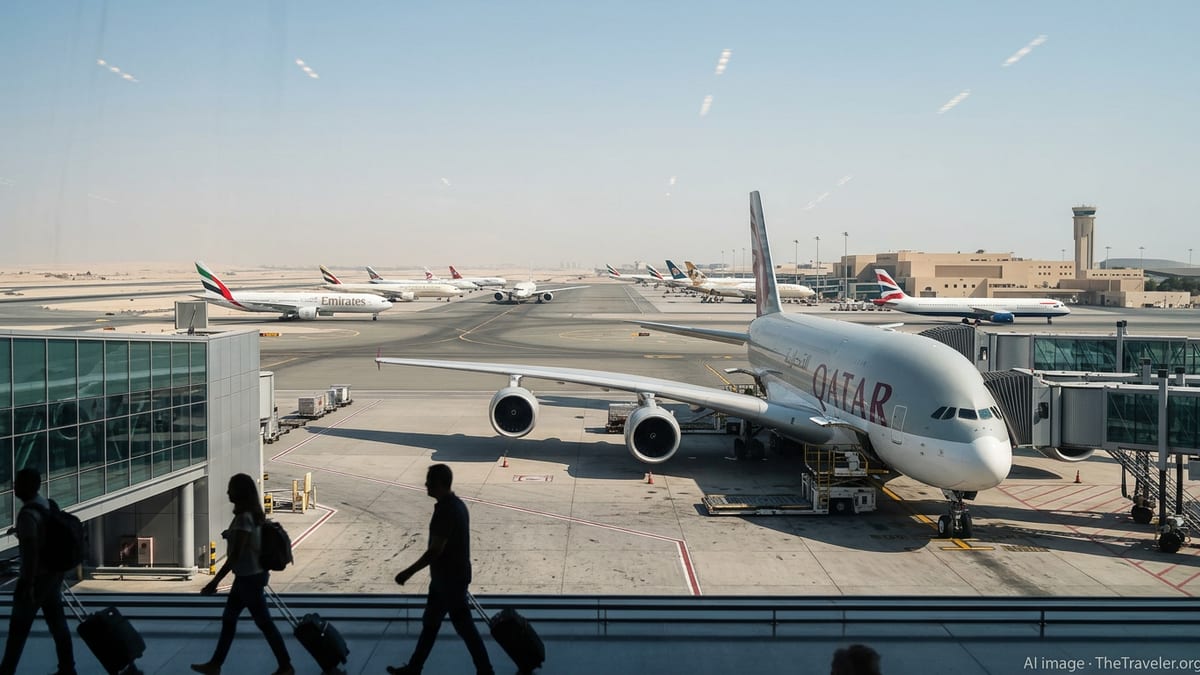
Five A380 Routes Affected Across Four Key Markets
Scheduling data compiled by aviation trackers for the northern summer 2026 season shows that Qatar Airways will withdraw its Airbus A380 from five long-haul routes serving major gateways in the United States, Germany, China and Australia, replacing the superjumbo with smaller widebodies or temporarily suspending nonstop service. The changes form part of a broader recalibration of the airline’s long-haul capacity as it navigates both demand shifts and ongoing operational constraints linked to the recent closure of Qatari airspace.
In the United States, the adjustments center on a reduction of capacity rather than a full exit, with the airline trimming frequencies and moving selected services back to the Boeing 777 and Airbus A350 on routes that had periodically seen the A380 deployed during peak periods. Industry coverage of the airline’s updated summer schedule highlights a near 30 percent cut in seats on the Doha to San Francisco sector from late March 2026, illustrating how the carrier is pulling back higher-capacity equipment on marginal routes.
In Germany, timetable changes show the A380 being withdrawn from at least one major hub, with Qatar Airways consolidating operations using twin-engine widebodies to preserve frequency while reducing overall seat count. Aviation analysts note that Europe remains one of the airline’s strongest long-haul markets, but the combination of airspace disruption and softer premium demand on some city pairs is prompting a measured reduction in superjumbo exposure.
In the Asia-Pacific region, the shake-up is most visible in Australia and China. On the Perth to Doha route, Qatar Airways has already begun phasing out the A380 in favor of a Boeing 777 fitted with the carrier’s Qsuite business class, a move framed by specialist aviation outlets as a strategic response to changing demand and cost pressures. On selected China services, published schedules indicate that A380 rotations will be suspended and replaced with smaller widebodies, aligning capacity more closely with current booking patterns.
A380 Network Retrenchment Follows Years of Gradual Return
The latest suspensions represent the next phase in what has been an extended and often cautious return of the A380 to Qatar Airways’ network. After grounding the type at the height of the pandemic, the carrier gradually reinstated the superjumbo on high-demand routes such as London Heathrow, Sydney and Perth, and more recently used the aircraft to launch flagship service on the Singapore route, a development widely covered by aviation media late last year.
As the A380 footprint expanded again, Qatar Airways repeatedly signaled that the aircraft would be limited to a handful of trunk routes where dense traffic and slot constraints could justify its high operating cost. Industry commentary has consistently described the airline’s A380 strategy as selective and opportunistic, with the type deployed to defend market share in key premium and connecting markets rather than as a backbone of the fleet.
That context helps explain why the current round of suspensions is concentrated on five specific destinations instead of a wholesale withdrawal. By trimming A380 exposure on underperforming or operationally challenging routes while retaining the aircraft on a few flagship city pairs, Qatar Airways is attempting to keep its most prestigious product visible to travelers without locking in long-term commitments where demand is uncertain.
The airspace closure that began in late February 2026 has also accelerated decisions that might otherwise have been phased in more gradually. Travel advisories and network updates published in recent days describe how the grounding of a portion of the long-haul fleet, combined with complex rerouting around restricted areas, has forced the airline to prioritize aircraft utilization on the most strategically important services.
Impact on Passengers in the US, Germany, China and Australia
For travelers in the affected countries, the most immediate change will be the loss of the distinctive two-deck A380 cabin on certain flights, along with a reduction in available seats on specific days of the week. In practical terms, this is likely to translate into fewer nonstop options during peak periods and increased reliance on connections via partner airlines, particularly for itineraries originating in second-tier cities in the United States, Germany, China and Australia.
In the United States, passengers flying from West Coast and secondary East Coast gateways may see higher average load factors, less flexibility in departure dates and times, and occasional upgauging or downgauging of equipment as Qatar Airways fine-tunes its schedule. Corporate travel managers and frequent flyers tracking the changes indicate that while daily connections via Doha remain intact on most major routes, premium-cabin award availability is already tightening where A380 services are being pulled.
German travelers are likely to experience subtler changes, with the swap to smaller widebodies primarily affecting the overall number of seats rather than the breadth of the network. However, the loss of the A380’s upper-deck business cabin and its spacious economy layout may be felt on high-yield routes popular with both business and leisure passengers connecting to Asia, Africa and the South Pacific.
In Australia and China, the impact is more closely tied to evolving market conditions. In Australia, the shift from A380 to Boeing 777 on the Perth route is being framed in local coverage as a trade-off between capacity and product quality, as the newer twinjets offer Qatar Airways’ latest business-class suites even as total seats fall. In China, the suspension of superjumbo operations on selected routes is seen as part of a broader regional recalibration following several years of uneven demand recovery and intermittent travel restrictions.
Fleet Strategy: Pivot Toward Twin-Engine Efficiency
Behind the route-level changes is a clear fleet strategy that favors modern twin-engine aircraft over the fuel-thirsty A380. Qatar Airways has invested heavily in the Airbus A350 and Boeing 787 families, and has continued to utilize its Boeing 777 fleet as the workhorse of long-haul operations, frequently highlighting the fuel efficiency and range flexibility of these types in investor presentations and public fact sheets.
The airline’s decision to reduce A380 exposure on selected routes while leaning into A350 and 777 deployments aligns with a wider trend across global aviation. Major long-haul carriers in Europe and Asia have either retired or sharply reduced their A380 fleets in recent years, citing structural changes in demand, rising fuel costs and the growing appeal of more flexible, smaller widebodies that can support higher frequencies with lower risk.
Qatar Airways is simultaneously rebalancing its partnerships and equity stakes, as illustrated by the decision last year to divest its holding in Hong Kong’s Cathay Pacific. Industry analysis of that sale has linked the move to a broader effort to focus capital on core fleet and network priorities, especially as the airline prepares for a new generation of aircraft deliveries and navigates a more complex geopolitical environment for Gulf carriers.
With the A380 no longer in production and maintenance costs climbing as the fleet ages, each superjumbo sortie must now be justified by strong yields and exceptionally high load factors. By concentrating the remaining A380s on a smaller set of routes where these conditions can be met, Qatar Airways is attempting to preserve the aircraft’s branding value while avoiding the financial drag that has prompted peers to withdraw the type.
What Travelers Should Watch in the Months Ahead
For now, the suspension of A380 routes to five destinations appears to be part of a dynamic and still-evolving response to airspace constraints, shifting demand and long-term fleet economics. Airline schedule filings are typically updated in several waves ahead of each season, meaning further refinements to aircraft types, frequencies and departure times are likely as the situation around Qatari airspace and regional connectivity develops.
Travel industry advisories recommend that passengers booked on Qatar Airways long-haul services over the coming months monitor their reservations closely for schedule and aircraft changes. Even where flights remain confirmed, there may be adjustments to departure times, connection windows in Doha and operating aircraft, with some travelers moved from A380 services to 777 or A350 flights offering a different onboard experience.
Analysts expect the carrier to continue prioritizing strategic trunk routes linking Doha with key hubs in Europe, North America and the Asia-Pacific region, while taking a more cautious approach to marginal or highly seasonal city pairs. If demand strengthens and airspace conditions stabilize, some of the currently suspended A380 operations could return in future seasons, but industry commentary suggests that the long-term trend is toward a smaller, more focused superjumbo footprint.
For travelers in the United States, Germany, China and Australia, the message is that Qatar Airways connectivity to Doha and beyond remains broadly intact, but the era of widespread A380 deployments is drawing to a close. The network that emerges from this transition is likely to be leaner, more reliant on fuel-efficient twinjets, and more responsive to rapid swings in global demand, even if it means fewer opportunities to fly on one of the world’s most distinctive passenger aircraft.