

More news on this day
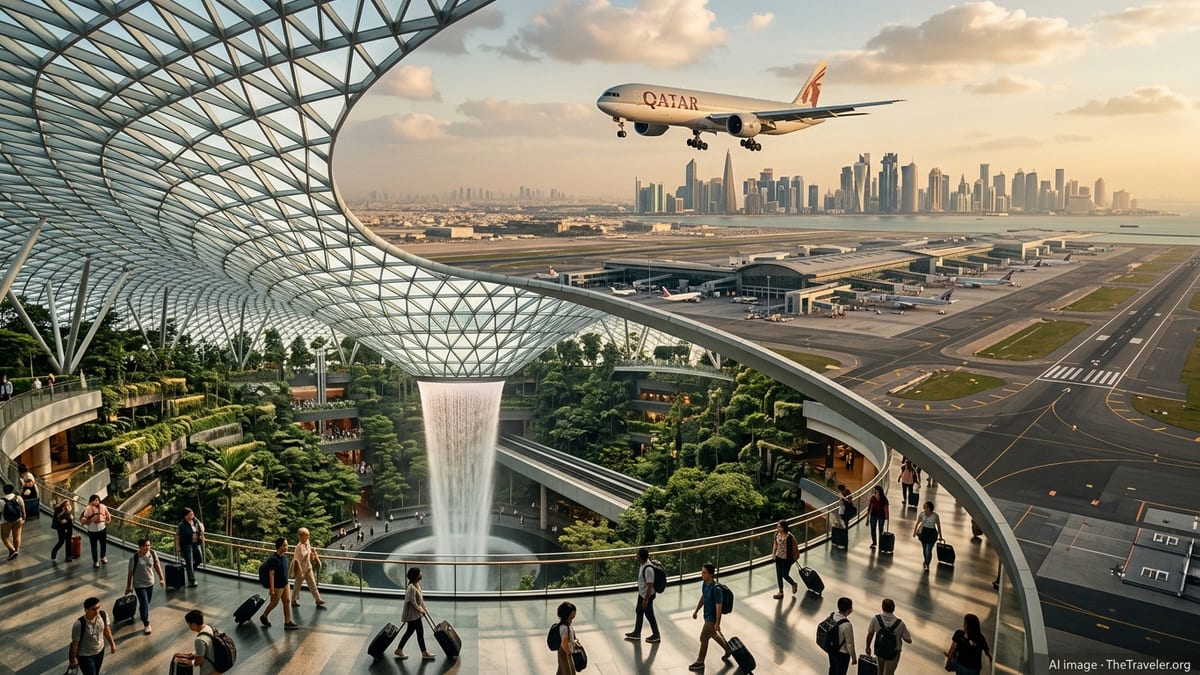
As airlines and airports race to capture a resurgent wave of tourism, Qatar Airways and Singapore’s Changi Airport are emerging as pivotal players in defining what global travel excellence will look like in 2026.
Get the latest news straight to your inbox!
Record-Breaking Accolades Reshape the Competitive Landscape
Qatar Airways has tightened its grip on the premium end of global aviation, securing the World’s Best Airline title at the 2025 Skytrax World Airline Awards. Publicly available rankings show the Doha-based carrier in first place worldwide, ahead of rivals such as Singapore Airlines and Cathay Pacific, and confirm that the airline has now claimed the top spot a record nine times.
The repeat recognition follows earlier wins in 2024, underscoring a pattern of consistent performance in long haul service, business class hard product and lounge experience. Industry coverage indicates that passenger surveys conducted between late 2024 and mid 2025 placed Qatar Airways at or near the top across multiple categories, reflecting a strong emphasis on cabin comfort, in flight service and network connectivity.
At the same time, Singapore’s Changi Airport has reasserted its position at the apex of airport rankings. According to Changi Airport Group’s own award listings and independent aviation reports, the hub reclaimed the title of World’s Best Airport in the Skytrax 2025 World Airport Awards, adding to a tally of more than 700 accolades and reinforcing its long running reputation as a benchmark for passenger experience.
Together, these parallel achievements by Qatar Airways and Changi Airport are shaping perceptions of what “best in class” means across both air and ground segments. As tourism demand rises and travelers become more discerning about every step of the journey, their combined performance is influencing how other airlines and airports position themselves for 2026.
Next-Generation Passenger Experience From Cabin to Terminal
Qatar Airways’ continued dominance in international rankings has been closely tied to its focus on the onboard experience. Published assessments highlight its premium Qsuite business class cabins, refined soft product, and the scale of the Hamad International Airport hub as key differentiators. Even as the airline navigates recent regional disruptions and phased schedule adjustments in March 2026, the broader strategy points to maintaining a high end, globally connected offering.
Aviation analysts note that repeated recognition for best business class and business class lounge services has elevated expectations for competitors. Features such as fully enclosed suites, direct aisle access in business cabins, and refined culinary programs are increasingly treated as baseline standards in the premium segment, particularly on routes linking Europe, Asia and Australasia.
On the ground in Singapore, Changi Airport continues to refine its own brand of experiential travel. Terminals 1 through 4, together with the Jewel mixed use complex, combine retail, entertainment, indoor nature and digital experiences in a way that blurs the line between airport and destination. Publicly available information from Changi Airport Group shows that the hub handled around 70 million passengers in 2025, placing it among the world’s busiest international gateways and demonstrating substantial recovery from the pandemic era.
For travelers, the convergence of these trends means that the future of long haul travel is increasingly defined by seamless transitions between high quality airline cabins and richly programmed hub airports. Both Qatar Airways and Changi Airport are leveraging design, technology and service culture to keep transit time feeling less like a layover and more like an extension of the destination.
Changi’s Terminal 5 Signals Singapore’s Tourism Ambitions
Singapore is using aviation infrastructure as a central lever for its wider tourism strategy. Work continues on the multi billion dollar Changi East project and the planned Terminal 5, which is expected to significantly expand capacity in the 2030s. While full opening is still several years away, 2026 is shaping up as a pivotal storytelling moment around the project.
In January 2026, Changi Airport Group launched “T5 In the Making,” an immersive exhibition that offers the public a preview of Terminal 5’s design and operating concept. According to published coverage of the initiative, the exhibition showcases mock ups, interactive displays and multimedia installations that explore how the terminal aims to integrate automation, sustainable design and new passenger flows.
The initiative is positioned as a way to build public awareness and anticipation well before construction milestones translate into finished infrastructure. For Singapore’s tourism sector, which is targeting visitor numbers broadly in line with or above pre pandemic levels by the mid 2020s, the exhibition also functions as a soft power tool, underlining the city state’s long term commitment to remain a premier global hub.
Supporting transport projects, including future mass rapid transit links toward the airport precinct and road expansions around the Changi region, are intended to ensure that increased aviation capacity is matched by efficient landside connectivity. These developments, taken together, point to a 2026 narrative in which Singapore is not only recovering tourism volume, but also actively shaping how visitors will move through the gateway in the next decade.
Tourism Recovery, Connectivity and the 2026 Outlook
Across Asia and the Middle East, tourism flows are rebounding toward or exceeding pre pandemic benchmarks, and both Qatar and Singapore occupy strategic positions in long haul traffic patterns. Forecasts cited in regional construction and tourism market reviews suggest that Singapore is planning for continued gradual growth in visitor arrivals through 2026, supported by aviation capacity, cruise infrastructure upgrades and new attractions.
Qatar Airways, for its part, continues to expand and recalibrate its global network, even as it adapts to short term airspace and security considerations in early 2026. The carrier’s role in connecting secondary European cities, African gateways and emerging Asian destinations to major tourism markets remains central to Qatar’s own visitor strategy, especially around major events and stopover programs in Doha.
For travelers, the combination of a top ranked airline and a consistently lauded hub airport represents a powerful draw when choosing itineraries in 2026. Itineraries that pair Qatar Airways’ premium cabins or competitive economy service with connections at hubs such as Doha and Singapore are increasingly framed in consumer media as high value options for long haul journeys.
Industry observers note that this concentration of quality in a handful of global hubs also has competitive implications. Other airports across Europe, North America and Asia are accelerating terminal refurbishments, digital processing upgrades and passenger experience investments in response to the standards set by operators like Changi and airlines such as Qatar Airways.
Raising the Bar for Global Travel Standards
The prominence of Qatar Airways and Singapore Changi Airport in recent rankings is influencing how policymakers, tourism boards and private operators think about the wider travel ecosystem. Investment is no longer focused solely on aircraft or terminal capacity; instead, it increasingly spans integrated retail concepts, sustainability credentials, multimodal connections and data driven personalization.
Changi’s emphasis on creating a destination within the airport, from indoor gardens to interactive attractions, is being studied by airports seeking to increase non aeronautical revenue and dwell time without undermining operational efficiency. At the same time, Qatar Airways’ track record across frequent flyer engagement, premium product differentiation and global partnerships is shaping how airlines calibrate loyalty propositions and alliances.
Looking ahead through 2026, publicly available plans in both Qatar and Singapore suggest that tourism excellence will be defined by resilience and adaptability as much as by comfort and design. Whether managing temporary route disruptions or phasing in new terminal capacity, both players are navigating a period of geopolitical uncertainty while still investing in long term growth.
As travelers return to the skies in growing numbers, the standards set by Qatar Airways and Singapore Changi Airport are likely to exert outsized influence on what passengers around the world come to expect. From check in to touchdown, the benchmarks now being established in Doha and Singapore are helping to define the next era of global tourism.