

More news on this day
As airspace closures and missile attacks repeatedly disrupt Middle East skies in early 2026, Gulf super-connectors Qatar Airways and Etihad Airways are quietly restructuring their loyalty programs, betting that revamped perks and tighter rules will keep high-value travelers loyal even as routings grow longer and less predictable.
Get the latest news straight to your inbox!
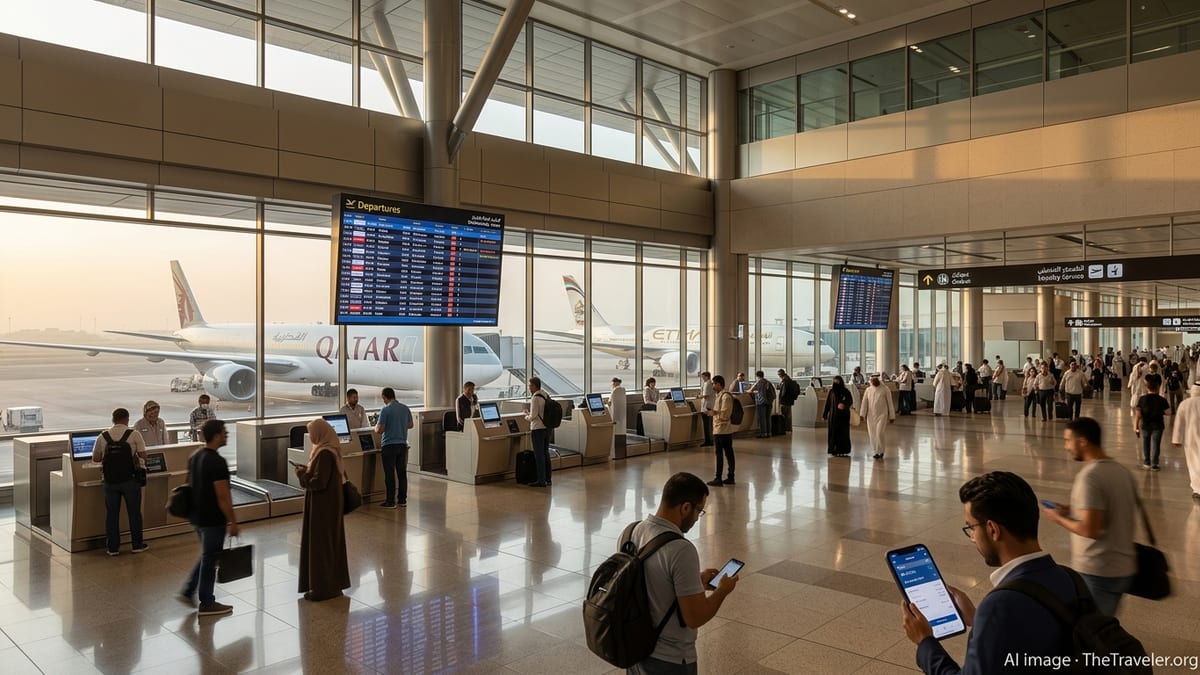
Airspace Turmoil Forces Gulf Carriers to Rethink Loyalty
Successive airspace shutdowns across Qatar, the United Arab Emirates, Iran, Iraq and parts of the Levant in recent weeks have turned the Middle East from a through-corridor into an obstacle course for global aviation. Publicly available flight-tracking data shows large swathes of formerly busy airways now closed or heavily restricted as the conflict involving Iran, Israel and the United States escalates. Analysts cited in international coverage estimate that hundreds of thousands of passengers have been stranded or rerouted as hub airports in Doha and Abu Dhabi reduced or suspended regular operations.
For Qatar Airways and Etihad, whose business models depend on shuttling long-haul travelers between continents via their Gulf hubs, the crisis has sharply increased operating costs. Rerouted flights burn more fuel and require extra crew time, while waves of cancellations have forced extensive rebooking, hotel accommodation and compensation. Industry reporting indicates that jet fuel already accounted for around 30 percent of airline operating costs in 2024, and the additional miles flown to skirt closed airspace are magnifying that pressure.
In this environment, loyalty programs have emerged as a financial and strategic shock absorber. By reshaping how points are earned and redeemed, and by tightening expiration rules, the Gulf carriers are trying to stabilize revenue from frequent travelers and credit-card partners while still advertising aspirational rewards. The latest changes at Qatar Airways Privilege Club and Etihad Guest reflect a delicate balance between cost control and maintaining traveler goodwill.
Qatar Airways Privilege Club: Avios Engine Under Stress
Qatar Airways completed its migration to Avios, the shared currency used by several International Airlines Group carriers, well before the current flare-up. Annual reports and program announcements highlighted the move as a way to create a deeper pool of partners and a more flexible earning and spending ecosystem. As the regional aviation crisis deepens, that decision is proving pivotal: the airline can continue to promote global Avios redemptions even when Doha schedules are reduced.
Publicly available program materials show that Privilege Club members continue to earn Avios based on booking class and route, with status tiers unlocking higher multipliers. However, the value side of the equation is more fluid. During periods of disruption, travelers report that award availability on high-demand evacuation or repatriation flights tightens significantly, while off-peak routes and dates can still yield good-value redemptions. The Avios link with British Airways and other partners offers an escape valve, allowing members to shift points out of the Gulf region toward more stable networks when needed.
Reports from travelers and loyalty specialists indicate that Qatar has also become more assertive about account integrity and activity requirements. While the airline continues to market generous earning through co-branded credit cards, hotel bookings and retail partners, there is a stronger emphasis on flight-based engagement and on maintaining accurate personal data. In a crisis environment where rebooking and rerouting are frequent, up-to-date profiles and contact details have become a practical necessity rather than a formality.
For flyers planning upcoming trips through Doha, the key takeaway is flexibility. Privilege Club members are increasingly advised by independent loyalty guides to keep some Avios parked with partner programs to hedge against sudden route changes, and to monitor the pricing of both cash and award tickets as schedules are rebuilt day by day around available airspace.
Etihad Guest’s 2024 Overhaul Meets a New Reality
Etihad Airways entered the current airspace crisis having just completed a major overhaul of its Etihad Guest program in mid 2024. According to coverage from aviation and loyalty publications, the revamp promised a simpler, more personalized scheme, with the headline improvement that every seat on the aircraft could be bought with miles at dynamic rates. At the same time, Etihad cut the price of many GuestSeat awards, while tightening the rules on mileage expiry.
Under the redesigned structure, Etihad Guest miles now generally expire after 18 months of inactivity, and crucially, only eligible flight activity resets the clock. Published guides to the program note that non-flying transactions such as credit-card transfers or shopping may no longer extend validity in the way they once did. This shift was already nudging members to take at least occasional flights on Etihad or its partners to preserve large balances.
The war-induced airspace restrictions have complicated that strategy. With regular Abu Dhabi services to high-risk destinations such as Tel Aviv reduced or suspended and other regional routes frequently rerouted, opportunities for quick mileage-preserving trips have narrowed. Travelers holding substantial Etihad Guest balances now face the dual challenge of finding available flights that avoid conflict zones while also beating the expiry countdown.
Loyalty analysts suggest that Etihad’s decision to make every seat bookable with miles is a modest hedge against this uncertainty. When schedules are disrupted, cash fares can spike on the remaining flights that do operate, but dynamic mileage pricing may sometimes offer a more predictable outlay, especially for last-minute travel. However, members must weigh that flexibility against reduced mileage lifespan and, in some cases, higher mileage prices than before the 2024 redesign.
New Perks and Quiet Devaluations: What Travelers Actually Get
Behind the technical charts and expiry rules, the core question for travelers is whether these restructurings actually improve the value of loyalty. For both Qatar Airways and Etihad, the picture is mixed. On the positive side, program updates over the past two years have expanded the range of ways to earn and redeem points, including more hotel and lifestyle partners, the ability to pay for ancillary services with miles, and closer cooperation with major bank rewards schemes.
Qatar’s adoption of Avios has opened up access to an extensive partner airline network and made it easier to combine balances earned on different carriers. Etihad’s move to allow miles to be used on any seat, not just classic awards, has reduced the frustration of searching for scarce award space during peak seasons. During the current crisis, these features mean that loyal customers have more pathways to turn their points into actual travel, even if it means flying different routes or partner airlines than originally planned.
At the same time, travelers are contending with what specialists describe as stealth devaluations. Dynamic pricing on both cash and award tickets can increase the number of miles required for popular long-haul premium cabins, particularly when demand surges after prolonged airspace closures. Tighter mileage expiry rules, especially at Etihad Guest, risk wiping out balances for members who are unable or unwilling to transit the region while conflicts persist.
For frequent travelers who continue to use Gulf hubs as essential connectors between Europe, Asia and Africa, the sweet spot may lie in combining airline-specific perks with broader bank or alliance-based currencies. Maintaining status in one of the flagship Gulf programs can still unlock priority services and fee waivers during disruptions, while keeping a portion of rewards in more flexible ecosystems provides insurance against sudden route or policy changes.
Practical Strategies for Flyers Navigating the Crisis
With the aviation map of the Middle East shifting from week to week, travelers are increasingly treating loyalty strategy as part of their risk management. Travel-management alerts and airline advisories emphasize the importance of checking flight status close to departure and being prepared for last-minute rerouting around closed airspace. For Qatar Airways and Etihad customers, that preparation now extends to how and where points are stored.
Loyalty commentators recommend that Privilege Club and Etihad Guest members start by auditing their balances, noting any upcoming mileage expiries and identifying which routes are currently operating with the fewest disruptions. In some cases, converting miles into partner programs or redeeming for near-term travel, even on slightly less-than-ideal itineraries, may be preferable to waiting for a perfect redemption that never materializes before balances lapse.
Travelers are also encouraged by independent guides to keep documentation of disrupted trips and associated rebookings, as this can prove useful when negotiating reinstatement of expired miles or fee waivers, especially where carriers have made ad hoc exceptions during extended closures. While policies vary and may not be publicly advertised in detail, published examples from previous disruption periods suggest that Gulf carriers have at times applied discretionary flexibility for loyal customers.
For now, the Middle East aviation crisis has underlined both the value and the vulnerability of airline loyalty programs. Qatar Airways and Etihad are using their schemes as financial lifelines and customer-retention tools in a volatile market. Travelers who understand the new rules, track the shifting perks and act early on threatened balances will be best placed to turn that turbulence into tangible benefits rather than lost miles.