

More news on this day
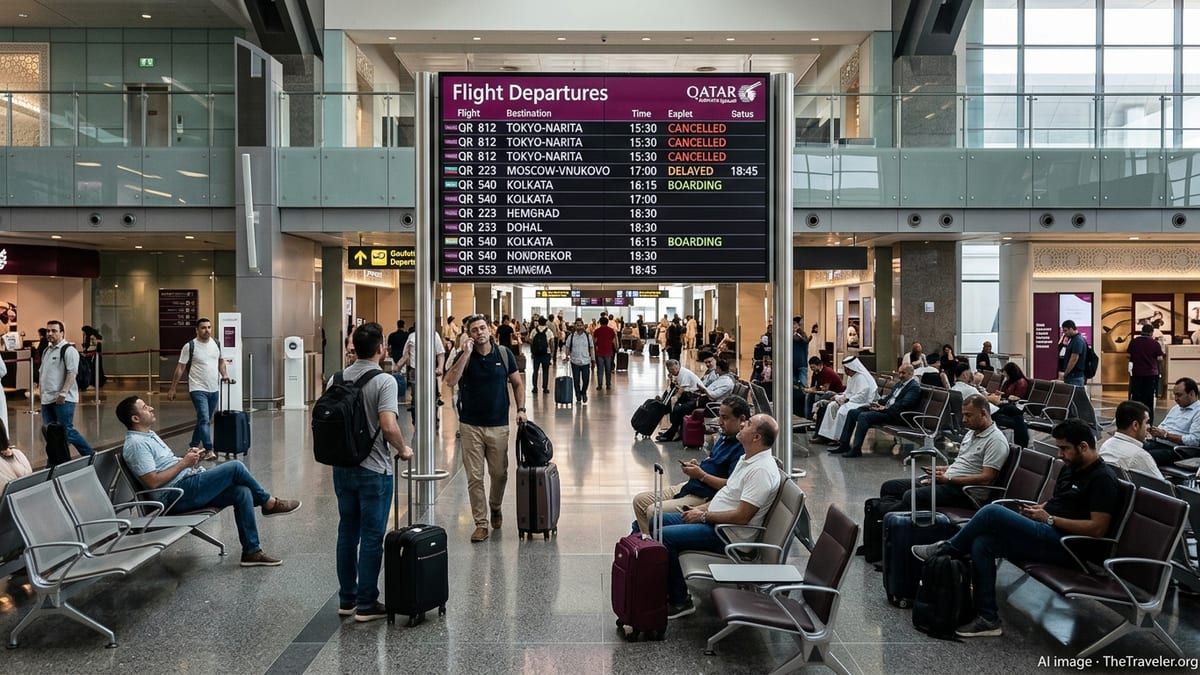
Qatar Airways is pushing through one of its most dramatic network shake-ups in years, suspending a dozen major international routes including services to Tokyo and Moscow, even as flights to the Indian city of Kolkata make a surprise return to the schedule.
Get the latest news straight to your inbox!
A Sharp Network Reset After Weeks of Disruption
According to published coverage and updated schedules, Qatar Airways has initiated a broad reset of its global network following weeks of disruption linked to regional airspace closures. The latest changes concentrate capacity on a smaller number of corridors while putting several long-haul and high-profile destinations on hold.
Publicly available timetable data indicates that the carrier is suspending 12 routes, with Tokyo and Moscow among the most notable cities to disappear from near-term schedules. The move marks a significant shift for an airline that has long marketed itself on connecting Asia, Europe, and the Americas through its Doha hub with high frequency and geographic reach.
Analysts note that the adjustment appears to be less about demand collapse and more about operational constraints. With aircraft and crews tied up by diversions, longer routings, and rolling cancellations since late February, the carrier is concentrating service where it can maintain more reliable operations, rather than trying to cover its full pre-disruption map.
The result is a mixed picture for passengers: some markets are temporarily losing their nonstop Doha links, while others are seeing frequencies restored or upgraded as Qatar Airways attempts to stabilize its core schedule.
Tokyo and Moscow Among 12 Routes Put on Hold
Japan and Russia are among the most high-profile markets affected. Industry schedule filings and aviation data providers show that Tokyo services, including flights to Narita, are being suspended in the current interim timetable window. For travelers in Japan, that reduces options for one-stop connections to Europe, the Middle East, and Africa that previously relied on Doha as a key hub.
Moscow is facing a similar pause. Routes to the Russian capital, which have historically formed part of Qatar Airways’ connectivity into Eastern Europe and Central Asia, are being withdrawn at least temporarily. This follows a pattern seen during earlier periods of geopolitical tension, when carriers trimmed exposure to markets facing airspace, regulatory, or operational headwinds.
Alongside Tokyo and Moscow, reports indicate that a wider group of long- and medium-haul routes are affected, bringing the total number of suspended city pairs to 12. While the full list varies slightly across reporting sources and schedule snapshots, the overall effect is clear: certain destinations that were once staples of the network are absent from current booking options, with passengers steered toward alternative hubs or alliances.
Travelers holding tickets on these suspended routes are generally being offered rebooking on remaining Qatar Airways services via different gateways, or rerouting via partner airlines where seats are available. However, passenger accounts shared publicly suggest that availability on popular dates remains tight, particularly into major European and Asian gateways.
Why Kolkata Is Back While Others Lose Service
In contrast to the cuts in East Asia and Eastern Europe, Kolkata has emerged as one of the surprise winners in the latest reshuffle. Flight search results and schedule disclosures show that Doha–Kolkata services, previously reduced amid the broader disruption, are being restored to the network.
India is one of Qatar Airways’ most important markets, and Kolkata plays a strategic role within that footprint. The city serves a large population with strong ties to the Gulf and onward destinations in Europe and North America, creating steady demand for both point-to-point and connecting traffic. Restoring Kolkata helps the airline re-anchor its presence in eastern India at a time when capacity in and out of Doha is still constrained.
Industry observers point out that Indian routes are often among the most resilient during periods of volatility, supported by labor, family, and education travel as well as price-sensitive leisure demand. Bringing Kolkata back into the fold allows Qatar Airways to channel this reliable demand through its hub, even as it steps back from more discretionary or operationally complex markets.
The decision also reflects a broader pattern in the airline’s current strategy: prioritize large-origin markets with consistent year-round demand and shorter sector lengths while deferring more marginal or operationally demanding city pairs until conditions stabilize.
Operational Pressures, Airspace Constraints, and Fleet Utilization
The shake-up cannot be understood without looking at the operational environment Qatar Airways has faced since late February. Public information from aviation authorities and traveler reports point to a combination of airspace closures and routing restrictions that have forced detours, added flight time, and cut into the usable hours of aircraft and crews.
Long-haul routes like Tokyo and Moscow are particularly sensitive to these factors. Extended routings can push flights toward crew duty limits and reduce the number of rotations that a given aircraft can operate in a week. In that context, trimming a handful of long sectors can free capacity to support multiple shorter flights on high-demand corridors, which may generate more predictable revenue for the airline.
Fleet utilization considerations appear to be central to the current schedule design. With a finite number of widebody aircraft and ongoing maintenance cycles, the airline is effectively rebalancing where and how those jets are deployed. Restoring Kolkata while suspending some longer-haul routes suggests a pivot toward markets that can be served efficiently within the current operational envelope.
At the same time, Qatar Airways is still signaling that these changes are interim rather than permanent. Timetable notes and public statements referenced in industry coverage emphasize that further adjustments are possible, and that additional routes may be reinstated as airspace issues ease and operational flexibility returns.
What Passengers Should Expect in the Coming Weeks
For travelers, the most immediate impact of the route suspensions is uncertainty. Those booked on affected services to Tokyo, Moscow, and other suspended destinations are being re-accommodated where possible, but many are reporting longer journeys, additional connections, and, in some cases, limited alternative dates.
Published guidance consistently encourages passengers to monitor their bookings closely, use airline apps and online tools to check flight status, and remain flexible about travel dates and routings. With schedules still being adjusted in short windows, flights that appear available one day may change or disappear in subsequent updates.
On the positive side, the restoration of Kolkata and selected other routes signals that Qatar Airways is not simply shrinking its network, but reallocating capacity to markets where it can operate more reliably. For travelers in India and other reinstated destinations, that may translate into more dependable options and fewer last-minute cancellations compared with the peak of the disruption period.
In the near term, the situation remains fluid. Industry analysts expect Qatar Airways to continue fine-tuning its network as airspace conditions evolve and as demand patterns become clearer into the northern summer season. For now, the suspension of 12 significant routes, including Tokyo and Moscow, alongside the return of Kolkata, underlines how quickly global air connectivity can be reshaped when operational constraints collide with strategic priorities.