

More news on this day
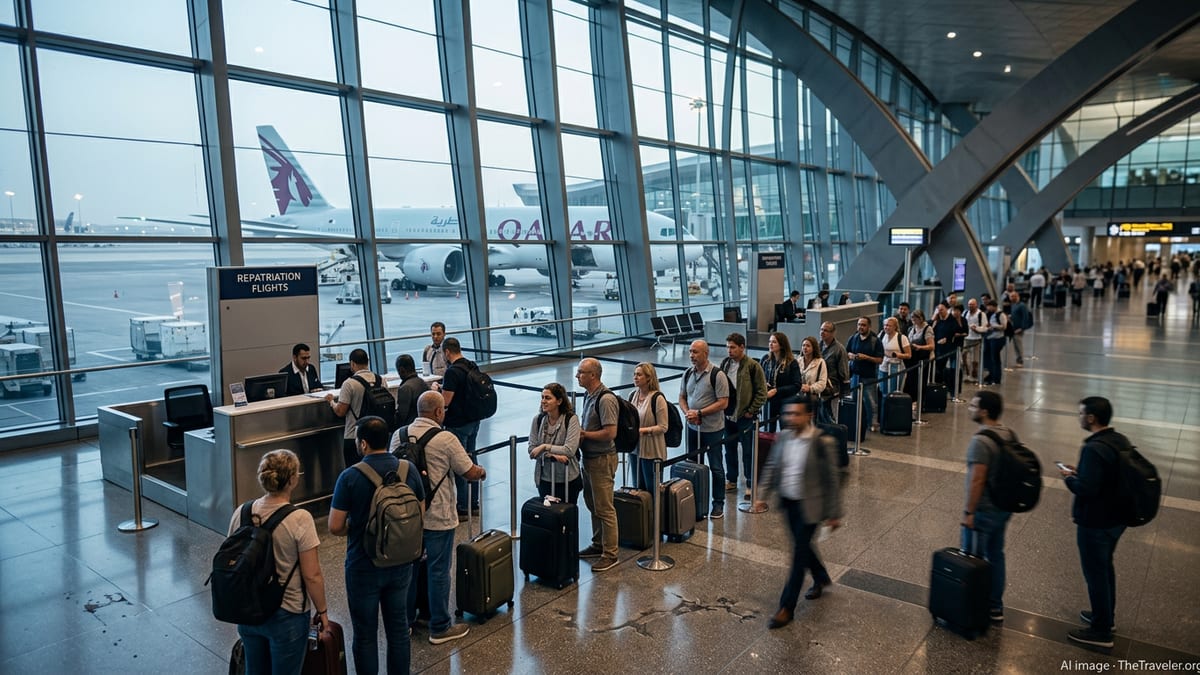
Stranded travelers are finally starting to leave Doha after days of flight chaos, as Qatar Airways today launched emergency repatriation services to major European hubs under a newly reopened relief corridor through Qatari airspace.
Limited Airspace Reopening Unlocks Relief Corridor
Qatar’s tightly controlled airspace, effectively closed since late February amid Iranian missile strikes across the Gulf, has partially reopened under emergency conditions, allowing a narrow corridor for evacuation and cargo traffic. The move follows authorization from the Qatar Civil Aviation Authority for what officials describe as a strictly limited and closely monitored operating window.
Within hours of the announcement, Qatar Airways confirmed it would use the safe corridor to launch special repatriation flights on 7 March from Hamad International Airport to London, Paris, Madrid, Rome, and Frankfurt. These routes were chosen to connect Doha with some of Europe’s largest long haul hubs, where passengers can access onward services arranged by other carriers or their home governments.
The approval does not yet signal a full reopening of Qatar’s skies. Regular scheduled operations for the Doha based carrier remain suspended, and authorities have stressed that the authorization is confined to a small number of humanitarian and relief movements while the wider security situation in the region remains volatile.
Nevertheless, the first departures out of Doha represent a symbolic and practical breakthrough for thousands of travelers who have spent days in airport hotels, transit halls, and temporary accommodation waiting for a path out of the Gulf.
Stranded Passengers Prioritized on First Departures
Qatar Airways has said that seats on the initial wave of repatriation flights were not opened for general sale, but instead pre allocated to customers already holding cancelled tickets and identified as most vulnerable. Priority was given to families traveling with young children, elderly passengers, and those with urgent medical or compassionate reasons to return to Europe.
At Hamad International Airport, scenes on Saturday were a mixture of relief and exhaustion as check in counters reopened for the first time in days for Qatar Airways operated departures. Airline staff escorted pre confirmed passengers through dedicated queues, while others without new flight details were turned away and advised to wait for further communication from the carrier.
Some travelers described being notified overnight that they had been reassigned onto the special services, following days of uncertainty as they tried to rebook on alternative airlines that themselves were grappling with rapidly shifting airspace restrictions. For many, the Qatar Airways flights offered the first reliable option to get back to Europe without complex multi stop routings around closed or contested skies.
Despite the joy at finally boarding, the atmosphere onboard remained subdued and practical. Cabin crews briefed passengers on the modified routings designed to keep aircraft clear of active conflict zones, and emphasized that the operation was being conducted under heightened safety and security oversight by Qatari and regional aviation authorities.
Key European Hubs: London, Paris, Madrid, Rome and Frankfurt
The decision to focus the initial services on London Heathrow, Paris Charles de Gaulle, Madrid Barajas, Rome Fiumicino, and Frankfurt reflects the role of these airports as both national gateways and major transfer hubs within Europe. By concentrating scarce capacity on these cities, Qatar Airways and aviation planners aim to maximize onward options for repatriated passengers once they arrive.
In London and Paris, ground handling teams and partner airlines prepared for the arrival of widebody aircraft carrying mixed nationalities, including tourists, migrant workers, and business travelers. Many had been stranded in Doha after connecting flights were canceled when Qatari airspace was abruptly shut in response to the Iranian strikes earlier in the week.
In Madrid and Rome, airport authorities coordinated with consular services to assist passengers needing rapid domestic connections or accommodation while they awaited trains and regional flights. Frankfurt, one of Europe’s busiest intercontinental hubs, similarly braced for an influx of displaced travelers seeking to reroute toward destinations across central and northern Europe.
While the immediate priority is to clear the backlog of passengers stuck in Doha, officials in several European capitals said they expected additional relief flights could be organized if security conditions allow the narrow operating corridor to remain open in the coming days.
Further Relief Flights Planned as Situation Evolves
Alongside Saturday’s departures from Doha, Qatar Airways has outlined plans for a second phase of limited operations, including flights scheduled on 8 March into Hamad International Airport from the same European hubs. Those inbound services are intended primarily for passengers whose final destination is Qatar, including residents and citizens who have been stranded abroad since the airspace closure began.
The airline has cautioned that these flights should not be interpreted as a full resumption of its global network. Instead, they form part of a phased response coordinated with the Qatar Civil Aviation Authority and regional partners, designed to relieve the most urgent passenger bottlenecks while keeping overall air traffic at a fraction of normal levels.
Travelers holding bookings between late February and mid March have been urged to monitor direct communications from Qatar Airways, which is continuing to offer date changes, refunds, or re routing on other carriers where possible. Industry analysts say it could take weeks for the airline to fully unwind the operational disruption and reposition aircraft and crews once standard commercial flying is deemed safe again.
For now, aviation authorities describe the airspace status as “restricted but navigable” for designated relief operations. Any further escalation in regional tensions or new missile activity could lead to an immediate suspension of the corridor, underscoring the fragile nature of the current arrangements.
Regional Aviation Slowly Restarts Under Tight Controls
The Qatar developments form part of a broader, tentative restart across the Gulf’s aviation sector after days of unprecedented disruption triggered by the Iranian missile campaign. Neighboring hubs have also begun operating limited evacuation and relief services, though most regular passenger flights remain grounded or on heavily modified routings to avoid sensitive airspace.
Industry observers note that the rapid grounding of fleets and closure of key corridors showcased both the vulnerability and resilience of the global air travel system. Airlines and air traffic controllers have had to redesign routings in real time, shifting long haul flights onto southern detours that add hours to journeys and significantly increase fuel burn and operating costs.
For passengers, the repatriation flights out of Doha and other regional hubs represent a crucial turning point after a week marked by cancellations, abrupt diversions, and long waits for information. Yet with only a small percentage of normal capacity restored, many travelers across the Middle East and beyond are still waiting for clarity on when they will be able to fly.
Aviation officials stress that safety remains the overriding consideration. Any decision to fully reopen Qatari airspace and restore the Qatar Airways network will depend on sustained security improvements and close coordination with international partners. Until then, the emergency flights now leaving Doha for London, Paris, Madrid, Rome, and Frankfurt stand as rare bright spots in an otherwise deeply disrupted global travel landscape.