

More news on this day
Travel disruption across the Middle East intensified this week as Qatar Airways cancelled hundreds of flights and imposed lengthy delays, leaving passengers stranded in Abu Dhabi, Doha, Jeddah and Riyadh and rippling across air travel in Saudi Arabia, Kuwait, Bahrain, Israel, Jordan and beyond.
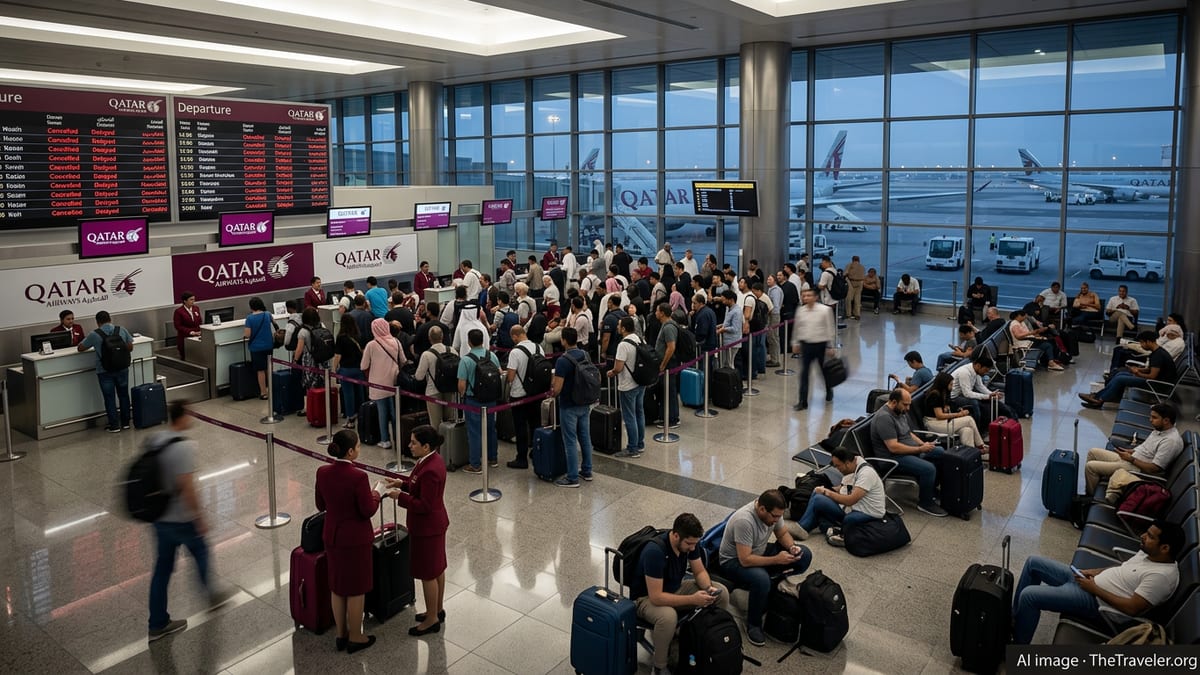
Mass Cancellations At Gulf Hubs
Qatar Airways is operating on an emergency schedule after days of airspace closures and security restrictions linked to the widening conflict involving Iran, the United States and Israel. The Doha based carrier has scrapped hundreds of services and sharply curtailed departures and arrivals at its Hamad International Airport hub, according to airline advisories and airport data.
Operational data compiled by regional aviation trackers indicate that more than 435 Qatar Airways flights have been cancelled over the past several days across its network, with at least eight additional services classified as heavily delayed. The cuts affect both short haul routes within the Gulf and long haul connections to Europe, Asia and Africa that normally rely on smooth transfers through Doha.
While a limited number of repatriation and relief flights have begun operating in and out of Doha, the airline has stressed that these do not represent a full resumption of its normal schedule. Passengers without a confirmed booking on these special services are being urged not to travel to the airport, as departure halls remain crowded with earlier stranded travelers awaiting rebooking.
The cancellations are part of a broader pattern of disruption across the Gulf, where carriers including Emirates, Etihad and Saudia have also been forced to scale back operations or reroute around closed or restricted airspace. The region’s large hub airports, which normally serve as vital junctions between Europe, Asia and Africa, have become choke points in a fast moving aviation crisis.
Stranded Passengers In Doha, Abu Dhabi, Jeddah And Riyadh
At ground level, the statistics translate into days of uncertainty for travelers who happened to be connecting through the region when the latest wave of closures hit. In Doha, airport authorities and the Qatari government have been providing hotel accommodation and visa extensions for thousands of passengers stuck in transit, while crews work through complicated rebooking queues.
Similar scenes have been reported in Abu Dhabi, where Qatar Airways code share services and interline connections have been disrupted alongside Etihad’s curtailed schedule. Passengers describe long lines at transfer desks, crowded gate areas and repeated changes to departure boards as airlines wait for clearance on new flight corridors or aircraft positioning.
In Saudi Arabia, the disruption has been most visible at Jeddah and Riyadh, key gateways for religious pilgrims and workers traveling to and from Asia and Africa. With Qatar Airways, Saudia and several foreign carriers all adjusting schedules simultaneously, many travelers have faced multiple cancellations in succession and limited alternative options that do not cross the affected airspace.
Travel advocates warn that the concentration of so many cancellations at a handful of regional hubs magnifies the impact on global mobility. With flights full on remaining routes and alternative itineraries often requiring long detours, some passengers are being told to expect delays of several days before they can reach their final destinations.
Knock On Effects Across Saudi Arabia, Kuwait, Bahrain, Israel And Jordan
The shock waves from Qatar Airways’ schedule cuts extend well beyond the airline’s main hubs. In Saudi Arabia, domestic and regional links that depend on feed from Doha have been thinned out, forcing travelers to rebook via alternative cities or postpone trips altogether. Smaller airports that typically rely on Gulf connections for international reach are seeing reduced traffic and heavier reliance on local carriers.
In Kuwait and Bahrain, both important stopover and labor migration gateways, airport authorities are grappling with a mix of cancellations and extended delays on flights that either connect through Doha or must now take longer routes to avoid closed airspace. Ground handling teams report challenges managing aircraft and crew rotations when arrival times are unpredictable and transit passengers are no longer arriving in steady waves.
The impact is also being felt further west, in Israel and Jordan, where airspace restrictions and security concerns have already narrowed options for international carriers. Qatar Airways does not serve all of these markets directly, but its role as a major connector means that reduced capacity out of Doha cuts into the pool of viable one stop itineraries to and from Tel Aviv, Amman and nearby cities.
Travel analysts note that the region’s aviation system is tightly interconnected, with Gulf hubs functioning as the backbone for journeys linking Europe, South Asia, Southeast Asia and parts of Africa. When one of the largest players such as Qatar Airways sharply reduces its schedule, the effects cascade across airline alliances, code share networks and local economies that depend on steady passenger flows.
Limited Relief Flights And Confusing Communications
In response to mounting criticism from stranded customers, Qatar Airways has expanded a program of limited relief and repatriation flights from Doha to selected European and Asian destinations on specific dates. The services are being prioritized for passengers whose original flights were cancelled during the initial days of the airspace closure and for those facing urgent travel needs.
However, the ad hoc nature of the relief schedule, combined with high demand and short notice announcements, has led to confusion. Many travelers say they have received inconsistent information from call centers, airport counters and the airline’s digital channels about when and how they might be rebooked. Social media posts from affected passengers describe repeated promises of updates that fail to materialize and difficulties securing written confirmations.
Industry observers point out that the airline is attempting to manage an unusually complex operational puzzle while working within constraints imposed by regulators and military authorities. Aircraft and crews are scattered across multiple countries, flight plans require last minute revisions, and available corridors must be shared with other carriers facing similar pressures.
Even so, consumer groups argue that communication shortfalls are compounding the stress on travelers. They are urging Qatar Airways and other regional airlines to provide clearer, more proactive guidance about passengers’ rights to refunds, alternative transport and accommodation, especially for those who may not be able to wait in the region for days on end.
What Travelers Should Do Now
With no firm timeline for a full restoration of normal schedules, travel experts are advising passengers with upcoming itineraries involving Doha, Abu Dhabi, Jeddah, Riyadh or other Gulf hubs to plan for continued volatility. Those holding Qatar Airways tickets are being encouraged to monitor their booking status frequently, use the airline’s app or online tools where possible and avoid heading to the airport without a confirmed, operating flight.
For travelers whose flights have already been cancelled, the first step is to decide whether to accept rebooking at a later date or seek a refund and arrange an alternative route on another carrier that is not dependent on the affected airspace. Travel agents and corporate travel departments can sometimes access additional inventory or creative routings that are not immediately visible to individual customers.
Specialists also recommend checking the terms of any travel insurance policies and credit card protections, which may cover some of the extra costs incurred by unexpected hotel stays, new tickets or missed connections. However, passengers are being warned to read the fine print, as some policies limit coverage for disruptions tied to armed conflict or government ordered airspace closures.
For now, the consensus among airline analysts is that Middle East air travel will remain fragile for days or weeks, even if temporary corridors allow for partial resumptions of service. Until the security picture stabilizes and airspace restrictions ease, travelers across Saudi Arabia, Kuwait, Bahrain, Israel, Jordan and the wider region will need to brace for a level of uncertainty that has not been seen since earlier geopolitical crises reshaped flight paths over the Gulf.