

More news on this day
Travel across the Middle East has been thrown into fresh turmoil as Qatar Airways cancels hundreds of services and delays others amid widespread airspace closures linked to the escalating conflict involving Iran, the United States and regional powers, leaving passengers stranded from Riyadh and Tehran to Dubai, Abu Dhabi, Istanbul, Kuwait and Beirut.
Get the latest news straight to your inbox!
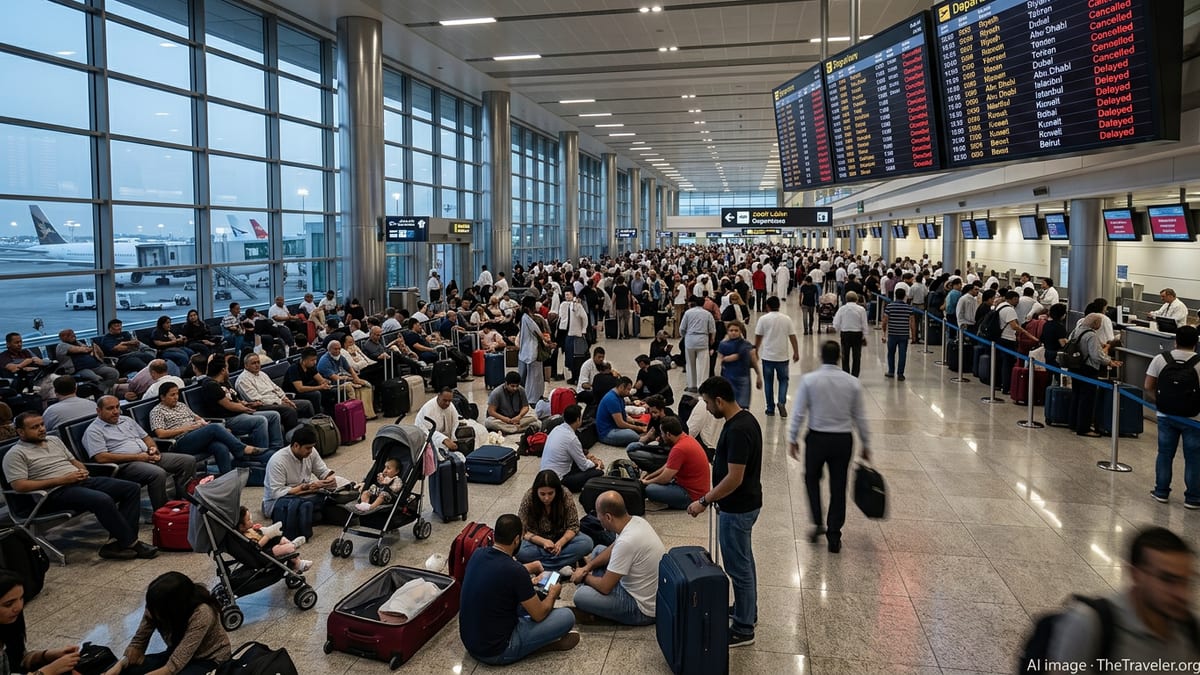
Mass Qatar Airways Disruptions Across Key Regional Hubs
Publicly available flight tracking and passenger reports indicate that Qatar Airways has pulled 261 flights from its schedule and delayed 14 more in recent days, as the carrier reacts to a fast-moving security situation in Middle Eastern airspace. The disruptions are concentrated on routes touching Saudi Arabia, Iran, the United Arab Emirates and Iraq, but are also affecting wider transit flows through Doha that normally connect Europe, Asia, Africa and the Americas.
Airport boards and online timetables for Riyadh, Tehran, Dubai, Abu Dhabi, Istanbul, Kuwait and Beirut show waves of Qatar Airways cancellations alongside scrubbed or curtailed operations by other international and regional airlines. These cancellations are compounding the broader shock already facing the sector after multiple countries in the region temporarily shut or severely restricted their airspace to civilian traffic.
The impact has been particularly acute at major hubs that depend on continuous long-haul connectivity. Dubai International and Abu Dhabi International, as well as Doha’s Hamad International Airport, have seen large portions of their scheduled departures wiped from departure boards over several consecutive days, with only a limited number of flights able to operate via lengthy detours around closed flight information regions.
For Qatar Airways, the cancellations have triggered a complex operational puzzle. Aircraft and crew are out of position, and the airline must juggle safety advisories, airport damage assessments, and shifting government restrictions while attempting to preserve at least a skeleton network for essential travel and repatriation.
Airspace Closures and Conflict Drive Regional Aviation Crisis
The latest wave of travel disruption is unfolding against the backdrop of the 2026 Iran conflict, which has led to the closure of swathes of Middle Eastern airspace. According to open-source aviation analysis and policy reporting, Iran’s skies largely emptied of civilian aircraft after a series of strikes in late February, as states including Bahrain, Iraq, Israel, Kuwait, Qatar and the UAE moved to restrict or suspend overflights for safety reasons.
These decisions have cascaded through global flight networks. Long-haul routes that typically cross Iran, Iraq and the Gulf to link Europe and Asia have been forced to reroute via longer, more southerly corridors or to suspend operations altogether. Reports from regional media and aviation data firms describe thousands of daily cancellations across multiple carriers, with the Gulf’s three major hub systems in the UAE and Qatar particularly affected.
The scale of the shock has quickly outstripped that seen during previous periods of regional tension, such as earlier missile exchanges or the diplomatic rift that once led to a blockade of Qatar. This time, the combination of active conflict, direct strikes on or near major airports, and overlapping airspace closures has left airlines with far fewer viable alternatives for safe overflight and refuelling.
Even when airspace is technically open, conflict-zone advisories from international regulators and industry bodies are encouraging operators to avoid certain flight information regions, further narrowing the corridors available for civilian traffic. The result is a patchwork of diversions, extended flight times and tactical cancellations that can change from hour to hour.
Passengers Stranded From Riyadh to Beirut
The human impact of the cancellations is visible in crowded terminals and mounting online complaints, as passengers report being stranded for days in cities such as Riyadh, Tehran, Dubai, Abu Dhabi, Istanbul, Kuwait City and Beirut. With 261 Qatar Airways flights cancelled and 14 delayed, entire itineraries have collapsed for travellers who depended on the Gulf’s dense web of connecting services.
Accounts shared on public forums and social platforms describe travellers sleeping in airport halls, queuing for hours at transfer desks and struggling to obtain clear information about rebooking options. Many itineraries that relied on a Qatar Airways connection through Doha, or on feeder services into the UAE’s hub airports, have become unworkable as onward legs are successively cancelled.
Travelers attempting to reroute via alternative carriers face limited options. Numerous international airlines have also suspended flights to Iran, Iraq, Kuwait and Lebanon, while some have sharply reduced services into the UAE and Qatar. Seats on remaining flights through comparatively less affected hubs, such as certain airports in Saudi Arabia and Oman, have become scarce and expensive, according to publicly listed fares and availability data.
The situation has been especially difficult for passengers trying to reach or leave conflict-adjacent areas for family, work or education reasons. With routine commercial links severely curtailed, many are forced into complex multi-stop journeys that stretch over several days and involve last-minute changes as airspace restrictions evolve.
Operational Challenges and Limited Recovery Pathways
For Qatar Airways and its regional peers, the crisis is as much operational as it is political. Large-scale cancellations disrupt tightly calibrated aircraft and crew rotations, forcing airlines to reposition jets over great distances once conditions permit. Ground handling, catering and maintenance arrangements built around dense daily schedules have also been upended, particularly at airports where infrastructure has sustained damage or where staffing is constrained by security concerns.
Publicly available updates indicate that some Gulf airports have begun cautiously rebuilding limited schedules, with a small number of long-haul and regional flights taking circuitous routes to avoid closed airspace. However, the pace of recovery remains slow. Even modest resumptions are vulnerable to reversal if the security situation deteriorates or if new restrictions are imposed on previously open corridors.
Qatar Airways has published travel waivers and schedule-change policies on its website and mobile app, allowing eligible passengers to request date changes or refunds when flights are cancelled. Yet execution of these policies has proven uneven in practice, according to numerous traveller accounts, as customer service hotlines, chat channels and airport desks contend with unprecedented volumes of rebooking requests.
Industry analysts note that full normalization of operations will likely depend on a sustained easing of regional tensions and a coordinated reopening of key flight information regions. Until then, airlines face a difficult balancing act: maintaining essential connectivity where possible, while avoiding undue risks to passengers, crew and aircraft in an active conflict environment.
What Travellers Can Expect in the Coming Days
With conditions changing rapidly, publicly available guidance from airlines, airports and aviation regulators converges on a cautious message for travellers: flexibility and constant monitoring are essential. Schedules for Qatar Airways and other carriers remain subject to abrupt overnight changes, particularly on routes touching Saudi Arabia, Iran, the UAE, Iraq, Kuwait and Lebanon, as well as on long-haul services that normally overfly those countries.
Passengers already in transit through affected hubs are likely to continue facing extended layovers, rebookings and occasional last-minute boarding gate cancellations. Those with upcoming trips through Doha, Dubai, Abu Dhabi or other regional hubs are being advised in public notices and travel advisories to verify their flight status repeatedly in the 24 hours before departure, and to prepare contingency plans in case of disruption.
Travel experts quoted in regional media suggest that, where feasible, travellers should consider alternative routings that avoid the most heavily restricted airspace, even if this means longer total travel times or additional connections. At the same time, they caution that the global reach of the hub-and-spoke system centered on the Gulf means that few itineraries to or from Asia, Africa and Europe are entirely insulated from the current instability.
As the situation unfolds, Qatar Airways’ sweeping cancellations and delays have become a visible symbol of how quickly geopolitical crises can reverberate through international travel. For now, the prospect of a swift return to normality across the region’s skies remains uncertain, leaving passengers, airlines and tourism operators braced for further volatility.