

More news on this day
Travelers passing through South Korea’s Incheon International Airport on March 12 faced mounting uncertainty after Qatar Airways abruptly canceled two key flights on the Seoul–Doha route, deepening disruption from a regional airspace closure that has already stranded thousands worldwide.
Get the latest news straight to your inbox!
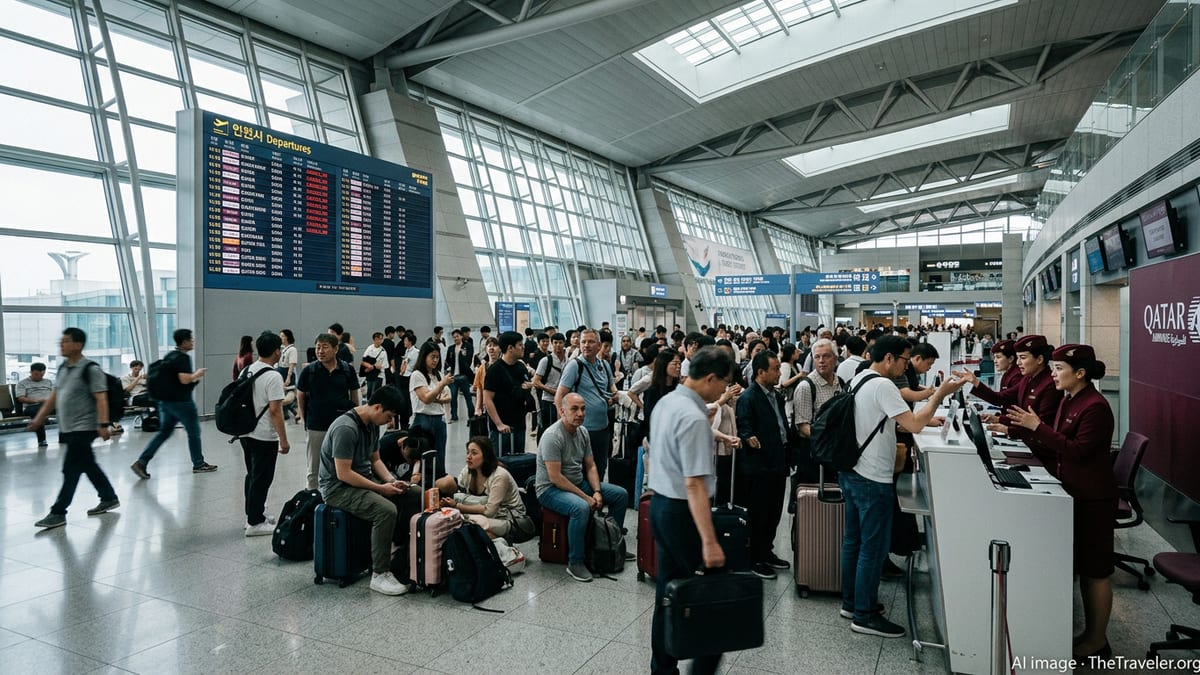
Key Incheon–Doha Flights Pulled Amid Regional Airspace Crisis
Qatar Airways passengers arriving at Incheon International Airport on Thursday reported learning at the last minute that their Doha-bound services had been scrubbed from departure boards, despite earlier assurances that a limited schedule would operate. The cancellations affected at least two high-demand rotations linking Seoul with Doha, a critical connection for travelers heading on to Europe, the Middle East and Africa.
The move comes as Qatar Airways continues to operate under severe constraints following the temporary closure of Qatari airspace in early March, which forced the airline to suspend most commercial operations and rely on a patchwork of relief flights. While select inbound services from Seoul to Doha had been scheduled as part of a reduced program this week, operational adjustments and capacity limits have left some of those plans in flux.
Passengers at Incheon on Thursday described a confusing situation in which earlier messages about confirmed departures clashed with live airport information screens showing flights as canceled. With few alternative long-haul options leaving at similar times and many itineraries built around tight onward connections via Doha, the loss of the two Qatar Airways services had an outsized impact.
Airport staff said they were working with the carrier to rebook affected customers where possible, but the scale of the ongoing disruption across the region meant that seats on other airlines were scarce, particularly for same-day travel.
Stranded Passengers Face Long Waits and Limited Alternatives
For some travelers, the cancellations at Incheon translated into an immediate loss of onward journeys, including long-planned trips to Europe and South Asia that depended on Doha as a transit hub. With Qatar Airways operating only a fraction of its normal schedule globally, rebooking options via Hamad International Airport remained limited, even for those willing to travel on later dates.
Many stranded passengers reported waiting for hours in lines at Qatar Airways service desks and partner ticket counters inside Incheon’s main terminal, seeking clarity on when they might next be able to depart. Others turned to online customer service channels, only to encounter long response times as the airline contends with a surge of disruption-related inquiries worldwide.
Local travel agents in Seoul said they had seen a sharp increase in urgent calls from customers asking whether it was still possible to secure seats on alternative carriers to destinations such as London, Paris, Frankfurt and Delhi. With peak outbound travel demand from South Korea already high in March, many long-haul services on other airlines were nearly full, and last-minute fares had climbed significantly.
Some South Korea–based travelers with flexible schedules chose to postpone their trips entirely rather than risk being stranded in transit. Others scrambled to reconfigure complex itineraries that had originally relied on Qatar Airways’ extensive global network, now heavily curtailed by the airspace constraints.
Incheon International Airport Responds to Mounting Disruption
Incheon International Airport officials acknowledged the heightened disruption on Thursday, noting that operational decisions about flight cancellations ultimately rest with individual carriers. However, the airport has deployed additional customer service staff and wayfinding personnel in affected zones to assist passengers seeking information and temporary accommodation options.
Airport lounges and nearby hotels reported a spike in occupancy as travelers opted to remain close to the terminal in case new seats became available at short notice. Some passengers with long layovers, including families with young children and elderly travelers, were offered meal vouchers or access to rest areas where capacity allowed, though such assistance remained uneven and dependent on individual ticket conditions.
Airport authorities emphasized that security and air traffic operations at Incheon itself are functioning normally, with disruptions stemming primarily from the regional situation affecting Doha and the surrounding airspace. Other major Middle Eastern and European carriers serving Seoul were operating, but with limited ability to absorb the sudden influx of displaced Qatar Airways customers.
Travel analysts said the events at Incheon underscore how dependent many Asia–Europe itineraries have become on a small number of Gulf and Middle Eastern hubs. When a crisis sharply constrains capacity at one of those hubs, the ripple effects at far-flung airports can be immediate, even if local conditions appear stable.
Qatar Airways’ Reduced Global Schedule Limits Recovery Options
Qatar Airways has been gradually rebuilding a skeletal flight program using temporary corridors authorized by aviation regulators, with a rotating list of destinations receiving limited services into and out of Doha on specific days. Recent schedules have included select arrivals from Seoul and other major cities, designed primarily to move stranded travelers rather than restore full commercial operations.
Industry notices and airline statements this week have reiterated that these special services are not equivalent to a normal timetable and remain highly subject to change. Aircraft and crew availability, changing airspace permissions, and safety assessments tied to regional tensions have all contributed to late adjustments, including the cancellations now hitting the Seoul–Doha route.
For South Korea–origin passengers, that means even confirmed bookings on relief flights are not guaranteed until the aircraft actually departs. Travel experts warn that, as long as Qatar’s airspace remains partially restricted, any attempt to route itineraries through Doha carries a higher-than-normal risk of disruption, particularly for tight connections or essential travel with fixed dates.
Qatar Airways has expanded its flexible booking policy for customers with travel dates in March, allowing multiple date changes or refunds on unused tickets in many cases. However, passengers at Incheon on Thursday said that generous rebooking rules offer limited comfort when there are few available seats on alternative dates, and when the overall outlook for restoring regular Seoul–Doha operations remains uncertain.
What Travelers in South Korea Should Do Now
For travelers currently holding Qatar Airways tickets from Seoul, industry advisers recommend checking flight status repeatedly on the day of departure and avoiding unnecessary trips to the airport without a clearly confirmed service. Because last-minute cancellations have become common, many passengers are being turned away at check-in despite earlier indications that flights would operate.
Experts also suggest that passengers who must travel in the next few days consider rerouting via other hubs that still have capacity, even if that means longer journey times or higher costs. Some South Korean and international carriers are offering limited additional capacity to European and Middle Eastern destinations, but availability varies significantly by route and date.
Those already stranded at Incheon are urged to document all expenses related to delays, including accommodation and meals, and to retain boarding passes and cancellation notices. While compensation rules differ depending on the origin and ticket type, detailed records can be important if travelers later seek refunds or support from airlines, insurers or credit card providers.
With no clear timeline yet for a full restoration of Qatar Airways’ Seoul–Doha schedule, travel specialists say South Korea–based passengers should prepare for continued volatility in the days ahead. For now, the airline’s cancellations at Incheon International Airport highlight the human impact of a fast-evolving airspace crisis centered thousands of kilometers away, yet deeply felt in departure halls across Asia.