

More news on this day
Travelers in South Korea are facing mounting disruption after Qatar Airways abruptly canceled two core services between Seoul and Doha, leaving passengers effectively stranded at Incheon International Airport as the airline pares back its network in response to regional airspace closures and security concerns in the Gulf.
Get the latest news straight to your inbox!
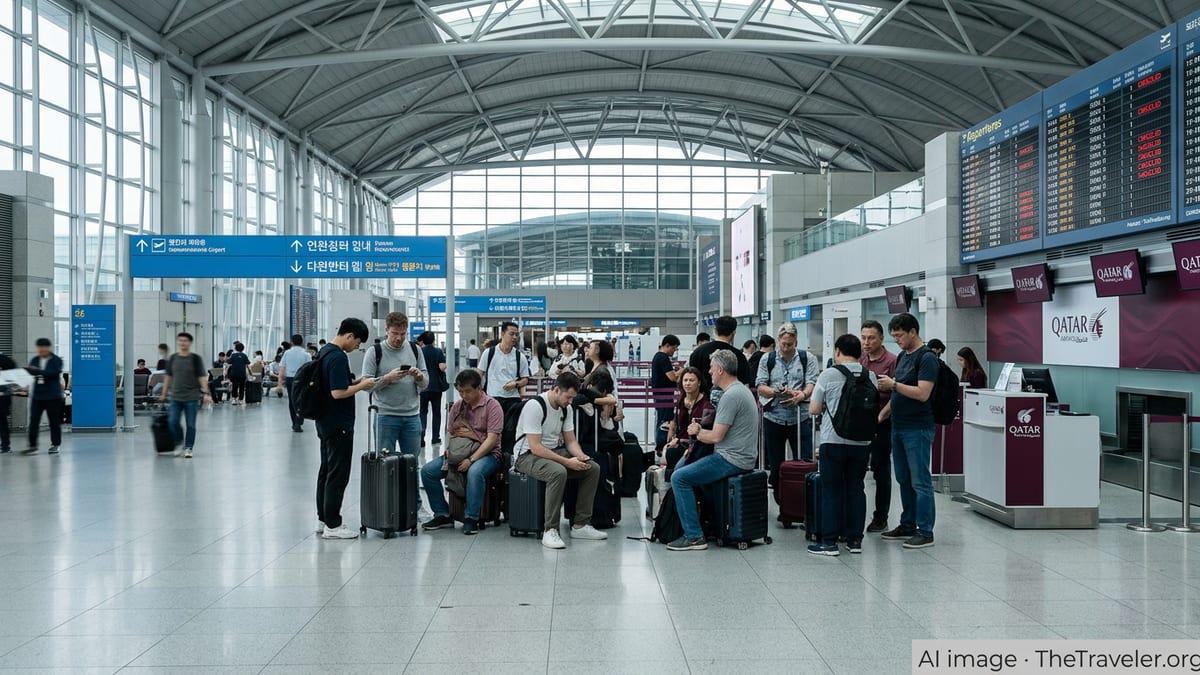
Key Seoul–Doha Links Cut Amid Regional Airspace Crisis
Qatar Airways, one of the primary Gulf carriers serving South Korea, has suspended two of its main daily rotations between Incheon International Airport and Doha, tightening an already strained web of connections between Northeast Asia and Europe, Africa, and the Middle East. The move follows sweeping restrictions on Qatari airspace and a sharply reduced schedule at Doha’s Hamad International Airport, which has seen hundreds of flights canceled or delayed in recent days.
While the airline continues to operate a small number of relief and repatriation services from Doha under temporary authorizations, the cuts to the Seoul–Doha route mean that many South Korea based travelers who would normally connect through Qatar’s hub have no immediate onward options. Industry data and passenger accounts indicate that in several cases, same day alternatives have not been offered, forcing travelers to seek last minute reroutings on other carriers or to wait indefinitely at Incheon.
The cancellations come at a time when South Korea’s outbound travel market had been steadily recovering, with Incheon once again functioning as a major gateway between Asia and Europe. The sudden loss of two key Qatar Airways flights underscores how quickly the wider Middle East security crisis has rippled through airports far from the conflict zone, creating uncertainty even on routes that are themselves considered safe.
South Korean aviation officials have said they are monitoring the situation closely and are in contact with Qatar Airways representatives in Seoul. However, they have also stressed that route and schedule decisions ultimately rest with the airline while regional airspace restrictions remain in flux.
Passengers Left Isolated at Incheon as Options Narrow
At Incheon International Airport, one of Asia’s busiest long haul hubs, stranded passengers reported long queues at transfer desks and information counters after the latest round of cancellations to Doha was confirmed. Many travelers had been planning to connect via Qatar’s network to major European cities, the Middle East, and Africa, only to learn at short notice that their flights had been removed from the schedule.
Several passengers described being provided with basic meal vouchers and hotel accommodation where required, but with little clarity on when they might be rebooked. With Qatar Airways currently running only a limited roster of services into and out of Doha, re-accommodating Seoul based travelers has proven challenging, particularly for those holding economy class tickets during peak travel days.
Compounding the difficulties, some transit passengers who had originated in Southeast Asia or Oceania and expected to connect in Seoul to a Qatar Airways service onward to Doha have found themselves effectively marooned at Incheon. Without a functioning onward leg, they must either attempt to backtrack to their point of origin or secure alternative itineraries on rival carriers linking through other regional hubs such as Singapore, Tokyo, or Dubai, where schedules are also under pressure.
Airport staff at Incheon have urged passengers with Qatar Airways bookings not to come to the terminal unless they have received explicit confirmation that their flight is operating. Travel agents in Seoul are likewise advising customers to verify their flight status repeatedly on the day of departure and to be prepared for last minute changes as the situation in the Gulf continues to evolve.
Impact on South Korea’s Global Connectivity
The suspension of two core Qatar Airways flights between Seoul and Doha carries implications that extend beyond the immediate group of stranded passengers. For South Korea, which has invested heavily in positioning Incheon as a competitive global hub, any prolonged reduction in long haul connectivity raises concerns about tourism flows, export logistics, and business travel.
Qatar Airways has long marketed its Doha hub as a fast, reliable bridge between Northeast Asia and secondary destinations in Europe and Africa that are not always served nonstop from Seoul. With capacity now sharply constrained, South Korean leisure travelers heading to destinations such as southern Europe, North Africa, or the Gulf states face more complex routings and potentially higher fares as demand shifts to alternative hubs.
Corporate travelers may also feel the strain. Many South Korean firms maintain operations in the Middle East energy sector and in emerging markets across Africa, markets that have historically been efficiently linked through Doha. Airlines based in Japan, Singapore, and the United Arab Emirates are likely to see increased demand from South Korean passengers seeking alternative one stop itineraries, but this will depend on their own ability to absorb last minute bookings during a period of broader regional instability.
Aviation analysts in Seoul note that while South Korea’s flag carrier and its partners can adjust schedules to partially offset the loss of Qatar Airways capacity, the Gulf carrier’s extensive network cannot be replaced overnight. They warn that if the disruptions in Qatar persist, airlines may be forced to reexamine seasonal plans, and travel planners could shift corporate contracts away from itineraries that rely on Doha as a transit point.
Qatar Airways’ Limited Relief Schedule Offers Little Certainty
Qatar Airways management has emphasized that safety considerations and airspace restrictions are driving the extraordinary scale of cancellations across its global network. The airline has secured limited operating corridors from Qatari aviation authorities and is using these to run a drastically reduced schedule of flights intended primarily to repatriate stranded passengers and move essential cargo.
In recent days, the carrier has issued a series of rolling updates detailing which destinations will be served on specific dates, typically only a day or two in advance. For travelers holding tickets on the Seoul–Doha route, this piecemeal communication has made forward planning difficult. The removal of two key Incheon services, announced on short notice, has added to the perception of uncertainty for passengers who rely on Qatar Airways for long haul connections.
Travel industry observers point out that while the airline is working to add temporary flights where possible and has encouraged affected customers to work through travel agents or online channels, the limited relief schedule remains focused on major flows such as London, Istanbul, and key regional points. Seoul, which sits at the far eastern edge of Qatar’s global network, has so far seen less flexibility in terms of extra flights or wide body upgauges to replace canceled rotations.
Qatar Airways has advised passengers that those with confirmed tickets on affected dates may be eligible for free rebooking, travel vouchers, or refunds, depending on fare conditions. However, many South Korea based travelers say that the lack of available seats in the near term means that financial remedies do little to solve their immediate need to get home, reach work assignments, or begin long planned holidays.
What Travelers in South Korea Should Do Now
For passengers in South Korea who are booked on upcoming Qatar Airways flights, travel experts recommend acting early and exploring contingency plans rather than waiting until the day of departure. Given the volatility of the situation, some travelers are opting to reroute entirely away from Doha, choosing alternative hubs in East Asia or other parts of the Middle East where schedules, while busy, are more predictable than those currently funneled through Qatar.
Passengers who decide to keep their Qatar Airways bookings are urged to monitor their reservations closely and to ensure that the airline and any travel agent involved have up to date contact information. With schedule changes often announced by text message or email, missing an update can mean spending unnecessary hours at the airport or missing a narrow rebooking window.
Consumer advocates in Seoul also remind passengers that they may have additional rights under South Korean or foreign regulations if their journeys begin or end at Incheon. Depending on the circumstances of the cancellation, travelers might be entitled to meals, accommodation, or partial compensation, although the application of these rules can be complex when disruptions are linked to security events or airspace closures beyond an airline’s direct control.
For now, there is no clear timeline for the full restoration of Qatar Airways’ normal operations through Doha, and by extension for the return of stable daily service between Seoul and the Gulf. Until that changes, South Korea based travelers are likely to face a more fragmented and uncertain long haul travel landscape, with Incheon’s departure boards reflecting the broader turbulence affecting global aviation.