

More news on this day
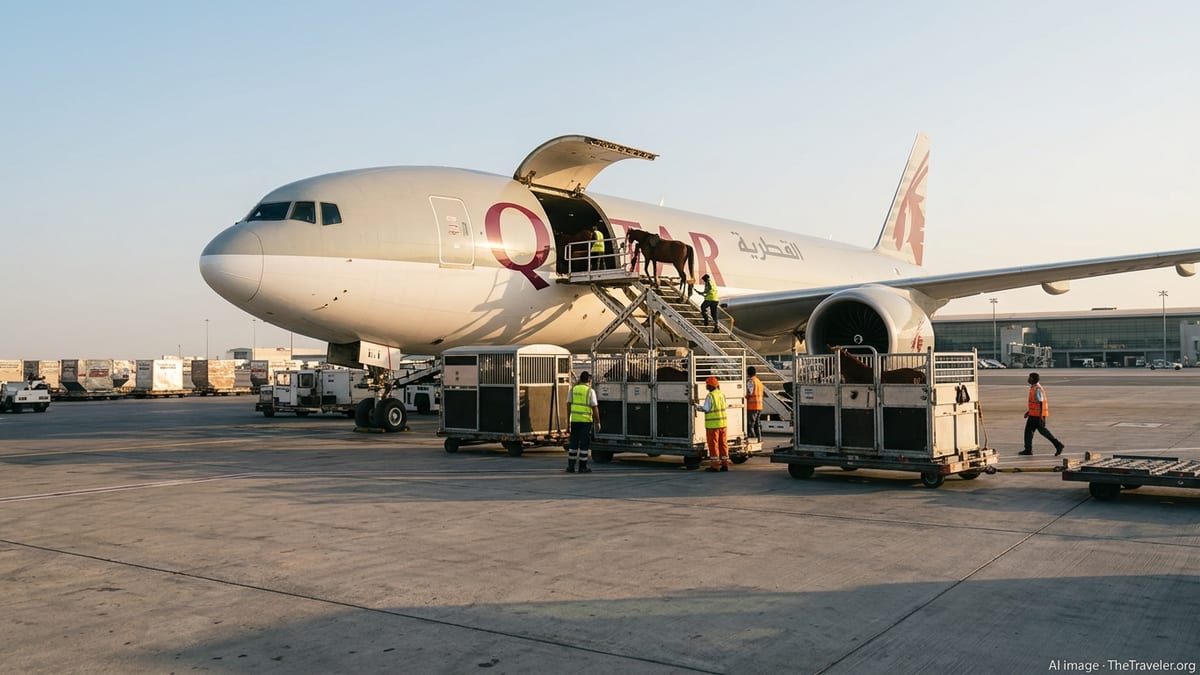
Qatar Airways Cargo has completed a high-profile charter using a Boeing 777 Freighter to transport 147 elite horses in a single operation, underscoring how purpose-built freighters and customized animal-care protocols are reshaping long-haul travel for valuable competition and breeding animals.
Get the latest news straight to your inbox!
Record Equine Charter Showcases Scale and Precision
The recent Qatar Airways Cargo equine charter, reported to have moved 147 top-tier horses aboard one Boeing 777F, illustrates the growing sophistication of the live-animal logistics segment. Publicly available information on the airline’s cargo activities indicates that such flights are typically aligned with major equestrian events and sales, where organizers require rapid, coordinated movement of large groups of high-value horses between continents.
While charter flights carrying racehorses and show jumpers are not new, moving nearly 150 horses in a single widebody freighter represents a significant operational milestone. The Boeing 777F’s high payload capacity and long range make it a preferred platform for these missions, allowing airlines to consolidate what might otherwise require several smaller flights into a more efficient operation.
The concentration of so many elite animals on one aircraft also reflects the economic importance of global equestrian calendars. Owners and trainers often plan competition and training schedules around the availability of such specialized cargo services, which must align aircraft routing, ground handling, and veterinary oversight across multiple jurisdictions.
How a Boeing 777F Becomes a Flying Stable
Transforming a high-tech freighter into a safe environment for 147 horses requires a modular approach. Horses are loaded in custom-built stalls, typically organized in double or triple configurations that fit into standard main-deck cargo positions. These stalls are designed to limit movement in turbulence, offer secure footing, and allow handlers to care for each animal during the flight.
Industry documentation on equine air transport practices indicates that specialized teams supervise loading and unloading using high-lift equipment and carefully planned ramp times to minimize noise and stress. The 777F’s large cargo door and unobstructed main deck are crucial advantages, permitting wide, straight paths for stalls and reducing the need for sharp turns or complex maneuvers on the ground.
In-flight, factors such as temperature, air circulation, and lighting are tightly managed. Modern freighters like the Boeing 777F provide adjustable climate zones to keep the cabin within an optimal range for horses, which are sensitive to both heat and abrupt temperature shifts. Trained grooms typically travel alongside the animals in designated areas on board, monitoring behavior, hydration, and feed schedules.
Welfare Standards Drive Procedures on the Ground and in the Air
Equine welfare is central to the planning of such large-scale horse charters. International air transport guidelines for live animals emphasize pre-flight health checks, appropriate rest periods, and acclimatization to stalls before departure. Reports on best practice in the sector indicate that organizers often coordinate with veterinary teams days in advance to ensure each horse is fit to fly and properly documented.
On the day of departure, the process is highly sequenced. Horses are moved from stables to the airport in staggered convoys to avoid long waiting times on the ramp. Once at the cargo terminal, each horse is led into its assigned stall, checked for signs of stress, and secured before the stall itself is lifted to the aircraft. This method reduces direct handling on the aircraft and shortens the critical window between loading and takeoff.
During flight, cabin conditions are monitored continuously to keep dust and odors under control and to maintain stable airflow. Some operators also adapt feeding regimes to minimize the risk of colic or dehydration at altitude. After landing, handlers prioritize a swift, calm disembarkation, followed by quarantine or veterinary checks as required by the destination country’s regulations.
Strategic Role of Equine Cargo in Qatar Airways’ Network
Qatar Airways Cargo has developed a prominent position in the live-animal segment, supported by a wide freighter network and a sizeable fleet of Boeing 777Fs. Corporate disclosures describe live animals, including horses, as a key specialized product within the carrier’s broader cargo portfolio, which also covers pharmaceuticals, perishables, and high-value industrial freight.
The airline’s geographic hub in Doha enables it to link major equestrian centers in Europe, the Middle East, Asia, and the Americas via one-stop routings. This positioning allows event organizers and breeding operations to schedule direct or near-direct connections for horses traveling to major race meetings, show-jumping circuits, and auctions, reducing total transit time compared with multi-stop land and sea transport.
Large, headline-grabbing charters such as the 147-horse operation help demonstrate the capabilities of both the aircraft and the carrier’s logistics systems. They also highlight the growing professionalization of equine logistics, in which airlines, freight forwarders, and specialist animal transport firms cooperate closely to manage complex, time-sensitive movements.
Implications for the Future of High-Value Animal Travel
The successful deployment of a single 777F to move 147 elite horses points to a broader trend in high-value animal travel: the shift toward integrated, aviation-centered supply chains. As global equestrian sports, luxury breeding markets, and bloodstock sales continue to internationalize, demand for reliable, welfare-focused air transport solutions is expected to remain strong.
Advances in aircraft technology and cargo handling are likely to further refine this niche. Freighters such as the Boeing 777F already offer relatively fuel-efficient performance for long-range missions, and industry discussions increasingly center on how to pair that efficiency with improved sustainability practices, including optimized routing and newer, lower-emission aircraft types as they enter service.
For travelers and destinations, these specialized flights are largely invisible, operating at cargo terminals and at off-peak hours. Yet they play a crucial role in enabling marquee racing festivals, show-jumping tours, and breeding seasons that, in turn, attract international tourism and investment. The Qatar Airways Cargo mission carrying 147 horses illustrates how modern air freight has become an essential, if often unseen, backbone of the global equestrian economy.