

More news on this day
Qatar Airways’ Doha hub has descended into unprecedented disruption this week, with more than 100 flight cancellations at Hamad International Airport triggering knock-on travel chaos across Melbourne, London, Dubai, Hong Kong, Singapore and other major routes.
Get the latest news straight to your inbox!
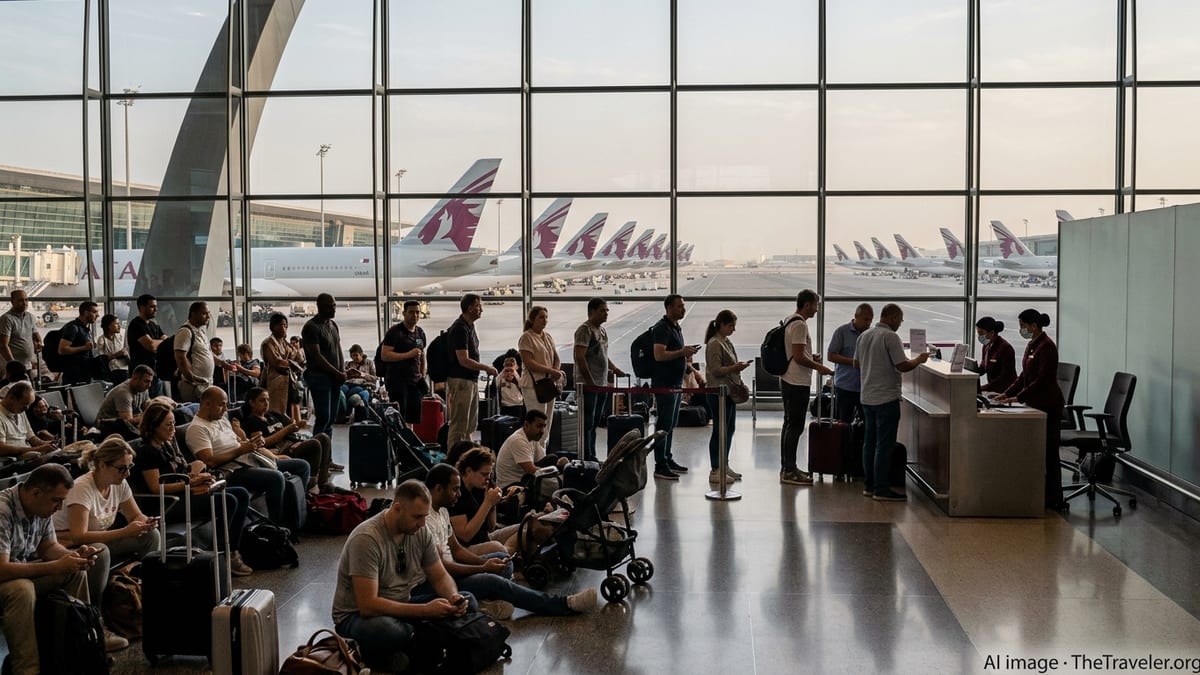
Airspace Closures Push Hamad International to a Standstill
The cancellations stem from the ongoing closure and severe restriction of Qatari and neighboring airspace following regional security tensions, which have crippled operations at one of the world’s busiest connecting hubs. Hamad International, normally a finely tuned transfer machine, has seen swathes of its schedule wiped out in recent days as Qatar Airways suspends most regular passenger services and instead concentrates on a skeleton network of relief flights.
Data from flight disruption trackers indicates that within a single 24 hour window more than 500 flights at Hamad International were either canceled outright or heavily delayed, with Qatar Airways accounting for the majority of affected services. Many of these were long haul connections linking Europe, Asia and Australia, creating ripple effects far beyond the Gulf as aircraft and crew became stranded out of position.
Qatar Airways has acknowledged that its standard timetable remains on hold, confirming that only a limited number of corridors into and out of Doha have been temporarily authorized. The airline has repeatedly stressed that safety considerations and regulatory restrictions are dictating when and where it can fly, but this has offered little comfort to passengers whose journeys have collapsed at short notice.
Global Route Network Hit From Melbourne to London and Singapore
The shockwaves from Doha’s partial shutdown have been felt throughout Qatar Airways’ global network. Flights linking Hamad International with key long haul destinations including Melbourne, London Heathrow, Dubai International, Hong Kong International and Singapore Changi have seen multiple rotations scrubbed, leaving terminals from Australia to Europe dotted with stranded Qatar Airways passengers.
In Melbourne, travelers booked on Qatar Airways’ popular overnight services to Doha reported repeated last minute cancellations and limited rerouting options, as the carrier’s Australian operations depend heavily on onward connections through its Gulf hub. At London Heathrow, departures to Doha have operated sporadically at best, with some services reclassified as special relief flights prioritizing passengers who have already been stuck in transit for days.
Major regional gateways such as Dubai and Singapore, typically among the most reliable connection points in the world, have not escaped disruption. With aircraft unable to reliably enter Qatari airspace or land in Doha, some Qatar Airways services have been reconfigured to operate as point to point or diverted segments via Muscat or Riyadh, while others have disappeared from departure boards altogether. Hong Kong and other Asian hubs have seen similar volatility, with passengers warned that previously confirmed bookings may still be subject to change up to the day of travel.
Stranded Passengers Face Long Waits, Patchy Communication
For many travelers, the immediate reality of the crisis has been days spent in airport hotels or crowded terminals, with little clarity on when they will be able to move. Reports from Hamad International describe long lines at Qatar Airways service desks and improvised waiting areas for families, students and business travelers whose journeys stalled in Doha between February 28 and mid March.
Stories emerging from Muscat, Riyadh and other diversion points paint a similar picture. Passengers on flights rerouted away from Doha have spoken of being left in limbo for several days as Qatar Airways worked to secure onward travel using a patchwork of limited rescue services and partner airlines. Some travelers have voiced frustration that flight status tools continued to show services as operating on time until shortly before departure, making it harder to make contingency plans.
Qatar Airways says its teams are working around the clock to provide accommodation, meals and rebooking assistance in line with local regulations and its own customer service policies. The airline has also reminded customers that those with tickets issued for travel during the disruption window may be eligible to change dates or request refunds without penalty, depending on fare rules. Nonetheless, across social media and passenger forums, complaints about slow responses, inconsistent information and difficulty securing alternative routes continue to mount.
Limited Relief Flights Offer Only Partial Respite
In an effort to break the backlog, Qatar Airways has progressively introduced narrow windows of limited operations using tightly controlled air corridors approved by authorities. The carrier has published several short term schedules detailing one off or low frequency flights from Doha to major hubs including London, Paris, Madrid, Rome, Frankfurt, Seoul, Moscow, Delhi, Beijing, Perth, Nairobi and Istanbul, as well as select services staged from Muscat and Riyadh.
These flights, often configured as special repatriation or relief services rather than standard commercial departures, have been heavily oversubscribed. Seats are generally prioritized for passengers who were already in transit when the airspace closures took effect, leaving those yet to begin their trips reliant on future schedule updates. Travel advisers note that while these operations are gradually reducing the number of people stranded in Doha and across the network, they remain a fraction of Qatar Airways’ normal daily capacity.
Industry analysts caution that the road back to a stable timetable will likely be slow and uneven. Aircraft and crew have been scattered across multiple continents, and the airline must rebuild rotations within the constraints of any remaining airspace restrictions. For travelers, that translates into a continued period of uncertainty, with rolling short term schedules rather than the predictable long range planning typically associated with a global hub carrier.
What Travelers Should Do If Their Qatar Airways Flight Is Affected
For passengers holding Qatar Airways tickets in the coming days, aviation experts emphasize preparation and flexibility. Travelers are being advised to monitor their booking through the airline’s official channels and to assume that flight status may change even within 24 hours of departure. Where possible, remaining reachable by phone and email and enabling travel alerts can help ensure that rebooking offers or schedule changes are not missed.
Those already on the road who find themselves stranded in Doha or at outstations such as Melbourne, London, Dubai, Hong Kong or Singapore are encouraged to seek written confirmation of any cancellations or delays, as this may be required later for insurance claims or compensation requests where applicable law provides such rights. Keeping receipts for hotels, meals and ground transport can also prove valuable when assessing reimbursement options.
Travel planners say that, for imminent trips that are not essential, postponement may be the least stressful course of action until Qatar Airways and regulators publish a more predictable operating pattern. For journeys that must go ahead, alternative routings on other carriers that avoid the affected airspace altogether may offer a surer path, even if it means longer travel times or additional connections. With no firm timeline yet for a full restoration of Qatar Airways’ network, many frequent flyers are recalibrating their plans and watching closely for the next operational update from Doha.