

More news on this day
Qatar Airways passengers across multiple continents are facing severe disruption as ongoing airspace restrictions and emergency schedules trigger widespread cancellations on routes touching Doha, Cairo, Melbourne, Birmingham, and Singapore.
Get the latest news straight to your inbox!
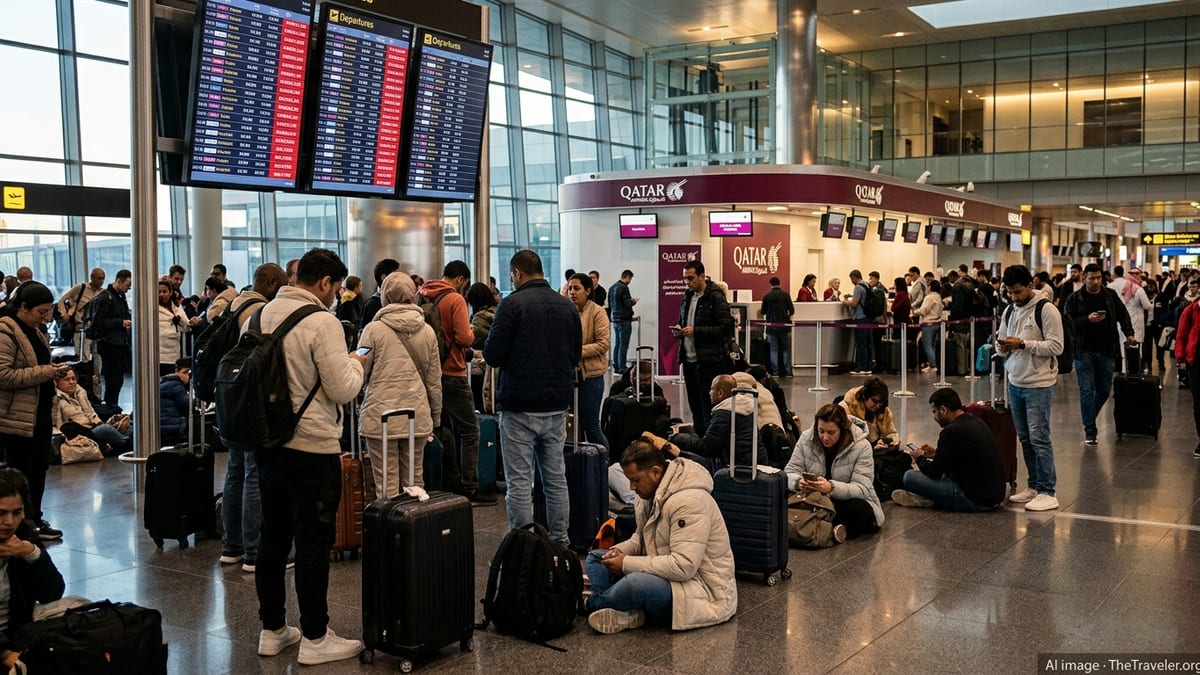
Regional Security Crisis Pushes Qatar Airways Network to Breaking Point
Publicly available information shows that the current wave of Qatar Airways disruptions is rooted in the wider security crisis that has engulfed Qatar and neighboring states since late February 2026. Following Iranian missile strikes and related military activity, Qatari airspace was closed on 28 February, forcing an abrupt halt to most commercial operations at Doha’s Hamad International Airport.
Analysis in international coverage indicates that only limited emergency and repatriation flights have been permitted since early March, placing intense pressure on a global network that relies on Doha as a central hub. With large parts of Middle East airspace restricted and airlines across the region cutting or suspending services, Qatar Airways has been forced into repeated timetable overhauls, rolling cancellations, and last minute schedule changes.
The result is a cascading impact across long haul routes linking Europe, Asia, Australia, and Africa. Flights that would usually connect smoothly via Doha are either grounded entirely or operating at sharply reduced frequencies, leaving passengers in transit cities such as Cairo, Singapore, Melbourne, and Birmingham uncertain about when or how they will be able to move onward.
Industry observers note that this disruption comes on top of earlier weather related disruption in early 2026, particularly in Europe, where major winter storms had already stretched airline resources and aircraft rotations. Against that backdrop, the sudden closure of Qatari airspace has turned a challenging winter into a full scale operational crisis for the carrier.
Stranded Stories From Doha to Melbourne and Singapore
Social media posts and passenger forums over the past three weeks describe travelers stranded for days in Doha after onward flights were cancelled with limited advance notice. Some report being offered only full refunds rather than rerouting, while others describe long waits for information as departure boards repeatedly update with new delays or cancellations.
In Melbourne, multiple reports describe Qatar Airways flights to Doha and onward to Europe being cancelled or removed from schedules in early March, sometimes just days before departure. Several travelers who were due to connect from Melbourne to destinations such as Berlin or other European capitals recount being left to choose between waiting for the airline to propose alternatives or paying substantial additional sums to rebook with other carriers.
Similar accounts have emerged from Singapore, where passengers booked on services to Europe via Doha have seen flights in mid March cancelled in the airline’s app or retimed significantly. Some describe being proactively contacted with rebooking options, while others say they only discovered cancellations when checking their reservations, prompting last minute changes to complex multi country itineraries.
In Birmingham and Cairo, disruption has taken the form of thinning schedules and intermittent cancellations rather than a complete standstill. Travelers on these routes report abrupt changes to departure days, extended layovers in Doha when flights do operate, and uncertainty over which interim timetable applies from one week to the next as the airline repeatedly updates its reduced network plan.
Interim Schedules Offer Limited Relief to Key Cities
Updated schedule information published in aviation and passenger communities suggests that Qatar Airways is slowly reintroducing a small number of routes from Doha under tightly controlled conditions. For the period from around 18 to 28 March, interim plans point to limited weekly services from Doha to Birmingham, Melbourne, and Singapore, typically using widebody aircraft but at frequencies far below normal levels.
On the Doha to Melbourne route, publicly shared timetables point to only a handful of weekly flights, leaving many travelers whose original departures fell earlier in March either refunded or still awaiting rebooking. Doha to Singapore and Doha to Birmingham services are also listed at reduced frequencies, often with altered flight numbers and timings compared with the pre crisis schedule.
The challenge for passengers is that these interim schedules are highly dynamic. Flight timings and operating days have been revised multiple times in recent weeks as airspace permissions, crew availability, and security assessments change. Travelers who believed they had been successfully rebooked have in some cases seen their new flights later altered or removed, restarting the search for alternatives.
Reports indicate that even where flights are operating, long layovers in Doha have become common as the carrier tries to stitch together a workable hub operation with a fraction of its usual frequency. For some Europe bound passengers traveling from Melbourne, Singapore, or Cairo, this has meant overnight or even 15 hour waits in Doha, adding further strain to already disrupted journeys.
What Affected Passengers Can Do Right Now
For travelers whose journeys touch Doha, Cairo, Melbourne, Birmingham, or Singapore, the most urgent step is to verify the real time status of every flight segment, even if a ticket still shows as confirmed. Publicly available information from passenger channels suggests that some cancellations are appearing first in the airline’s digital tools rather than via email, so regular checks are essential.
Many travelers report being offered a choice between a full refund or rebooking under temporary flexible policies when their flights are cancelled. Those who can afford to wait have sometimes secured rerouting on partner airlines or alternative Qatar Airways services days or weeks later. Others, particularly those needing to reach time sensitive events such as weddings or work commitments, have chosen to accept refunds and purchase entirely new tickets on unaffected carriers.
Travel forums also suggest that being prepared with researched alternative routings before contacting customer service can improve the odds of a swift solution. Examples include suggesting one world or codeshare partners that still have viable paths between Southeast Asia, Australia, the Middle East, and Europe that do not rely on Doha, or that use newly authorized relief corridors.
Passengers transiting airports like Melbourne, Singapore, and Birmingham are also being advised by fellow travelers to monitor local airport and airline announcements on the day of travel. While official channels provide the definitive status, airport departure boards and staff can sometimes signal thresholds such as minimum check in times, last minute aircraft changes, or the conversion of delays into outright cancellations.
Planning Future Trips Amid Ongoing Uncertainty
With the broader regional security situation unresolved as of late March 2026, analysts caution that Qatar Airways’ schedule is likely to remain volatile for some time. Even as limited routes from Doha to Birmingham, Melbourne, Singapore, and other destinations restart, further changes are possible if airspace restrictions tighten again or operational constraints evolve.
Travel planners increasingly recommend that new bookings involving a Doha connection in the coming weeks be made with maximum flexibility in mind. That can include choosing fares that allow date or routing changes, avoiding nonrefundable add ons where possible, and considering travel insurance products that include disruption cover for airspace closures and security events.
Travelers who must use Qatar Airways for loyalty, pricing, or network reasons are watching for further updates to the carrier’s temporary policies. Publicly available guidance indicates that during the current disruption the airline has expanded its options to include complimentary date changes, destination changes in some cases, and refunds for flights within specific affected date ranges.
For now, the experiences of those stranded in Doha, Cairo, Melbourne, Birmingham, and Singapore underline the importance of building redundancy into any long haul itinerary touching the Gulf. Until full commercial use of Qatari airspace is restored and a stable schedule is reestablished, passengers are likely to face a travel environment where flexibility, rapid information checks, and backup plans are as essential as tickets and passports.