

More news on this day
Qatar Airways is sharply limiting its global operations after the sudden closure of Qatari airspace, leaving thousands of passengers worldwide scrambling to rebook journeys as the carrier operates only a handful of relief and repatriation flights.
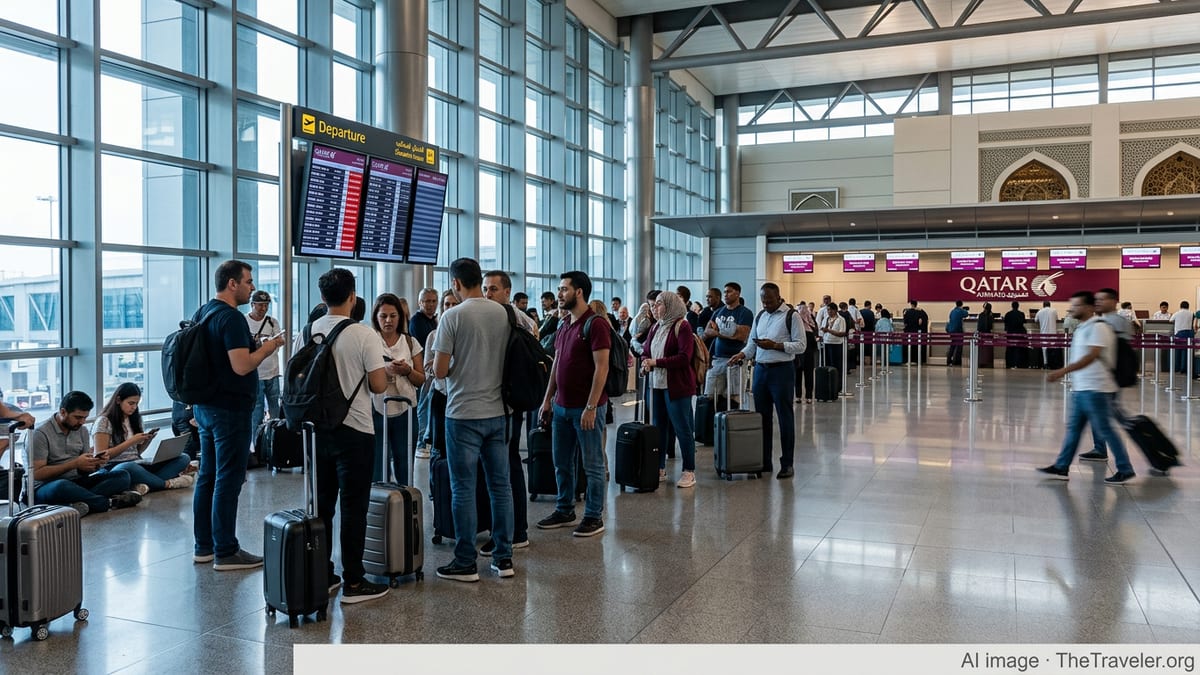
Airspace Closure Forces Abrupt Network Pullback
The current disruption began on February 28, 2026, when Qatari airspace was abruptly closed amid a fast-moving regional security crisis. Commercial flights into and out of Doha’s Hamad International Airport were suspended, halting the hub operations that typically funnel passengers between Europe, Asia, Africa and the Americas.
In the days that followed, Qatar’s aviation regulator moved cautiously to reopen limited contingency routes. The Qatar Civil Aviation Authority has confirmed that only restricted navigational corridors are available, and that these are being used primarily for evacuation-style passenger services and essential cargo. Standard commercial schedules remain largely on hold, and the authority has warned that capacity will stay constrained while security assessments continue.
Qatar Airways, which built its business model around high-frequency connections via Doha, has responded by halting most regular services and shifting to a skeleton timetable. The carrier is coordinating closely with regulators and military authorities to utilize the safe corridors that have been approved, while repeatedly emphasizing that its primary focus is on passenger safety and controlled, gradual restoration of operations.
The crisis marks one of the most severe shocks to Qatar Airways’ global network in recent years, affecting not only point-to-point traffic to Doha but also the vast web of connecting itineraries that depend on the Gulf hub.
Limited Relief Flights From Key Global Gateways
After several days of blanket suspensions, Qatar Airways has begun operating a small number of relief flights under special authorization. According to company statements and official notices, the airline is running tightly controlled services from major gateways including London, Paris, Madrid, Rome, Frankfurt and Bangkok into Doha on March 8, with earlier relief operations routed via Muscat.
These flights are being treated as priority repatriation services rather than a return to normal commercial activity. Seats are heavily restricted and allocated first to stranded passengers with previously confirmed tickets whose original journeys were disrupted by the airspace closure. The airline has urged travelers not to go to the airport unless they have received specific confirmation that they are booked on one of these services.
Capacity constraints are severe. Even before the latest crisis, Qatar Airways was preparing modest schedule cuts on certain long-haul routes for the second quarter of 2026, trimming weekly departures from Doha by several percentage points. Those earlier adjustments, driven by demand and fleet optimization, now intersect with emergency reductions, compounding the challenge of finding space for displaced travelers.
Industry analysts note that while the limited relief flights are a vital lifeline for some, they cover only a fraction of Qatar Airways’ usual global schedule. Passengers whose journeys do not align with the few operating corridors may face extended delays or the need to switch to other airlines and routings entirely.
Global Travelers Face Cancellations, Rebookings and Refunds
The abrupt halt to regular operations has triggered a cascade of itinerary disruptions for passengers across continents. Travelers who were due to connect through Doha between February 28 and mid-March report receiving cancellation notices with little advance warning, followed by a flurry of rebooking offers, schedule changes or refund options.
Qatar Airways has introduced temporary flexibility measures for those holding tickets during the affected period. Customers with confirmed bookings over the key disruption window have been offered complimentary date changes or the option to seek a refund on the unused portion of their ticket. Ancillary products such as lounge access packages, meet-and-assist services and pre-paid airport hotel bookings have been suspended or restricted for flights scheduled through the end of March, reflecting the uncertainty over which services will actually operate.
For many travelers, however, the difficulty lies not only in airline policies but in basic seat availability. With relief flights and rerouted options heavily oversubscribed, some passengers are resorting to purchasing new tickets on other carriers that avoid the affected airspace entirely, often at significant personal cost. Others are choosing to postpone or cancel travel plans altogether, wary that further security developments could extend the disruption.
Travel agents and corporate travel managers are reporting intense pressure as they try to rebuild complex itineraries that once relied on seamless Doha connections. Routes between Southeast Asia and Europe, southern Africa and North America, and Australasia and the Middle East are all affected, with knock-on impacts across rival hubs as displaced demand shifts to alternative carriers.
Strategic Route Cuts Add to Capacity Squeeze
The immediate crisis comes on top of a broader strategic recalibration of Qatar Airways’ network that was already under way. In the United States, for example, the airline has announced a near 30 percent reduction in flights on the Doha to San Francisco route for the upcoming summer 2026 season, shifting from daily service to five weekly departures.
Similarly, schedule filings for the second quarter of 2026 indicate that Qatar Airways had been planning moderate reductions across parts of its global network, trimming weekly departures from Doha by more than six percent compared with earlier timetables. These changes reflect evolving demand patterns, competitive pressures and long-haul operating economics, and were designed to fine-tune capacity rather than signal broader retreat.
When layered atop the current airspace closure and limited-flight regime, however, these planned cuts further tighten the available seat supply. Regular travelers who might previously have had multiple daily options on key trunk routes now find only a handful of weekly flights, if any, to choose from once operations resume in a limited form.
Aviation experts say the combination of strategic right-sizing and emergency closures is particularly challenging for a hub-and-spoke carrier. Even small reductions in frequency can ripple through the network, affecting connection times and onward links. In the present environment, those complexities are magnified by fast-changing security conditions and operational restrictions outside the airline’s direct control.
What Passengers Should Do Next
With the situation evolving daily, travelers booked on Qatar Airways in the coming weeks are being urged to monitor official airline communications closely. The carrier has been issuing daily operational updates, typically in the morning Doha time, outlining which routes, if any, will be activated under the limited safe-corridor arrangement.
Passengers with imminent departures are advised to check the status of their flights through official channels and to avoid traveling to the airport without explicit confirmation that their service is operating. Those whose journeys fall within the designated disruption window should review their eligibility for complimentary date changes or refunds, and consider whether alternative routings on other carriers might better suit their timing and risk tolerance.
Travelers planning new trips that would normally route through Doha may wish to build flexibility into their itineraries, including changeable tickets and longer connection windows at alternative hubs. Some industry observers suggest that, until there is clearer visibility on the full reopening of Qatari airspace, conservative planning and contingency options are prudent, particularly for time-sensitive travel such as business trips, events or study commitments.
For now, Qatar Airways’ adjustments to its travel routes, from emergency suspensions to targeted schedule cuts, are reshaping how passengers move across key global corridors. The scale and duration of the impact will depend on how quickly regional security stabilizes and how fast regulators are prepared to restore the airspace capacity on which the airline’s worldwide network depends.