

More news on this day
Qatar Airways has reduced its stake in Virgin Australia in a move that underscores a broader strategic recalibration in Australia’s tightly contested aviation market, where alliances, capacity constraints and regulatory scrutiny are reshaping how global and local carriers compete.
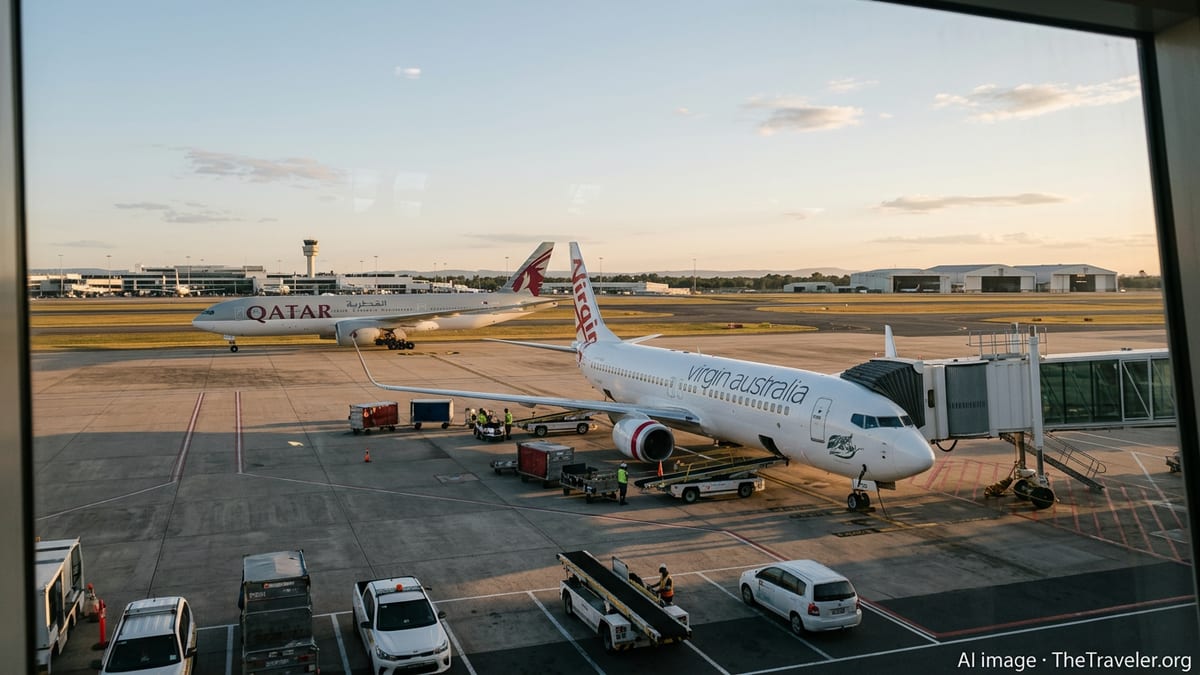
Smaller Slice, Still a Dominant Shareholder
A disclosure to the Australian Securities Exchange this week confirmed that Qatar Airways has trimmed its holding in Virgin Australia, selling just over 2 percent of its stake. The Doha-based carrier now controls about 67.7 percent of Virgin Australia’s voting power, down from nearly 69.8 percent previously, reflecting the sale of more than 16 million shares while retaining a commanding position on the share register.
The adjustment in ownership follows an intensive period of investment and partnership building between the two airlines. Qatar Airways secured approval in 2025 to acquire up to 25 percent of Virgin Australia’s equity as part of a broader recapitalisation and alliance strategy, later consolidating a majority voting position through its share structure. The latest reduction is modest in scale, but closely watched for what it may signal about Qatar Airways’ long-term intentions in the market.
Market observers note that the divestment does not alter Qatar Airways’ status as Virgin Australia’s key strategic investor. With more than two thirds of the airline’s voting rights still in its hands, the Gulf carrier remains central to Virgin Australia’s international ambitions, especially on long-haul routes linking Australian cities with the Middle East and onwards to Europe and Africa.
For Virgin Australia, the filing provides updated clarity for potential investors ahead of a widely anticipated return to public markets. The airline, which exited voluntary administration in 2020 under new majority owner Bain Capital, has been steadily rebuilding its balance sheet and network, with the Qatar Airways partnership seen as a critical pillar of its long-haul growth story.
Alliance Deepens Despite Stake Reduction
The decision to pare back the stake comes even as the operational partnership between Qatar Airways and Virgin Australia continues to deepen. The two carriers operate an expansive codeshare arrangement, with Virgin Australia placing its code on Qatar-operated services between Doha and major Australian gateways, while Qatar Airways customers tap into Virgin’s domestic and short-haul network to reach smaller cities across the country.
Central to the strategy has been the use of Qatar Airways aircraft on routes marketed under Virgin Australia’s brand, a wet-lease model where Qatar supplies aircraft, crew, maintenance and insurance while Virgin focuses on sales and distribution. This has effectively given Qatar Airways additional access to the Australian market despite limits on its own direct services, and allowed Virgin Australia to offer long-haul connectivity without committing its own widebody fleet.
Regulators have previously highlighted the public benefits of this model, citing increased seat capacity, new connection options and a more competitive environment on international routes traditionally dominated by Qantas and its partners. Industry analysts say the modest stake sale suggests a financial or portfolio adjustment by Qatar Airways rather than a retreat from the alliance, which continues to underpin both carriers’ network strategies.
From a commercial standpoint, the partnership also plugs Virgin Australia into the broader oneworld ecosystem in which Qatar Airways plays a leading role, even though Virgin itself remains outside the alliance. For Australian travellers, the result is a wider menu of one-stop itineraries to Europe and beyond, coupled with frequent flyer reciprocity and lounge access benefits that strengthen Virgin’s proposition against Qantas.
Competitive Pressure on Qantas and a Shifting Landscape
The recalibration in Qatar Airways’ shareholding lands at a time of heightened competition and political sensitivity in Australian aviation. The federal government’s earlier decision to block additional Qatar Airways flights into major Australian cities was widely interpreted as a protective measure for Qantas, prompting debate over capacity, fares and consumer choice. In that context, Virgin Australia’s deepening alignment with Qatar Airways has been seen by many as a counterweight to the Qantas and Emirates axis.
By leveraging Qatar Airways’ global network while focusing its own resources on domestic and short-haul routes, Virgin Australia has positioned itself as a challenger brand offering differentiated international access. The strategic stake has given Qatar Airways a powerful platform inside Australia, while Virgin has secured access to long-haul capacity without the capital burden of new widebody aircraft.
At the same time, new entrants and expanding rivals are altering the competitive calculus. Turkish Airlines has flagged more ambitious Australian plans, while low-cost carriers continue to chase market share across key domestic and leisure routes. The Qatar–Virgin partnership, and any changes to its financial structure, are therefore watched not just as a bilateral story but as part of a wider rebalancing of capacity and alliances in and out of Australia.
For Qantas, the persistence of a strong Qatar–Virgin axis complicates its grip on lucrative Europe-bound traffic. Travellers increasingly weigh one-stop options via Middle Eastern and Asian hubs, and any incremental shifts in pricing or capacity from the Qatar–Virgin alignment could ripple through premium and economy cabins alike.
Implications for Investors and a Possible Relisting
The stake reduction also plays into expectations around a potential relisting of Virgin Australia on the Australian Securities Exchange. Bain Capital has long signalled that an initial public offering would be the logical next step in its turnaround of the airline, and recent corporate filings and prospectus documents have been interpreted as groundwork for that move.
Analysts say a slightly lower but still dominant shareholding by Qatar Airways may be designed to broaden the free float and appeal to a wider pool of institutional investors when Virgin eventually returns to public markets. A diversified register could ease concerns over concentrated control while preserving the strategic benefits of having a major global airline as both partner and cornerstone shareholder.
For Qatar Airways, trimming its stake provides capital flexibility at a time when it is investing across a range of partnerships and fleet initiatives worldwide. The airline has stressed its commitment to a refreshed group strategy that prioritises targeted alliances, disciplined capacity growth and resilience to geopolitical and economic shocks. Adjusting its exposure to Virgin Australia may simply reflect that portfolio approach rather than any loss of confidence in the Australian carrier.
Investors will be alert to whether further stake movements follow in coming months. For now, the message from the market is that Qatar Airways remains firmly embedded in Virgin Australia’s future, even as fine-tuning of the shareholding structure continues behind the scenes.
What It Means for Travellers Across Australia
For passengers on the ground and in the air, the immediate impact of the share sale is likely to be limited. Existing schedules between Australian cities and Doha remain driven by bilateral capacity constraints and aircraft availability rather than marginal shifts in equity stakes. Virgin Australia continues to market daily services to Doha via key gateways such as Sydney, Melbourne, Brisbane and Perth, funnelling travellers onto Qatar Airways’ extensive onward network.
Frequent flyers in Virgin Australia’s Velocity program still enjoy access to Qatar Airways flights, including points earning and redemption, lounge access at major hubs and reciprocal status recognition. These benefits are a core part of the commercial agreement rather than strictly tied to the exact percentage of equity held by Qatar Airways, making them more resilient to incremental stake adjustments.
Travel agents and corporate buyers report that demand for competitive long-haul fares out of Australia remains strong, particularly as leisure and business travel continue their post-pandemic recovery. For many, the key questions revolve around pricing, reliability and connection times rather than ownership structures. As long as the Qatar–Virgin network proposition remains intact, the alliance is expected to maintain its appeal to price-sensitive and premium travellers alike.
In the longer term, however, any broader reshaping of shareholdings and alliances in Australia’s aviation sector could filter through to route choices, frequencies and product investment. With regulators, governments and airline executives all weighing their next moves, Qatar Airways’ decision to reduce its Virgin Australia stake is being closely studied as an early sign of how the next phase of competition in the Australian skies may unfold.