

More news on this day
Travel across the Middle East has been thrust into renewed turmoil as Qatar Airways scrapped 261 flights and delayed 14 more in recent days, leaving passengers stranded in Saudi Arabia, Iran, the United Arab Emirates, Iraq and beyond amid ongoing airspace restrictions linked to the Iran conflict.
Get the latest news straight to your inbox!
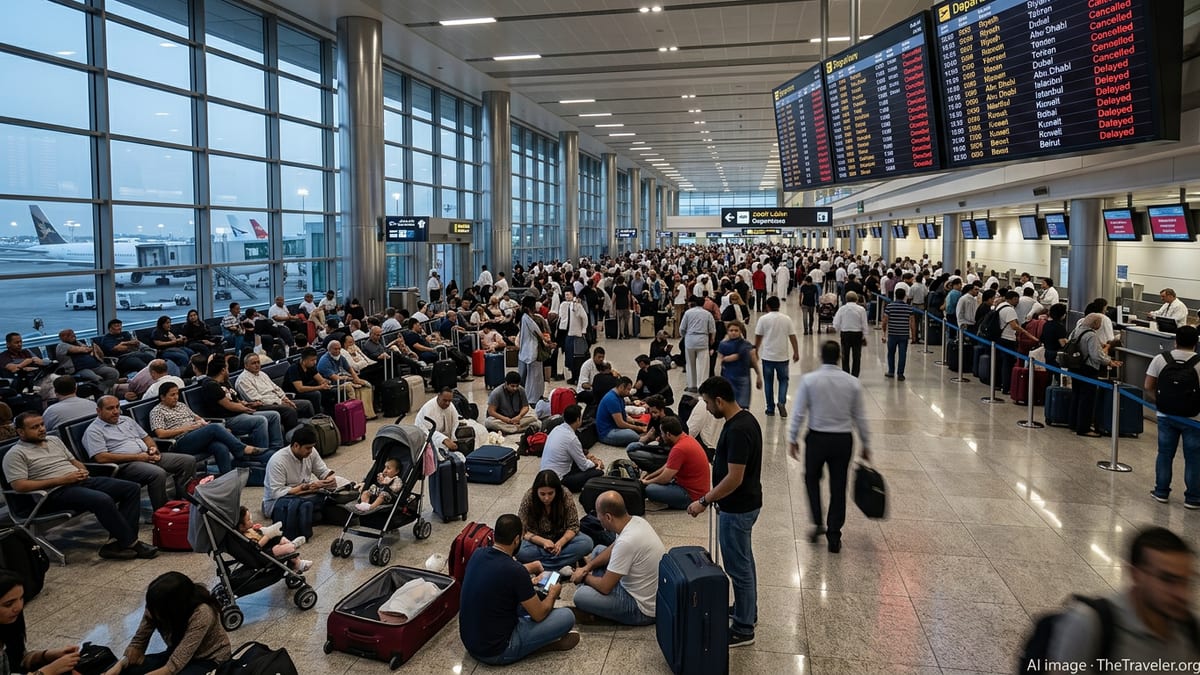
Network Shock at Qatar Airways and Hamad International
Publicly available airline data and industry reporting indicate that Qatar Airways, one of the region’s most influential hub carriers, has dramatically thinned its schedule as airspace closures and re-routing constraints ripple outward from the Iran war. The figures of 261 cancellations and 14 delays highlight how deeply the carrier’s global network has been hit, even as a limited schedule continues to operate to and from Doha.
Coverage from aviation and travel outlets describes Hamad International Airport in Doha operating at a fraction of normal capacity after waves of Iranian missile and drone attacks in early March targeted infrastructure in Qatar and neighboring states. While core facilities in Doha remain functional, temporary airspace closures and narrow operating corridors have forced Qatar Airways to suspend or pare back flights across its long-haul network, with knock-on impacts across the Middle East, Europe, Asia and North America.
Reports indicate that in addition to outright cancellations, many Qatar Airways services have been subject to lengthy ground holds and diversions as air traffic control authorities reroute traffic away from high-risk airspace. This combination of route suspensions and rolling delays has made it difficult for the airline to reposition aircraft and crew, slowing recovery and contributing to further disruption at downline airports.
According to published coverage tracking the airline’s response, Qatar Airways has begun operating a more limited, corridor-based schedule intended to gradually clear the backlog of stranded travelers. However, analysts note that as long as airspace access remains constrained over parts of Iran, Iraq and the Gulf, the carrier’s highly interconnected hub-and-spoke model will continue to face severe strain.
Passengers Stranded Across Riyadh, Tehran, Dubai and Abu Dhabi
The sharp reduction in Qatar Airways services has been most visible at major regional gateways, where passengers expecting routine connections via Doha have instead found themselves stuck in transit. Travel industry reports describe crowded terminals and improvised overnight stays in cities such as Riyadh, Tehran, Dubai and Abu Dhabi as travelers wait for scarce rebooked seats or alternative routings.
In Saudi Arabia, cancellations on routes linking Riyadh and other major cities to Doha have disrupted business, religious and family travel at a time when regional demand remains strong. Available accounts from passenger rights groups and travel advisories note that some Saudi-based travelers heading to Europe, North America or Asia via Qatar are being offered long detours through alternative hubs, often involving extended layovers and complex multi-stop itineraries.
In the United Arab Emirates, where Dubai and Abu Dhabi normally function as powerful competitors to Doha, the situation is similarly fragile. Public data shows that UAE airports have already faced their own wave of cancellations and delays linked to regional security concerns, leaving limited spare capacity to absorb Qatar Airways passengers. As a result, many travelers report difficulty securing seats on Emirates, Etihad or other carriers, even when they are willing to backtrack or change continents to reach their destination.
Reports from Iranian and Iraqi airspace further complicate the picture. With restrictions and closures periodically affecting routes over and into Iran and Iraq, services connecting Tehran, Baghdad and other cities to Doha have been curtailed or suspended. This has stranded passengers not only in local terminals but also in third-country hubs where they were expecting onward Qatar Airways connections.
Ripple Effects Reach Istanbul, Kuwait, Beirut and Beyond
Beyond the core Gulf hubs, the shock to Qatar Airways’ schedule is also being felt in secondary but strategically important airports, including Istanbul, Kuwait City and Beirut. Industry monitoring platforms and travel news outlets show rising numbers of disrupted itineraries involving these cities, where Qatar Airways typically funnels passengers onward to Europe, Africa and the Americas through Doha.
At Istanbul’s main international airport, publicly available disruption tallies over recent days have combined Qatar Airways cancellations with delays and schedule cuts from Turkish and Gulf carriers. With Istanbul already serving as a major alternative bridge between Europe and Asia, the additional load from rerouted Middle East traffic has contributed to longer queues, tight connection windows and increased baggage misconnection risk for passengers.
In Kuwait City and Beirut, where Qatar Airways typically operates fewer daily services, a single cancellation can wipe out an entire day’s worth of connectivity. Reports indicate that travelers in these markets have at times been given only limited rebooking options, such as traveling a day or more later, accepting routings through multiple transit points, or accepting refunds and making their own arrangements. For those flying for time-sensitive reasons, including medical visits or family emergencies, the lack of near-term alternatives has been particularly challenging.
Travel analysis pieces emphasize that because the Gulf region sits at the crossroads of global air routes between Europe, Asia and Australia, disruptions at a single hub carrier like Qatar Airways quickly propagate worldwide. Airports as far afield as Frankfurt, Vienna, Boston and San Francisco have reported disrupted arrivals and departures involving Qatar Airways services that originate or connect through the Middle East.
Security Tensions and Airspace Closures Drive the Crisis
The underlying driver of the current wave of cancellations and delays is the heightened security situation linked to the ongoing Iran war and associated regional tensions. News reports detail how missile and drone incidents, as well as military activity around key energy and infrastructure sites, have prompted governments to impose sudden airspace closures or restrictions over parts of Iran, Iraq and the Gulf.
Short-notice changes to flight paths, or complete prohibitions on flying over particular regions, have forced airlines to ground or reroute aircraft on routes that typically rely on these corridors to maintain competitive flying times. For Qatar Airways, whose global network is heavily concentrated around east-west flows through Doha, even incremental route extensions can have a cascading effect, pushing crew duty times beyond legal limits and making tightly timed bank connections logistically impossible.
Regulatory advisories from European and other aviation safety agencies have added further complexity. Several authorities have warned or temporarily prohibited airlines under their jurisdiction from using designated Middle East airspace, including parts of Saudi Arabia and Oman, in response to evolving risk assessments. This has affected not only Qatar Airways but also European, Asian and North American airlines that share similar routing patterns through the region.
Analysts cited in recent coverage argue that the current disruption underscores how exposed Gulf super-connectors are to geopolitical shocks. With multiple major carriers all relying on a relatively narrow band of airspace and infrastructure, a single security crisis can trigger overlapping waves of cancellations that no single airline is able to absorb or reroute efficiently.
Traveler Options and Outlook for Recovery
For travelers caught in the disruption, consumer advocates and passenger rights specialists are urging careful documentation of delays, cancellations and additional expenses. While compensation rules vary by jurisdiction, regulations such as the European Union’s EC 261 framework can provide entitlements to reimbursement and assistance when flights depart from or arrive in covered territories and the disruption falls within an airline’s responsibility.
Travel advice circulating through industry channels recommends that affected passengers use multiple channels to manage their bookings, including official airline apps, third-party booking platforms and direct contact with travel agents. Given the scale of the disruption and the pressure on call centers, reports suggest that automated rebooking tools and airport ticket desks are sometimes able to offer faster solutions than phone-based support.
Looking ahead, published schedules and airline statements point to a gradual ramp-up of Qatar Airways operations through mid to late March, provided that airspace access does not deteriorate further. Some Qatar Airways services have been restored on a limited basis, and additional flights are being added selectively to clear backlogs on high-demand routes as corridors reopen and operational certainty improves.
However, industry observers caution that full normalization could take weeks, and that passengers planning to transit Doha or other Gulf hubs should build in additional time, monitor their itineraries closely and be prepared for last-minute changes. With regional security dynamics still fluid, the Middle East’s role as a global aviation crossroads remains under pressure, and airlines like Qatar Airways will likely face continued challenges in stabilizing schedules in the short term.