

More news on this day
As demand for trips to the United Arab Emirates keeps climbing, travelers eyeing Dubai in 2026 are looking closely at how Qatar Airways is operating its short but strategically important Doha–Dubai link amid a volatile regional backdrop.
Get the latest news straight to your inbox!
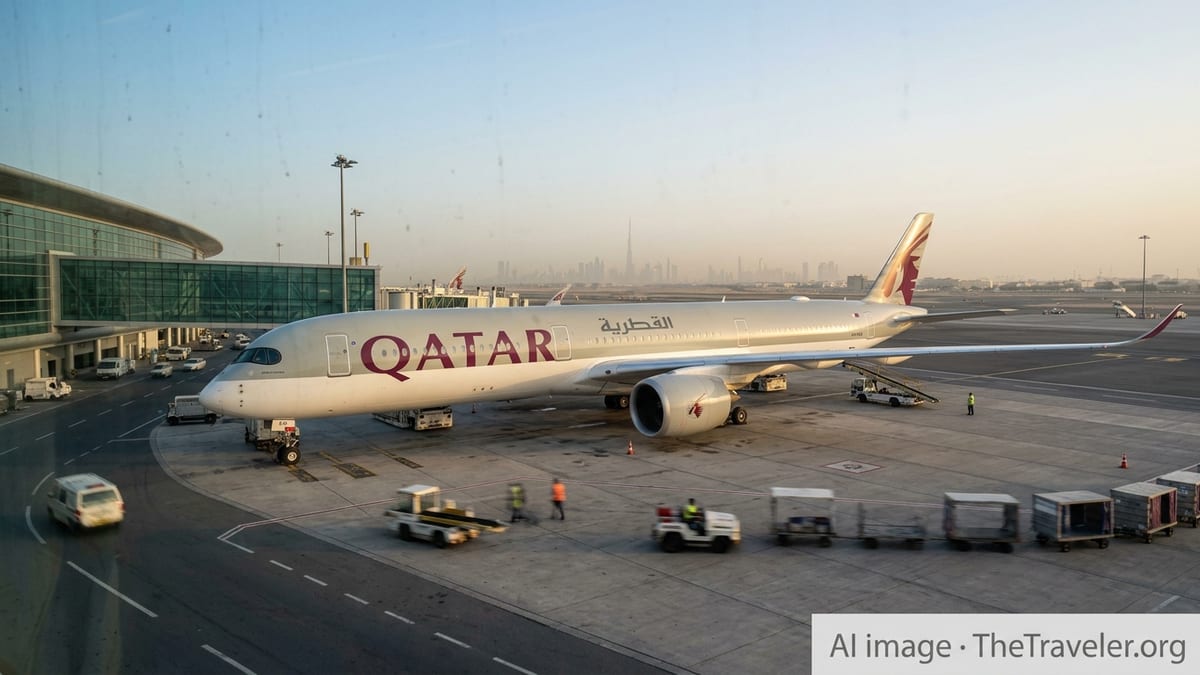
Qatar Airways and the Doha–Dubai Corridor in 2026
Qatar Airways continues to position Doha’s Hamad International Airport as a major global transit hub, using the one-hour Doha–Dubai hop as a key feeder for long-haul traffic across Europe, Asia, Africa and the Americas. Publicly available schedules indicate that the airline remains one of the primary full-service carriers on the route alongside flydubai, with typical block times of around 1 hour 15 to 1 hour 20 minutes between Dubai International and Doha.
Data from independent schedule trackers shows multiple daily Qatar Airways departures between Doha and Dubai International under flight numbers in the QR1000 series, often supplemented by additional rotations in peak weeks. The route has historically ranked among the carrier’s highest-frequency city pairs, with earlier filings showing more than 70 weekly flights in some seasons, reflecting the strong demand for two-way business and leisure traffic between Qatar and the UAE.
For many passengers, especially from North America and Europe, a Dubai itinerary on Qatar Airways still means an overnight or early-morning long-haul sector into Doha, followed by a short regional connection onward to Dubai. In the opposite direction, late-night departures from Dubai feed into Qatar Airways’ extensive overnight wave out of Doha, allowing same-day connections to cities across Asia and Africa.
While some regional rivals focus on nonstop Dubai services from their own hubs, Qatar Airways leans on its connecting model. The airline’s expanding fleet of widebody aircraft, including Airbus A350 and Boeing 787 jets, continues to support this hub strategy, with smaller narrowbodies typically deployed on the short Doha–Dubai sector to match dense, high-frequency demand.
Schedule Volatility and Airspace Closures
Travelers planning Qatar Airways trips to Dubai in 2026 must pay closer attention than usual to schedule changes, as regional tensions and airspace restrictions have periodically disrupted normal operations. In 2025 and early 2026, reports across aviation advisories and news coverage documented temporary shutdowns or restrictions affecting Qatari and Emirati airspace, prompting widespread cancellations and rerouting of flights through the Gulf region.
Qatar Airways’ own travel alerts and trade bulletins through mid-2025 highlighted waves of schedule adjustments designed to preserve the broader network, including rescheduling and consolidating services across multiple routes. By early 2026, additional disruptions tied to wider Middle East instability led to further temporary suspensions and limited relief operations, including flights aimed at returning stranded travelers to Doha and other hubs.
These developments have meant that, although Qatar Airways maintains its Doha–Dubai link as a core regional route, frequencies and timings can shift at short notice when airspace restrictions are imposed. Industry advisories circulated in March 2026 pointed to a patchwork of limited flights operating across the region as carriers, including Qatar Airways, responded to government advisories and evolving security assessments.
Against this backdrop, travel specialists advise that anyone using Qatar Airways to reach Dubai in 2026 build flexibility into their plans, avoid tight self-made connections with other airlines, and stay prepared for potential last-minute timing changes or aircraft swaps on Gulf sectors.
What Passengers Should Expect on Board and in Transit
For travelers whose flights operate as planned, the onboard experience on Qatar Airways’ Dubai services in 2026 broadly reflects the carrier’s wider regional product. The short hop is typically flown by narrowbody jets configured with a two-cabin layout, offering a business class recliner or lie-flat seat depending on aircraft type, and an economy cabin with full-service amenities relative to the brief flight time.
Service levels on the Doha–Dubai leg are generally streamlined compared with long-haul flights, but passengers can still expect standard refreshments and the airline’s branded inflight experience. Onboard entertainment offerings may be available through seatback screens or personal-device streaming, although the short duration limits usage. Baggage allowances and ticket conditions are governed by the long-haul sector in most through itineraries, so travelers connecting from intercontinental flights typically retain the same allowance through to Dubai.
In Doha, Hamad International Airport functions as the key connection point for Dubai-bound passengers. The airport has continued to expand its concourse space, retail areas and lounges, allowing relatively short minimum connection times even during peak banks. Travelers on a single Qatar Airways ticket can usually have bags checked through to Dubai, clearing security in Doha and transferring airside without re-checking luggage.
For premium passengers, Qatar Airways’ lounge network in Doha remains a major part of the appeal when choosing the airline to reach Dubai. Access policies vary by booking class and frequent flyer status, but many business-class travelers and elite-tier members can use large dedicated spaces between long-haul and regional legs, an attractive feature for those facing longer layovers caused by disrupted schedules.
Booking Strategies and Flexibility for 2026 Travel
Given the mix of strong demand and intermittent disruption, booking strategy matters for anyone planning to fly to Dubai with Qatar Airways in 2026. Publicly available guidance from the airline throughout 2025 and early 2026 has consistently encouraged passengers to monitor their bookings through the Qatar Airways website or mobile app, where last-minute timing changes and rebooking options are typically reflected earlier than through third-party channels.
Some travel advisories and agency bulletins published in recent months note that Qatar Airways has periodically offered flexible policies for itineraries affected by regional airspace issues, including complimentary date changes within limited windows, or alternative routings where capacity allows up to late April 2026. These measures, while subject to change, are designed to help passengers adapt when flights on routes such as Doha–Dubai are rescheduled or temporarily suspended.
Travelers booking for the second half of 2026 are working with a moving target as airlines across the region adjust capacity in response to both geopolitical conditions and continued growth in Dubai tourism. Industry reports show Dubai’s hotel inventory and occupancy rising through 2025, suggesting that airlines, including Qatar Airways, will seek to restore and possibly grow frequencies as conditions stabilize and demand continues to build.
For now, experts suggest favoring itineraries that keep the entire journey, including the Dubai leg, on Qatar Airways or its close partners, to simplify rebooking in case of disruption. Booking directly with the airline or with a responsive travel agent can also make it easier to access schedule updates, voluntary changes and assistance if further airspace or operational issues emerge.
Practical Tips Before You Fly to Dubai via Doha
With conditions shifting throughout 2025 and early 2026, practical preparation has become as important as price when choosing Qatar Airways to reach Dubai. Travelers are widely advised to reconfirm flight status in the 24 hours before departure using official airline channels, paying particular attention to any notifications referencing airspace restrictions, rerouting or aircraft changes on Gulf sectors.
Allowing additional buffer time between arriving in Doha and departing for Dubai can reduce stress if schedules tighten or gates change at short notice. For those originating in Dubai and connecting in Doha to long-haul flights, choosing earlier departures rather than the last possible flight of the day can help preserve onward connections if delays occur on the short regional hop.
Insurance with clear coverage for disruption related to airspace closures or security events can provide further reassurance. Policy wording varies, so travelers should verify whether cancellations or reroutings on Middle East sectors, including the Doha–Dubai leg, qualify for reimbursement of additional accommodation or rebooking costs.
Despite the heightened uncertainty, Qatar Airways’ Dubai services remain an important bridge for global travelers in 2026. For many, the combination of a large long-haul network, a modern hub in Doha and frequent short flights into Dubai continues to offer a compelling way to reach one of the world’s busiest tourism and business centers, provided they stay informed and flexible as conditions evolve.