

More news on this day
Qatar Airways is widening its temporary network coverage, adding service to 33 additional destinations through April 15, 2025, as part of a rolling schedule update designed to carefully rebuild global connectivity while aviation markets remain volatile.
Get the latest news straight to your inbox!
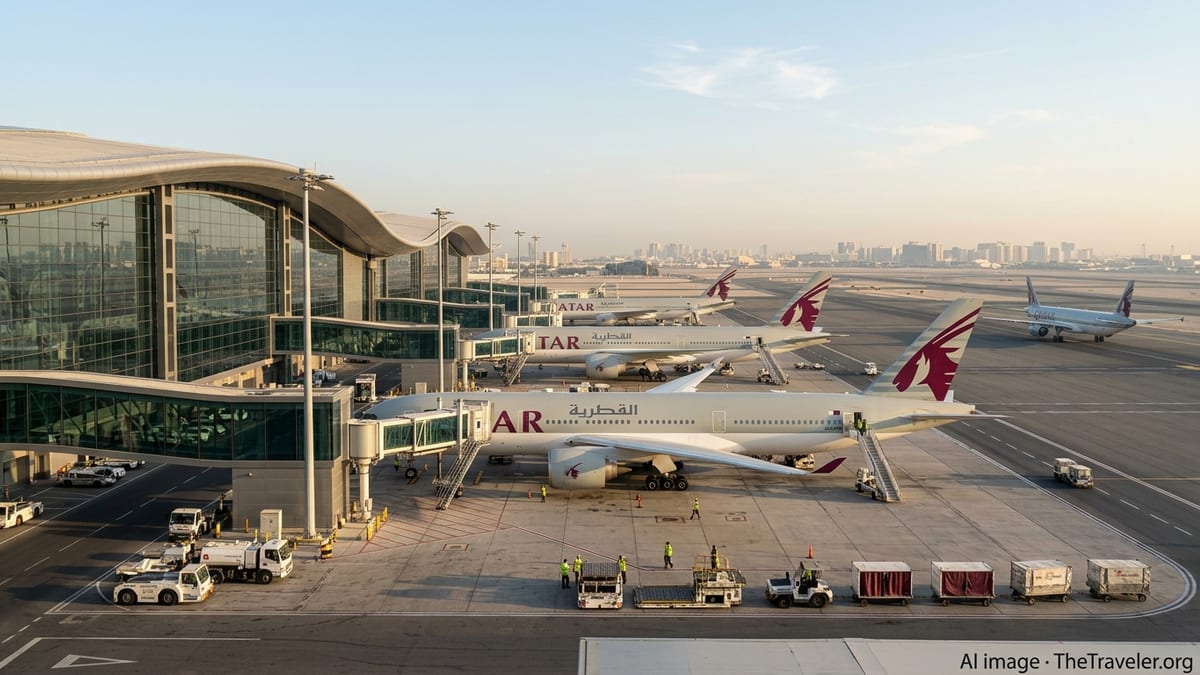
Expanded Schedule Offers Wider Reach Under Temporary Constraints
Publicly available information indicates that Qatar Airways has been operating under a constrained, time-bound schedule framework, publishing flight lists in blocks that typically run for several weeks at a time. The latest update extends that approach into mid-April 2025 and brings 33 more destinations back into the timetable, giving the carrier a broader global footprint even as operations remain officially limited rather than fully restored.
These additional cities span the airline’s core regions in the Middle East, Europe, Asia, Africa and the Americas, reflecting a strategy focused on re-establishing key trunk routes and high-demand markets first. While exact frequencies vary by destination, the expansion means more passengers can once again use Doha’s Hamad International Airport as a connecting hub, rather than relying solely on point-to-point alternatives or last-minute rerouting on other carriers.
Industry coverage suggests that the update through April 15, 2025, fits into a pattern of gradual increases, with Qatar Airways adding clusters of destinations and extra weekly frequencies as airspace access, operational capacity and demand patterns allow. The airline continues to describe these timetables as limited, highlighting that they are not yet equivalent to its full pre-disruption global network.
For travelers, the practical effect is a greater chance that long-booked itineraries can now be honored without major detours. However, the phased nature of the rollout means that many passengers are still navigating cancellations or rebookings if their routes fall outside the temporary list, or if frequencies have not yet returned to daily service.
Key Markets Come Back Online Across Multiple Regions
Reports from aviation-focused outlets and passenger advisories show that the 33 additional destinations now covered to April 15, 2025, are concentrated in markets where Qatar Airways traditionally has strong traffic flows. Major capitals and commercial centers in Europe and Asia appear prominently, mirroring earlier limited-schedule lists that prioritized cities such as London, Frankfurt, Madrid, Beijing, Bangkok and Mumbai.
Regional connectivity is also a focus, with flights to Gulf and wider Middle East cities helping to restore critical short-haul links that feed long-haul services. This is consistent with the airline’s pre-existing hub-and-spoke model, which relies on dense regional feeder traffic to sustain intercontinental routes to North America, Latin America, Africa and the Pacific.
In the Americas, the extended schedule keeps several North and South American gateways in operation, maintaining at least a skeletal bridge between Doha and major financial and leisure markets. While frequencies on some of these routes remain below historical peaks, their inclusion in the limited timetable underscores their importance for both transfer traffic and point-to-point demand.
The mix of 33 destinations suggests that Qatar Airways is prioritizing markets where there is a strong blend of visiting friends and relatives traffic, business travel and tourism, allowing aircraft to operate with healthier load factors even under constrained conditions. It also provides an initial platform for future ramp-ups once operational restrictions ease.
Temporary Network Still Falls Short of Pre-Disruption Scale
Even with the addition of 33 destinations through April 15, 2025, the current network remains a reduced version of Qatar Airways’ typical global reach, which spans more than 170 passenger destinations in normal times. Analysis of public schedules and timetable changes shows that some popular leisure routes and secondary cities are still absent or served less frequently than before.
For example, coverage indicates that some Southeast Asian beach and resort destinations, selected secondary European cities and certain African points are not yet fully integrated into the interim plan. Capacity on others is limited to only a few departures per week, which constrains flexibility for travelers seeking specific dates or smooth same-day connections via Doha.
Travel industry observers note that the airline appears to be adopting a cautious capacity strategy, striking a balance between maintaining network relevance and avoiding the operational strain of overextending during a period of ongoing uncertainty. This approach may help stabilize schedules and reduce last-minute changes, but it also means that a substantial portion of Qatar Airways’ pre-disruption map remains either dormant or only partially restored.
Passengers and travel agents continue to report mixed experiences, with some itineraries reactivated thanks to newly listed destinations, while others remain cancelled or subject to complex rerouting options involving long layovers or alternative airports. The addition of 33 destinations brings the network closer to its previous shape, but it does not yet mark a full return to normal operations.
What the April 15, 2025 Cutoff Means for Travelers
The temporary nature of the schedule update, with validity explicitly stated through April 15, 2025, is central to how passengers should interpret the changes. Rather than a firm long-term commitment, the date functions as a planning horizon, after which a fresh update is likely, based on evolving operational conditions and demand.
For travelers holding tickets through mid-April 2025, the continued publication of route-specific lists provides some additional clarity compared with the early stages of disruption, when longer stretches of the calendar remained uncertain. Where a destination now appears in the limited timetable, passengers generally have greater confidence that their flights are set to operate, although last-minute changes remain possible.
Those booked for travel after April 15, 2025, however, still face ambiguity. The absence of a route from the current block of dates does not necessarily mean it will remain suspended later in the year, but it also offers no reassurance that services will resume on schedule. As a result, many passengers continue to adopt a wait-and-see approach, tracking official updates and monitoring inventory for signs that their routes are being reintroduced.
Travel management companies and corporate buyers are closely studying the April 15 cutoff as they plan business travel programs for spring and early summer 2025. The addition of 33 destinations improves connectivity for some multinational firms, particularly those with regional hubs in Europe, Asia and the Middle East, but still leaves gaps that may need to be filled by alternative carriers on certain corridors.
Guidance for Passengers Navigating the Expanded Network
With Qatar Airways’ network now covering more destinations on a limited basis, experts in the travel trade are advising passengers to pay close attention not only to whether their city appears on the list, but also to how frequently it is served and on which days of the week. Reduced frequencies can affect minimum connection times and may require more flexible travel dates than usual.
Publicly available guidance from the airline stresses that travelers should not proceed to the airport unless they hold a confirmed ticket on an operating flight. This emphasis reflects the continuing risk of schedule adjustments and the need to avoid unnecessary crowding at terminals, particularly on days when interim operations are concentrated on specific corridors.
Passengers are also being encouraged to review rebooking and refund policies that apply to their tickets, many of which have been updated in light of the evolving situation. In some cases, extended windows for complimentary date changes or credit vouchers offer a measure of flexibility for those whose routes remain excluded from the limited schedule through April 15, 2025.
For now, the addition of 33 destinations represents a meaningful but measured step in Qatar Airways’ effort to rebuild its global network. Travelers who find their city newly restored to the timetable gain more options and a clearer path to completing long-planned journeys, while the broader industry continues to watch how the carrier balances gradual expansion with the operational realities of a still-fragile aviation environment.