

More news on this day
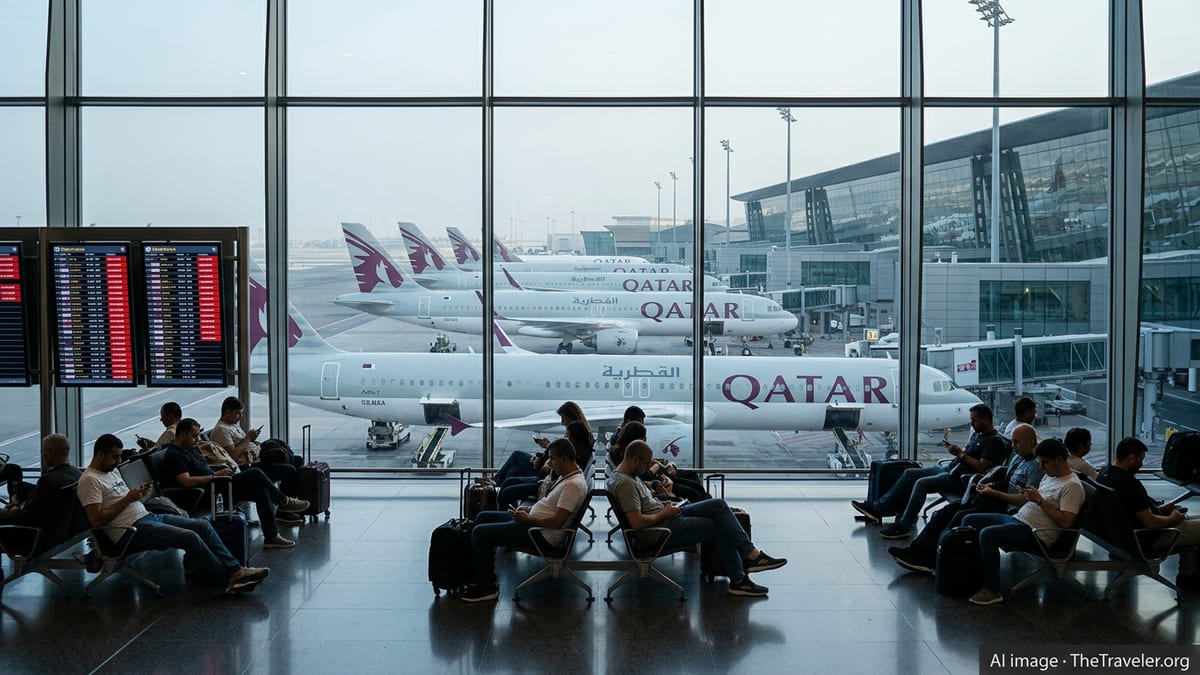
Qatar Airways has temporarily halted all passenger flights worldwide after Qatari airspace was closed amid escalating regional conflict, triggering one of the most disruptive aviation shutdowns for Gulf hubs since the Covid-19 pandemic and leaving tens of thousands of travelers stranded across continents.
What Is Behind the Sudden Shutdown of Qatar Airways Flights?
The suspension of Qatar Airways services follows the closure of Qatari airspace after strikes and counterstrikes across the Middle East that began on February 28, 2026. Authorities in Qatar shut the country’s skies as a precaution, forcing Hamad International Airport in Doha to halt all takeoffs and landings and effectively grounding the national carrier’s global network overnight.
The move coincided with a wider regional clampdown on airspace. The United Arab Emirates, including Dubai and Abu Dhabi, as well as several neighboring states, closed or heavily restricted their skies due to security concerns. With much of the Gulf’s high-altitude corridors unavailable, airlines that rely on the region as a crossroads between Europe, Asia, Africa and the Americas have been forced into mass cancellations and diversions.
Qatar Airways confirmed that all flight operations remain temporarily suspended and said services will not resume until the Qatar Civil Aviation Authority declares the airspace safe to reopen. The airline has indicated that updates will be issued in stages, with status reviews scheduled in Doha on March 3 and beyond, but has not provided a firm restart date, describing the halt as open-ended and dependent on the security situation.
The knock-on effects reach far beyond Doha. Many travelers who were using Qatar Airways to connect between long haul destinations now find themselves marooned at outstations from Europe to Southeast Asia, as return legs are scrubbed and crews and aircraft are stranded out of position.
How the Airspace Closures Are Disrupting Travel Across the Region
The closure of Qatari and UAE airspace has choked off some of the world’s busiest transit corridors. Doha’s Hamad International Airport, together with Dubai International and Abu Dhabi’s Zayed International, normally handles a dense web of connecting flights linking cities from Sydney and Singapore to London, New York and São Paulo. With these hubs effectively offline, airlines have lost critical refueling and transfer points on east west routes.
For Qatar Airways, whose model is built almost entirely around funneling passengers through Doha, the impact is especially severe. Unlike point-to-point carriers that can reroute around trouble spots, its network is designed as a single global hub. With that hub shut and the surrounding airspace restricted, there is no practical way to operate even a skeleton schedule without significant safety and routing compromises.
Other Gulf carriers, including Emirates and Etihad, have also temporarily suspended many flights, but some have been able to operate limited services over alternative corridors when air traffic control allows. By contrast, Qatar’s total airspace closure means all Qatar Airways departures and arrivals are frozen, and even aircraft that were already airborne when the shutdown took effect were forced to divert or return to their origin airports.
Aviation data providers report thousands of cancellations and widespread delays affecting not only direct flights to the Middle East, but also routes between Europe and Asia that would normally overfly the region. Longer routings around closed airspace mean extended flight times, extra fuel burn and tighter crew duty limits, further compounding the disruption.
What Stranded Qatar Airways Passengers Should Do Right Now
With call centers overwhelmed and airport queues stretching for hundreds of meters, travelers are being urged to use digital channels first. Qatar Airways is steering passengers to manage bookings through its official app or website, where most tickets can be changed or held as credits. In many cases, rebooking can be requested without speaking directly to an agent, which is significantly faster than waiting in line at a service desk.
Passengers currently abroad are advised to stay in close contact with their accommodation providers and to keep receipts for any out of pocket expenses such as meals, local transport and emergency overnight stays. Whether these costs will be reimbursed depends on a mix of airline policies, fare conditions and local consumer protection rules, but documentation will be essential for any later claims.
Experts recommend that travelers avoid attempting to piece together their own alternative itineraries via separate one way tickets unless absolutely necessary. With the situation fluid and further cancellations possible, stringing together multiple carriers on independent bookings can leave passengers exposed if a single leg fails. Where rerouting is needed, using a single ticket issued by Qatar Airways or a partner airline provides the strongest protection.
Travelers already at an airport should pay attention to public announcements and information screens, which in many hubs are being updated in near real time as slots open or close. Boarding passes and paper itineraries printed earlier in the day may no longer reflect actual operations, so relying on them alone can lead to confusion and missed opportunities to rebook.
Rebooking, Refunds and Your Rights as a Qatar Airways Customer
Qatar Airways has issued special guidelines to travel agents and partner airlines covering rebooking, refunds, ticket validity and fee waivers for passengers affected by the airspace closure. While the full internal documents are not public, agents report that the carrier is generally allowing one free change for most itineraries, subject to seat availability, with the option to shift travel to later dates once operations resume.
For passengers who no longer wish to travel, or whose plans are time sensitive, refund options are being made available on many affected tickets, particularly for journeys scheduled in the immediate days of the shutdown. Depending on the original fare rules, refunds may come as cash to the original form of payment, as a voucher or as a credit balance that can be used for future travel within a specified validity period.
Customers who booked through online travel agencies or traditional bricks and mortar agents may need to work directly with their point of sale rather than with Qatar Airways itself. In these cases, the airline’s waiver policies are passed on to the intermediary, which then processes rebookings or refunds according to its own procedures. This can introduce delays, but it also means agents may be able to propose creative rerouting via alternative carriers once regional airspace begins to reopen.
Travel insurance offers a more complicated picture. Many standard policies treat war and military conflict as exclusions, limiting coverage for flight cancellations that stem from security crises. Some comprehensive plans, however, may reimburse certain expenses, especially if policies include travel disruption or missed connections as covered events. Passengers should read their policy wording carefully and contact their insurer with specific questions before assuming they are either covered or excluded.
When Might Qatar Airways Flights Resume, and What to Expect Next
As of the morning of March 3, 2026, Qatar Airways has not confirmed a firm restart date for its global schedule. The airline has committed only to resuming flights once the Qatar Civil Aviation Authority declares Qatari airspace safe and to issuing timed operational updates, including one scheduled for later in the day. Industry analysts caution that even once a green light is given, the return to normal operations will be gradual rather than instantaneous.
Restarting a global hub operation after a full stop requires repositioning aircraft and crews, revalidating flight plans and rebuilding carefully timed connection banks. Airlines typically prioritize routes with the largest numbers of stranded passengers and those that connect major partner hubs, meaning some city pairs may see services restored much sooner than others. Travelers with flexible schedules may find it easier to secure seats on these initial departures, while those bound for smaller destinations might wait several days longer.
Meanwhile, the broader regional airspace picture remains fluid. Authorities in the UAE and other Gulf states are reviewing the situation hour by hour, and any partial reopenings are likely to come with altitude restrictions and narrow corridors designed to keep civil aviation away from sensitive areas. This will constrain capacity even after airports reopen, and some routings that previously overflew conflict zones may remain off limits for an extended period.
For now, industry experts advise travelers booked on Qatar Airways in the coming week to assume potential disruption, to avoid non refundable add ons such as prepaid tours or hotels at their intended destination, and to monitor both airline communications and reputable news outlets several times a day. While the shutdown is expected to ease as the security situation stabilizes, the ripple effects on schedules and capacity could linger well beyond the formal reopening of Qatari and UAE airspace.