

More news on this day
Passengers traveling between Iraq and key Gulf hubs such as Doha, Bahrain, and Amman are facing fresh disruption after Qatar Airways and Gulf Air canceled more than 20 flights from Baghdad, Basrah, Najaf, and other Iraqi cities amid tightening airspace restrictions across the region.
Get the latest news straight to your inbox!
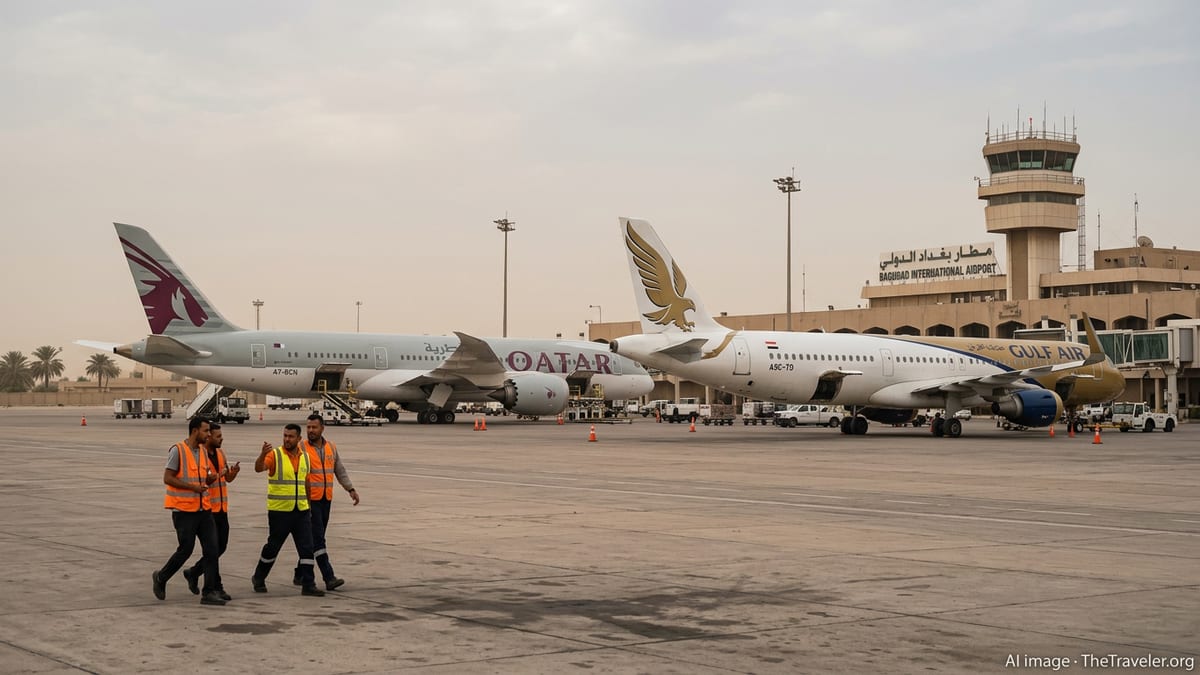
Regional Airspace Restrictions Hit Iraq–Gulf Routes
The latest wave of cancellations comes as airspace over much of the Gulf remains heavily restricted following weeks of escalating tensions and missile activity that have already forced thousands of flights to be rerouted or grounded. Authorities in Qatar, Bahrain, Iraq, and neighboring states have imposed rolling airspace controls, creating highly constrained operating corridors for commercial carriers.
Qatar Airways, whose global network relies on smooth access to its Doha hub, has been among the hardest hit. The carrier has already been operating on a skeleton schedule due to the closure of Qatari airspace, and the additional constraints over Iraq have now prompted the suspension of multiple services linking Doha with Baghdad, Basrah, and Najaf.
Gulf Air, the Bahraini flag carrier, has also scaled back flights into Iraq as Bahrain’s airspace remains restricted and regional overflight options narrow. Services that normally connect Iraqi travelers with Bahrain’s hub and onward to destinations such as Amman have been thinned out or temporarily halted, leaving passengers scrambling for alternatives.
Iraqi aviation authorities have kept airports at Baghdad, Basrah, and Najaf open, but airlines must constantly adapt to shifting risk assessments and routing limitations. The result is a patchwork of last-minute schedule changes that can leave flights operating one day and grounded the next.
More Than 20 Flights Pulled From Schedules in Newest Update
In the latest update to their operations, Qatar Airways and Gulf Air together have withdrawn more than 20 flights serving Iraq over the coming days, according to airline advisories and schedule data reviewed by travel agents. The bulk of the cuts affect rotations between Doha and Baghdad, Doha and Najaf, as well as Bahrain services touching Iraqi gateways and feeding traffic to Amman and other regional cities.
Travel-industry briefings circulated to corporate clients describe a pattern of rolling cancellations rather than a single, fixed suspension period. Some Qatar Airways flights into Iraq that had briefly reappeared in reservation systems after a partial easing of restrictions have now been removed again, while Gulf Air has trimmed frequencies or temporarily zeroed out certain Iraq-bound flights from its Bahrain hub.
For passengers on the ground, these adjustments are often communicated only hours or a day before departure. Travelers report receiving text messages or app notifications informing them that their flight from Baghdad or Basrah to Doha or Bahrain has been canceled, with rebooking options limited due to the broader airspace closure affecting alternative routings.
While the headline figure of more than 20 canceled services captures only a snapshot of the current situation, the overall impact is cumulative: frequent flyers on Iraq–Gulf routes now face an environment where any future departure remains provisional until wheels-up.
Knock-On Effects for Connections to Doha, Bahrain, and Amman
The Iraq cancellations are particularly disruptive because flights to Doha and Bahrain function as crucial connectors to the wider world. Travelers from Baghdad, Basrah, and Najaf commonly rely on Qatar Airways and Gulf Air to reach long-haul destinations in Europe, Asia, and North America via their hubs, as well as short- and medium-haul links to Amman and other Levant cities.
With flights to Doha significantly reduced, Iraqi passengers are losing access to Qatar Airways’ global network at a time when other Gulf carriers are also curtailing operations. Even where limited relief or repatriation flights are running to Doha, they typically depart from a small number of major cities and are heavily oversubscribed, leaving little room for routine business or leisure travel originating in Iraq.
On the Bahrain side, reduced Gulf Air operations mean fewer options for same-day connections to Amman and onward destinations. Some passengers have been rebooked onto complex multi-stop itineraries via airports that still have open corridors, increasing both travel time and cost. Others report being offered ticket refunds or open-date vouchers rather than near-term alternatives.
The disruption is also affecting inbound traffic. Pilgrims, business travelers, and diaspora communities who would normally route through Doha or Bahrain to reach Najaf and other Iraqi cities are finding those itineraries difficult or impossible to book, complicating travel plans set months in advance.
Airlines Shift to Relief Operations and Flexible Policies
Both Qatar Airways and Gulf Air have emphasized that passenger safety remains the first priority as they navigate the volatile operating environment. Qatar Airways has largely pivoted to a model centered on limited relief and repatriation flights, activated when authorities open temporary safe corridors and subject to suspension if the security picture worsens.
Gulf Air has adopted a similarly cautious stance, operating select rotations where risk assessments and available routings permit, while suspending others on short notice. Travel advisories from global security consultancies continue to warn that the regional airspace situation is fluid, with potential changes measured in hours rather than days.
To soften the blow for affected customers, both airlines are maintaining expanded disruption policies that allow for fee-free date changes, route changes where possible, or refunds for canceled segments. However, passengers report lengthy call-center waits and slow processing times as carriers deal with a surge of rebooking and refund requests across their networks.
Travel-management companies handling corporate accounts in Iraq and the Gulf say they are advising clients to avoid nonessential trips, particularly those requiring connections through Doha or Bahrain, and to build in contingency days for any travel that cannot be postponed.
What Travelers in Iraq Need to Do Now
For passengers in Baghdad, Basrah, Najaf, and other Iraqi cities, the most important step is to treat any existing booking involving Doha, Bahrain, or Amman as subject to change. Airlines are urging customers to monitor their reservations closely through official apps and customer portals, as online schedules may not always update in real time on third-party booking sites.
Travelers whose flights with Qatar Airways or Gulf Air have already been canceled should contact the airline or their travel agent promptly to secure rebooking or refunds, as inventory on alternative routes is limited and tends to fill quickly after each new wave of schedule changes. Those with travel later in March are being told to watch for policy extensions and operational updates that could widen or narrow the current suspension windows.
Industry analysts caution that full restoration of Iraq–Gulf connectivity will depend not only on the reopening of Qatari and Bahraini airspace, but also on the stability of regional missile and drone threats that have reshaped flight paths across the Middle East. Even after baseline safety conditions improve, carriers are expected to reintroduce capacity gradually, prioritizing the most in-demand city pairs and times.
Until then, travelers between Iraq and hubs such as Doha, Bahrain, and Amman face an environment defined by uncertainty, where flexibility, constant monitoring, and backup plans are essential parts of any itinerary.