

More news on this day
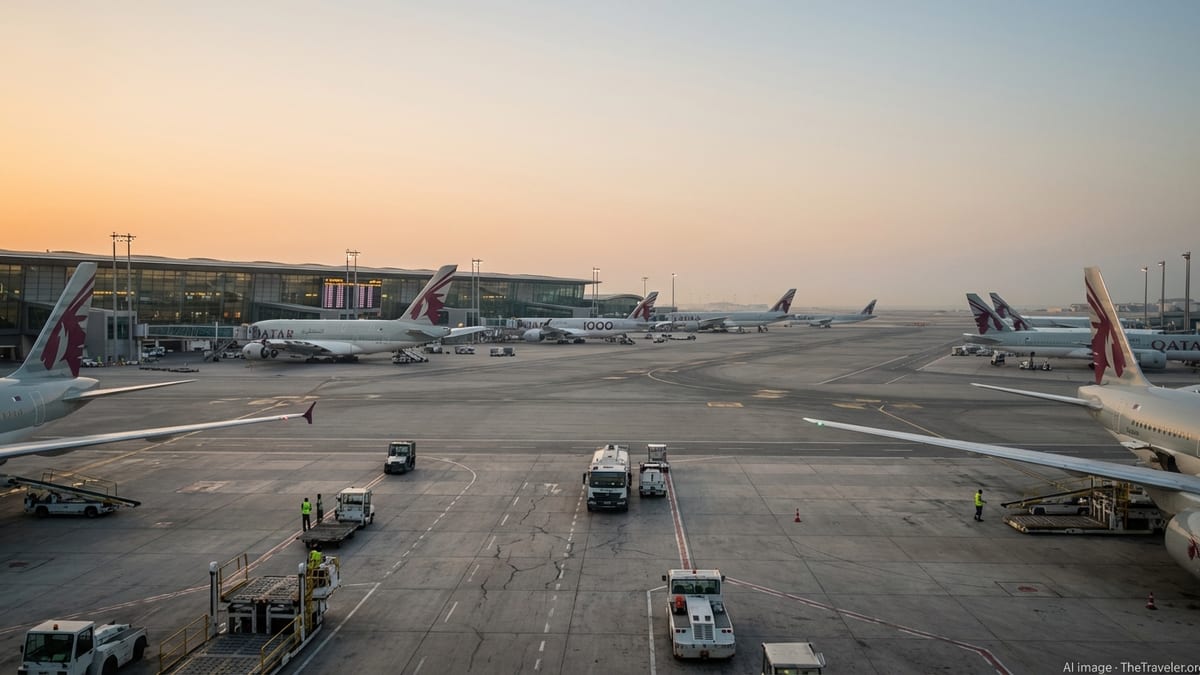
Qatar Airways has temporarily suspended all flights to and from Doha after Qatari authorities abruptly closed the country’s airspace on February 28, 2026, triggering major disruptions across one of the world’s busiest transit hubs.
What Qatar Airways Has Announced So Far
In a statement issued on Saturday, Qatar Airways Group confirmed an immediate halt to its entire operation to and from Doha following the closure of Qatari airspace. The airline said the suspension is temporary and that services will resume once airspace restrictions are lifted by the authorities.
The carrier stressed that safety remains its “highest priority” and framed the move as a precautionary response to evolving regional developments affecting aviation. While no specific end time has been given, Qatar Airways warned that delays and schedule changes are likely even after flights restart as the network and aircraft rotations are gradually restored.
Qatar Airways added that it is working closely with government stakeholders and civil aviation regulators to manage the disruption and coordinate the eventual resumption of flights. The airline has advised passengers to rely on its official communication channels and travel agents for the latest information on rebooking and future departures.
The temporary suspension affects Qatar Airways’ global network of more than 170 destinations, as virtually all scheduled passenger and cargo flights connect through its Doha hub at Hamad International Airport.
Airspace Closure and Regional Security Context
The move by Qatar Airways follows a decision by the Qatar Civil Aviation Authority to temporarily suspend air traffic in Qatari airspace as a precaution amid rapidly unfolding regional tensions on February 28. Authorities said the measure is intended to ensure the highest levels of safety and security for all flights while they assess the latest developments.
The closure comes on a day of severe disruption across Middle Eastern skies, with multiple countries restricting or shutting sections of their airspace following military strikes involving Iran and Israel and allied forces. Large swathes of airspace over Iran, Iraq and parts of the Gulf have effectively become no-go areas for commercial aviation, forcing airlines to cancel or reroute long-haul services between Europe, Asia and Africa.
Industry data shows that the corridor over the Gulf and surrounding region is one of the world’s busiest for intercontinental traffic, meaning any prolonged closure is likely to have global ripple effects. Flights that would normally transit the region are being diverted around affected areas, adding several hours of flying time, increasing fuel burn and placing additional pressure on airline schedules already operating near capacity.
Regional carriers, including Qatar Airways, face particular challenges because their hub-and-spoke models rely on precisely timed waves of connections through a single airport. Any sudden shutdown of airspace or hub operations knocks that connectivity out of sync, leaving aircraft and crew out of place and passengers stranded mid-journey.
Impact on Hamad International Airport and Global Connections
Doha’s Hamad International Airport, repeatedly ranked among the world’s leading airports and the primary base for Qatar Airways, has effectively seen its role as a global transfer hub pause for the duration of the airspace closure. Departures and arrivals have been heavily curtailed, with aircraft held on the ground, turned back in flight or diverted to alternate airports.
Passengers transiting through Doha between Europe and Asia, as well as between Africa and North America or Australasia, are experiencing missed connections, last-minute cancellations and extended layovers. Travel itineraries carefully planned around tight connections at Hamad International have unraveled as flight banks collapse and airlines scramble to re-accommodate customers on future services.
Qatar Airways has deployed additional ground staff at Hamad International and other key airports in its network to manage queues, issue updated boarding passes, arrange hotel accommodation where required and assist with visa and transit formalities. The airline is prioritising vulnerable travellers, families, and those with limited onward options while it works through a backlog of disrupted itineraries.
Travel agents and corporate travel managers are also contending with a surge in change requests as business travellers and holidaymakers seek alternative routes that avoid the affected airspace. Some passengers are being shifted onto remaining services via other Gulf or European hubs where routing remains possible, though capacity is limited and demand is intense.
What Passengers Should Expect in the Coming Days
For now, all Qatar Airways flights to and from Doha remain suspended until further notice, and travellers with imminent departures should expect significant disruption. Passengers whose journeys involve a Qatar Airways sector or a Doha transit are being urged not to travel to the airport without a confirmed alternative itinerary or explicit guidance from the airline or their booking agent.
Once Qatari airspace reopens, Qatar Airways plans a phased restart of operations rather than an immediate return to full schedules. Aviation analysts say it may take days, and potentially longer, to restore normal connectivity as aircraft and crew are repositioned, maintenance windows are rescheduled, and flight plans are refiled over newly approved routings.
Travellers should anticipate rolling delays, retimed departures and potential last-minute changes even after services resume. Long-haul flights may operate with extended flight times if they are required to skirt restricted zones, further complicating crew duty limits and aircraft utilisation. Many airlines, including Qatar Airways, are likely to build in additional buffers to account for congestion on alternative corridors.
Passengers are being encouraged to monitor their bookings frequently, keep contact details updated with the airline, and allow extra time for connections on any new itineraries. Flexible travel policies, including fee waivers and options for rebooking at a later date, are expected to play a key role in managing customer demand as confidence gradually returns.
Broader Effects on Middle East and International Aviation
Qatar Airways’ suspension is part of a wider pattern of emergency measures across Middle Eastern aviation as carriers respond to security advisories, changing risk assessments and rapidly expanding no-fly zones. Airlines in the region and beyond have announced cancellations, diversions and temporary route suspensions, particularly on services touching Iran, Israel and neighbouring countries.
The disruptions are reminiscent of earlier geopolitical crises that reshaped flight corridors, including the closure of large parts of Russian airspace in 2022 and prior stand-offs affecting routes between India and Pakistan. Each episode has forced airlines and regulators to reassess how they balance safety, commercial viability and network resilience in politically sensitive airspace.
A sustained closure of Qatari and surrounding airspace would have implications not only for passenger travel but also for air cargo flows that move through Doha. Qatar Airways’ cargo arm is a major player in global freight, carrying everything from pharmaceuticals and electronics to fresh food between Asia, Europe, Africa and the Americas. Extended disruption could affect supply chains that depend on just-in-time deliveries via the Gulf.
For now, aviation authorities across the region are closely monitoring the security environment and coordinating with airlines on risk assessments. The pace at which Qatar’s skies and the wider Middle Eastern corridor can safely reopen will determine how quickly global air travel stabilises and whether the latest crisis becomes a short-lived shock or a longer-term challenge for carriers and travellers alike.