

More news on this day
Qatar Airways has announced the temporary suspension of all flights to and from Doha after Qatar’s civil aviation authorities ordered an unprecedented closure of the country’s airspace on February 28, sending shockwaves through global travel networks and leaving thousands of passengers facing cancellations, diversions and long delays.
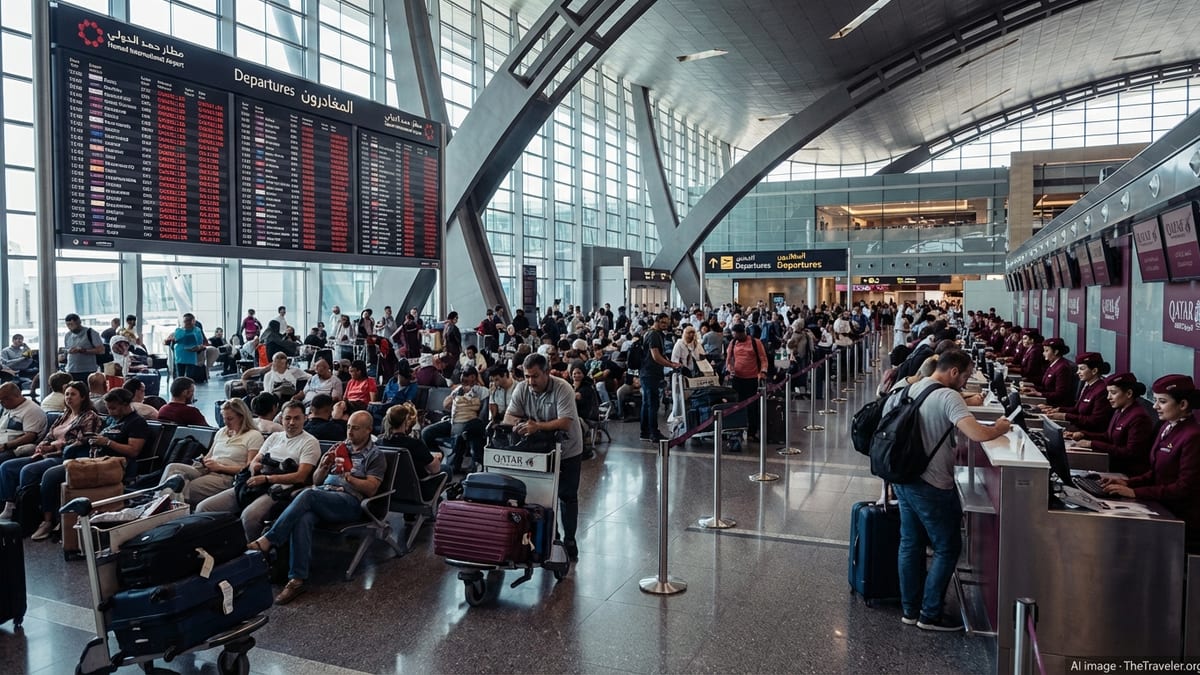
Unprecedented Airspace Closure Shuts Down Qatar’s Aviation Hub
The Qatar Civil Aviation Authority confirmed that air navigation in the country’s airspace was suspended on Saturday as a precautionary safety measure in response to fast-moving regional developments. The decision effectively closed one of the Middle East’s most strategically important air corridors, used heavily by airlines linking Europe, Asia, Africa and Oceania.
Hamad International Airport in Doha, the hub for Qatar Airways and a key transfer point for long haul itineraries, quickly halted all aircraft movements. Airport authorities said departures and arrivals were paused in coordination with government and civil aviation bodies, stressing that passenger and crew safety remained the overriding priority.
The shutdown comes amid a wider surge in airspace restrictions across parts of the Middle East following fresh military strikes and escalating tensions involving Iran and Israel. Multiple regional and international carriers have rerouted or cancelled flights across the Gulf and broader region as aviation regulators reassess overflight risks.
Officials in Doha said the situation is under continuous review and that normal operations will resume once authorities deem the airspace safe to reopen. No timeline has yet been given, adding to uncertainty for airlines and travelers with imminent plans to transit through Qatar.
Qatar Airways Suspends Network as Disruption Ripples Worldwide
In a statement, Qatar Airways Group confirmed a temporary suspension of all flights to and from Doha, describing the move as a direct consequence of the airspace closure. The airline, one of the world’s largest long haul carriers, said it is working closely with government stakeholders and relevant aviation authorities and will restart services as soon as airspace restrictions are lifted.
The grounding of Qatar Airways’ Doha operations is hitting global connectivity far beyond the Gulf. The carrier’s extensive network links more than 150 destinations with tightly timed connections through Hamad International Airport. With its hub effectively offline, itineraries spanning Europe to Asia, the Indian subcontinent, Africa, Australia and the Americas are seeing cascading disruptions.
Passengers and travel agents reported last minute cancellations, boarding gate holds and prolonged uncertainty on flights that would typically route through Doha. Long haul services already airborne when the airspace closure took effect have been subject to diversions and extended flight times as dispatch teams scramble to identify alternative routings around restricted airspace.
The airline has warned that even after operations resume, significant delays and knock-on schedule changes are likely as aircraft and crew are repositioned and backlogs are cleared. Travelers booked in the coming days are being advised to monitor official airline communications and airport departure boards closely.
Travelers Face Cancellations, Diversions and Long Waits
For passengers, the sudden shutdown has translated into crowded terminals, long queues at service desks and hours of uncertainty about onward travel. At Hamad International Airport, additional ground staff have been deployed to help rebook itineraries, arrange overnight accommodation where required and provide basic assistance to those stranded in transit.
Travelers on social media described check in counters abruptly suspending processing for flights bound for Doha, while others reported being kept on hold at departure gates as airlines awaited clarity on routing and airspace availability. For some, itineraries that usually involve a single connection in Doha have turned into multi-leg journeys via alternative hubs or have been postponed entirely.
Consumer advocates note that the complexity of this disruption, involving multiple jurisdictions and overlapping airspace closures, makes it harder for passengers to quickly secure alternative options. Many long haul routes in and out of Asia and Africa have become heavily reliant on Gulf hubs such as Doha, meaning any prolonged outage exerts outsized pressure on remaining capacity through other regional centers.
Travel industry analysts say that while airlines will seek to accommodate affected customers wherever possible, peak season loads and limited spare capacity on alternative routes could leave some travelers facing multi-day delays or forced itinerary changes, particularly on niche or less frequently served routes.
Knock-On Effects Across Middle East and Global Carriers
The suspension of flights in and out of Qatar comes as airlines across the Middle East and beyond rush to adjust operations in the wake of new conflict-related airspace restrictions. Carriers based in the Gulf, Europe and Asia have already announced cancellations or reroutings on services that typically cross Iranian, Iraqi and neighboring airspace.
Regional airlines that rely on dense networks of short and medium haul flights are particularly exposed, with some temporarily halting operations to key destinations as they reassess risk profiles. Long haul carriers, meanwhile, are facing extended flight times as they add considerable mileage to avoid closed or high risk flight information regions.
Industry observers warn that fuel costs, crew duty time limits and aircraft availability could all become constraining factors if diversions and elongated routings persist, potentially leading to more cancellations and reduced schedules. The cumulative effect, they add, could be a noticeable reduction in overall capacity on popular corridors between Europe, the Middle East and Asia in the short term.
Aviation safety specialists note that airspace closures of this scale inevitably create congestion in adjacent corridors as traffic is funnelled through fewer available routes. Air traffic control agencies in neighboring states are coordinating to manage higher volumes safely, but passengers may experience additional delays in the form of airborne holding patterns and extended taxi times.
What Passengers Should Expect in the Coming Days
With no confirmed timeframe for the reopening of Qatar’s airspace, travel experts say flexibility will be key for anyone scheduled to fly via Doha or across the wider region in the near term. Rebooking policies and options will vary by carrier and ticket type, but many airlines are expected to offer fee waivers, alternative routings or travel credits for journeys directly affected by the shutdown.
Passengers are being urged to keep contact details up to date with their airline, monitor flight status channels closely and allow extra time at airports, particularly if they are already en route or in transit. Those with nonessential travel through the region in the next few days may wish to explore postponement or alternative routings through different hubs, where available, to avoid potential last minute disruption.
Travel agencies and corporate travel managers are now reassessing itineraries that rely heavily on Qatar Airways and Doha connections, particularly for time sensitive business trips. Some are exploring temporary shifts to other Gulf or European hubs, though the broader pattern of regional airspace closures means alternatives may also face pressure.
For now, Qatar’s closure and Qatar Airways’ sweeping suspension of flights underscore the vulnerability of global aviation networks to sudden geopolitical shocks. Until authorities reopen the airspace and airlines can safely restore their schedules, travelers planning to cross the region should brace for a period of heightened uncertainty and potential disruption.