

More news on this day
Qatar Airways has extended the temporary suspension of its scheduled flight operations after the closure of Qatari airspace, announcing a small programme of relief flights from March 5 to help stranded passengers while the wider aviation industry braces for prolonged disruption across one of its most important hubs.
Airspace Closure Freezes a Major Global Hub
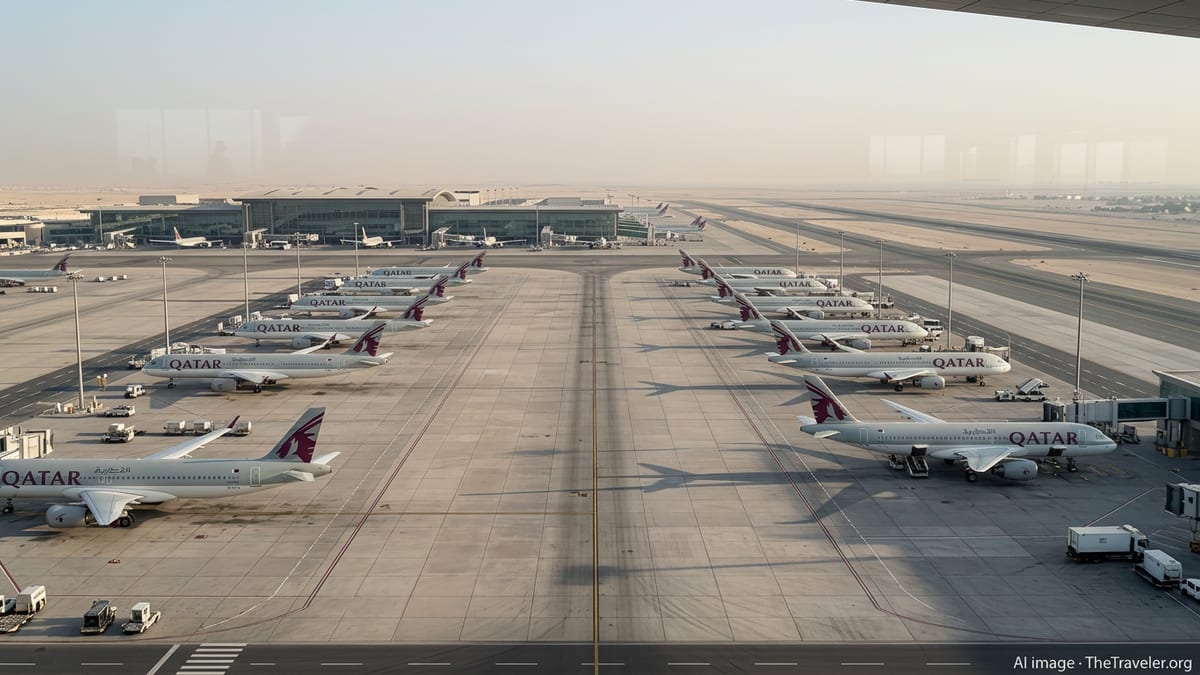
The shutdown of Qatari airspace in late February sent an immediate shock through global aviation, halting operations at Doha’s Hamad International Airport and forcing Qatar Airways to ground regular services across its network. The carrier confirmed that all scheduled flights remain paused as it awaits clearance from the Qatar Civil Aviation Authority to resume operations.
The closure comes amid heightened regional tensions and broader airspace restrictions across parts of the Middle East, complicating routings between Europe, Africa and Asia. Industry data providers estimate that tens of thousands of passengers each day rely on Doha as a transfer point, meaning the sudden loss of capacity has rippled far beyond the Gulf.
Qatar Airways has reiterated that safety remains its overriding priority and that no regular flying will restart until regulators deem the country’s airspace safe. The airline has issued rolling daily updates, stating that the next advisory will come once authorities provide clearer guidance on reopening.
In the meantime, passengers with near-term travel dates have seen their itineraries cancelled, rebooked or rerouted via alternative hubs, with travel waivers issued to allow changes and refunds without standard penalties.
Limited Relief Flights Offer a Lifeline
In an attempt to ease the pressure on stranded travellers, Qatar Airways has begun operating a limited number of relief flights from March 5. These services, routed through Muscat and select regional gateways rather than Doha, are designed to move passengers onward to key European destinations while Hamad International remains effectively shut to regular traffic.
According to the airline, planned relief services include flights from Muscat to London Heathrow, Berlin, Copenhagen, Madrid, Rome and Amsterdam, as well as a service from Riyadh to Frankfurt. Capacity is constrained and tightly controlled, with seats allocated primarily to passengers whose original journeys were disrupted by the airspace closure.
Qatar Airways has urged customers not to proceed to any airport unless they have received direct confirmation and travel details from the airline. The carrier is contacting affected travellers individually with updated itineraries, reflecting both the scarcity of available seats and the operational complexity of flying around closed airspace.
Travel agents and partner airlines are working alongside Qatar Airways to re-accommodate passengers where possible, but high demand, overlapping regional restrictions and limited spare capacity mean that many travellers continue to face extended delays, unexpected stopovers and last-minute changes.
Stranded Passengers Face Uncertainty and Changing Rules
The abrupt halt in operations has left passengers scattered across multiple continents, from diversion airports in the Gulf to holiday destinations in Asia and Europe. Reports from regional media and social platforms describe travellers spending days in transit hotels or waiting for rebooking options as airlines and authorities adjust to a rapidly shifting operational picture.
Qatar Airways has introduced temporary guidelines allowing greater flexibility for tickets due to be flown through Doha between late February and mid-March. These include options to rebook on later dates, reroute via alternative hubs when available, or seek refunds, particularly where onward connections have also been cancelled.
Yet the evolving nature of the airspace restrictions and the need to coordinate with multiple regulators mean that policies are being updated frequently. Passengers are encouraged to rely on official airline communications rather than static booking displays, which in some cases have continued to show flights as “on time” even after blanket suspensions were announced.
For many travellers, the episode underscores how quickly a modern, highly interconnected network can seize up when a single critical hub is removed from the system, and how limited the options can be once surrounding airspace is also constrained.
Operational and Financial Challenges for Qatar Airways
For Qatar Airways, the prolonged suspension presents mounting operational and financial pressures. As one of the world’s largest long-haul carriers, its business model is built around intensive utilisation of widebody aircraft and tight connectivity at its Doha hub. Every day of lost flying represents not only foregone revenue but also a complex web of crew rostering, aircraft positioning and maintenance scheduling challenges.
The airline has already deployed additional ground and customer service staff, both in Doha and at key outstations, to handle rebookings and care for passengers. Hotel accommodation, meal vouchers and alternative transport arrangements have added to short-term costs. At the same time, aircraft and crews stand idle or repositioned, waiting for clarity on when normal operations can resume.
Analysts note that aviation insurers, lessors and financiers will be watching closely to assess the duration and scope of the disruption. While major Gulf carriers typically benefit from state backing and strong balance sheets, a sustained closure of national airspace could test the resilience of even the sector’s strongest players, particularly if broader regional demand softens or rerouting adds significant fuel and crew costs once flying restarts.
The episode also highlights the strategic risk of hub concentration. For Qatar Airways, which has built its brand and network on funneling global traffic through Doha, diversification of routings and partnerships may become more pressing once the immediate crisis abates.
Wider Implications and Future Opportunities for the Aviation Sector
The closure of Qatari airspace and the suspension of Qatar Airways flights reverberate far beyond one carrier. The Gulf region serves as a vital bridge between continents, and any prolonged disruption forces airlines worldwide to reconsider routing, fleet planning and risk management assumptions. Recent events have revived industry debate about overflight exposure in geopolitically sensitive corridors and the adequacy of contingency planning when several neighboring countries impose restrictions simultaneously.
In the short term, rival hubs in Turkey, Saudi Arabia and beyond may see increased traffic as airlines reconfigure schedules, although capacity bottlenecks and their own security assessments limit how quickly they can absorb displaced demand. In the medium term, regulators and carriers are likely to review airspace management protocols, information-sharing and the speed at which advisories are issued, with an eye to avoiding sudden groundings where possible.
For Qatar Airways and its peers, the crisis may accelerate investment in more flexible network structures, deeper alliances and digital tools that can rebook and inform passengers more rapidly during disruptions. The airline’s move to mount targeted relief flights through third-country airports hints at one such adaptive strategy, using partnerships and creative routings to keep at least some traffic moving even when the primary hub is offline.
At the same time, the episode reinforces the premium passengers place on reliability, communication and support during irregular operations. How airlines handle stranded customers over the coming days and weeks will shape brand perceptions long after flights resume over Doha, offering both risks and opportunities in an increasingly competitive long-haul market.