

More news on this day
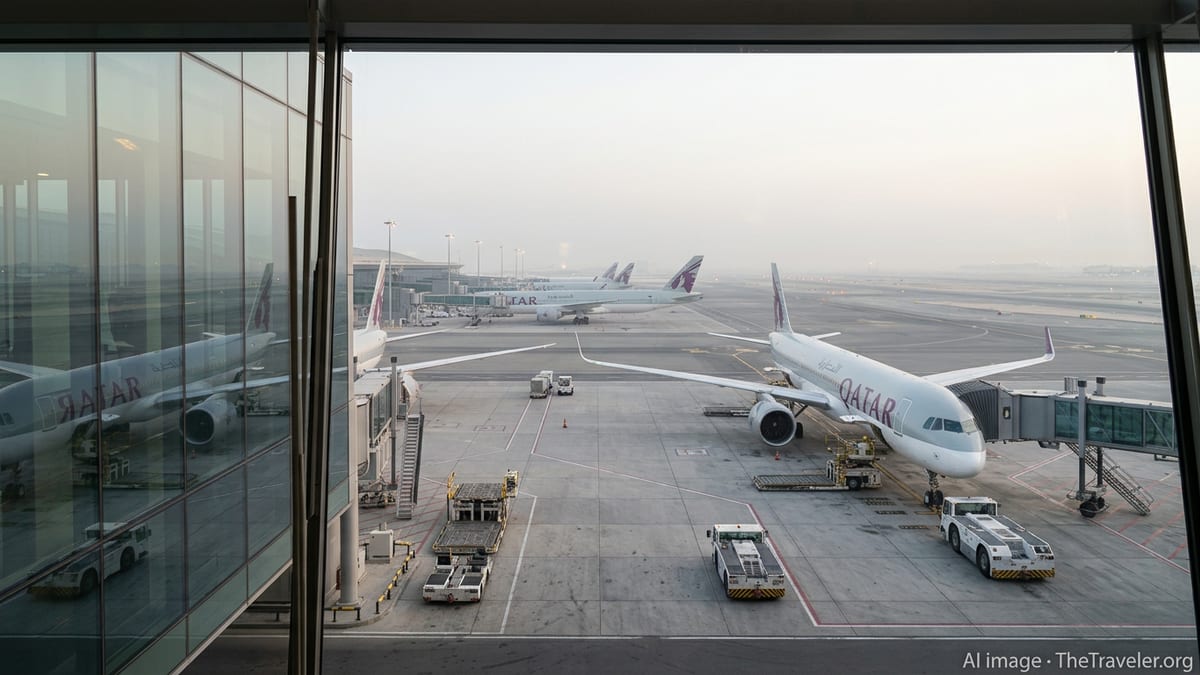
Qatar Airways has suspended scheduled flights across its global network after the sudden closure of Qatari airspace, saying full services will only resume once aviation authorities formally declare operations safe.
Airspace Shutdown Forces Network-Wide Suspension
The Qatar Civil Aviation Authority ordered the temporary suspension of air traffic in Qatari airspace in recent days as a precaution amid heightened regional tensions, effectively grounding regular commercial operations at Doha’s Hamad International Airport. Qatar Airways, which relies on Doha as its central hub, confirmed that its scheduled flights remain temporarily suspended as a direct result of the closure.
The airline has reiterated that it will not attempt a broad restart of its global schedule until the Qatari regulator formally announces the safe reopening of national airspace. Officials have framed the shutdown as a safety-first response to evolving security risks in the region, stressing that the move is designed to protect passengers, crew and airport personnel.
The disruption has rippled far beyond Qatar’s borders. As one of the world’s largest long haul carriers, Qatar Airways typically operates hundreds of daily flights to more than 170 destinations, funnelling passengers through Doha between Europe, Asia, Africa and the Americas. The abrupt halt has left many travellers stranded or scrambling to find alternatives on other airlines and routings.
Industry analysts say the decision underscores how quickly geopolitical shocks can upend even the most meticulously planned airline schedules. With no firm timeline yet for a full reopening of Qatari airspace, they expect continued uncertainty for passengers whose journeys depend on transiting Doha.
Limited Relief and Repatriation Flights Under Tight Controls
While regular scheduled services remain on hold, Qatar Airways has begun operating a small number of tightly controlled relief and repatriation flights, made possible by temporary safe corridors approved by the Qatar Civil Aviation Authority. These flights are being used to bring stranded travellers to and from Doha, and are subject to strict operating parameters and short-notice adjustments.
In statements issued over the weekend, the airline said it had secured authorisation for a limited series of departures from Doha to key European hubs, as well as inbound services from selected cities back to Hamad International Airport. The carrier has emphasised that these special flights do not amount to a wider resumption of normal commercial operations, but are instead emergency measures to assist passengers caught mid-journey when the airspace closed.
Seats on these services are being prioritised for vulnerable travellers, including families with young children, elderly passengers and those with urgent medical or compassionate travel needs. Qatar Airways has contacted eligible customers directly with flight details and has urged the wider public not to travel to the airport without explicit confirmation of a seat.
Operational capacity on these contingency routes is severely constrained, reflecting both safety considerations and the need to avoid congestion in airspace that remains partially restricted. Aviation observers say the carefully calibrated approach suggests that authorities are not yet ready to endorse a broader return to normal air traffic levels over Qatar.
Uncertainty for Passengers as Airline Extends Flexible Options
For thousands of passengers worldwide, the suspension has triggered a cascade of cancellations and rebookings. Qatar Airways has advised travellers with imminent departures to monitor official channels closely and to ensure their contact details are updated so they can receive direct notifications about any relief flights or itinerary changes.
The airline has introduced a range of temporary flexibility measures for customers holding tickets during the affected period. These include complimentary date changes within a defined window from the original travel date and the option to request a refund of the unused portion of a ticket. The policies are intended to offer a degree of certainty at a time when flight status can change at short notice.
Travel agents and corporate travel managers report heavy demand for rerouting onto other carriers that are able to skirt the restricted airspace, often via longer paths over alternative regions. This has driven up prices on some competing routes and created additional pressure on already busy hubs across Europe and Asia.
Consumer advocates are urging passengers to document all communications with airlines and intermediaries and to familiarise themselves with local regulations on refunds and rebooking. However, they note that in cases of airspace closures linked to security events, many of the standard compensation rules do not apply, leaving flexibility policies at the discretion of carriers.
Global Aviation Impact and Safety Calculus
The grounding of Qatar Airways’ regular operations has significant implications for the wider aviation ecosystem. The carrier is a major connector between continents, and its sudden absence from many routes is forcing alliance partners, rival airlines and airports to adapt quickly to shifting passenger flows.
Some airlines have adjusted routings to avoid the restricted area while maintaining service between Europe and Asia, often accepting longer flight times and higher fuel burn in exchange for perceived safety benefits. Others have reduced or temporarily suspended services that previously relied on overflying Qatari airspace, adding further complexity for travellers.
Aviation safety specialists point out that the closure of an entire national flight information region remains a relatively rare step, typically reserved for situations in which there are credible risks from military activity or other security threats. In such circumstances, regulators and airlines tend to adopt a highly conservative stance, erring on the side of grounding flights until surveillance data, military coordination and risk assessments all support a controlled reopening.
For Qatar Airways, the stakes are especially high. The airline has built its brand around premium service and a vast connecting network centred on Doha. A misjudged return to normal operations in an unstable security environment could carry both safety and reputational consequences, which is why executives have repeatedly framed the suspension as a necessary, if painful, precaution.
Timeline for Full Resumption Hinges on Safety Declaration
Despite growing pressure from stranded passengers and industry partners eager for clarity, Qatar Airways has so far avoided committing to a fixed date for restoring its full timetable. Instead, the carrier continues to link any comprehensive restart to one critical milestone: an official declaration from the Qatar Civil Aviation Authority that Qatari airspace is once again safe for unrestricted civil aviation.
Authorities have indicated that they are working around the clock with security and defence agencies to evaluate risks and to design contingency corridors that could support a phased reopening. A partial resumption using limited navigational routes has already begun to ease some of the backlog, but regulators are signalling that a measured approach will prevail over speed.
Travel industry experts expect that, once a safety declaration is issued, Qatar Airways will ramp up flights in stages, initially focusing on key trunk routes and high-demand markets before rebuilding its broader network. Even then, residual delays and schedule changes are likely for some time, as aircraft and crews are repositioned and operational patterns stabilise.
Until that point, passengers with upcoming trips involving Doha are being advised to plan conservatively, consider alternative routings where feasible, and remain prepared for last-minute changes. For now, the message from both the airline and Qatari regulators is clear: full resumption of services will come only when it can be done with an acceptable margin of safety.