

More news on this day
Global premium air travel is entering a new arms race, and 2026 is shaping up as a decisive year. From Doha to Dubai, Singapore to Hong Kong and Tokyo, the world’s leading network carriers are rolling out a new generation of business class cabins that promise greater privacy, more personal space and smarter technology. At the center of this push is Qatar Airways, whose benchmark Qsuite has helped spur Emirates, Singapore Airlines, Cathay Pacific, ANA and others to accelerate their own upgrades and transform expectations of life at 35,000 feet.
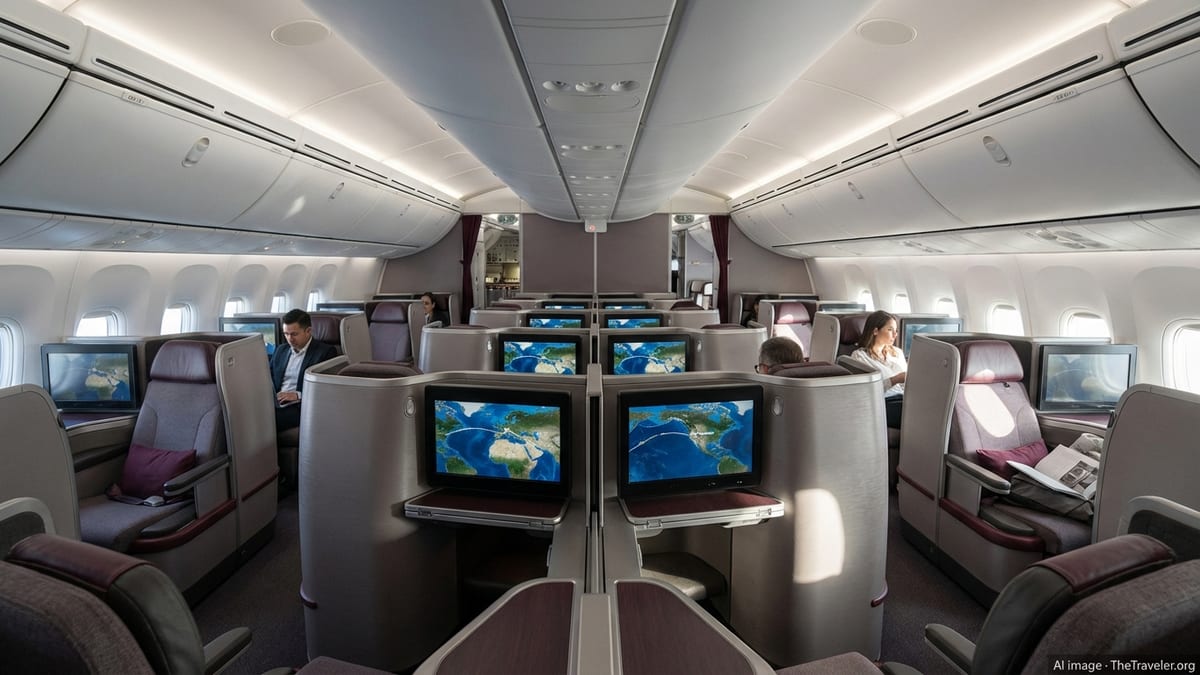
Qatar Airways’ Qsuite Sets the Benchmark for 2026
For nearly a decade, Qatar Airways has used its Qsuite product as a calling card, projecting an image of ultra-luxury and privacy usually associated with first class. Fully closing doors, lie-flat beds and the now-famous “quad” configuration that allows four seats to form a private social or meeting space have fundamentally shifted what business class can be. As demand for premium cabins recovers and often surpasses pre-pandemic levels, that template is shaping how competitors design their next wave of seats.
In 2026, the Doha-based carrier is expected to continue leaning on Qsuite as a strategic differentiator across key widebody fleets serving Europe, North America and Asia-Pacific. While the airline has not yet announced a wholesale replacement for Qsuite, industry analysts note that Qatar Airways has quietly refined the product through soft upgrades, from improved bedding and amenity kits to expanded à la carte dining and upgraded connectivity. The result is a business class that still feels modern even as rivals race to catch up.
Qatar Airways has also used its premium cabins to deepen corporate and alliance partnerships, particularly within oneworld, where joint ventures depend on consistent hard products and seamless experiences. With more global firms prioritizing traveler well-being and productivity over marginal cost savings, the airline’s emphasis on privacy, work-friendly spaces and sleep quality is expected to remain central to its pitch in 2026 scheduling and sales campaigns.
Crucially, Qatar Airways’ aggressive investment in lounges, including at its Doha hub, is reinforcing the value proposition of business class as a gate-to-gate experience rather than just a better seat. As competitors unveil new cabins, they are increasingly benchmarking not just against what happens onboard, but against the end-to-end premium journey Qatar Airways has helped define.
Emirates Accelerates a Massive Retrofit Ahead of 2026
In Dubai, Emirates is moving into the next phase of what has become one of the most extensive cabin retrofit programs in commercial aviation. The carrier is preparing to upgrade the interiors of 111 aircraft, including 60 Airbus A380s and 51 Boeing 777s, with work scheduled to ramp up from August 2026. The project is designed to bring a consistent, next-generation look and feel across much of its long-haul fleet, positioning the airline to defend its stronghold in premium travel well into the next decade.
Business class cabins are central to that plan. Emirates is introducing new-generation seating inspired by the Safran designs already installed on its Airbus A350 fleet, aiming for a more private, cocoon-like environment. Features promoted by the airline include refined leather upholstery, upgraded storage, multiple power and charging options and wireless charging pads integrated into side tables. For business travelers used to Emirates’ older angled layouts, the refreshed cabins are expected to feel significantly more contemporary.
Technology is another pillar of the Dubai carrier’s 2026 strategy. Aircraft undergoing retrofit will receive Panasonic’s latest Astrova in-flight entertainment platform, with 4K screens, high dynamic range and spatial audio. Emirates is also rolling out high-speed Starlink Wi-Fi across retrofitted jets, targeting a level of connectivity that allows passengers to work, stream and communicate with fewer compromises than in the past. In effect, the airline is betting that a more immersive, always-on digital experience will be as important to business class customers as fine dining and champagne.
With premium demand strong on trunk routes between Europe, the Middle East, Asia and Africa, Emirates’ retrofit timeline is closely watched by corporate travel managers. The ability to guarantee a consistent, top-tier business product on more aircraft, combined with the airline’s extensive network and joint ventures, could reshape how companies allocate premium budgets across the Gulf’s heavyweight carriers in 2026 and beyond.
Singapore Airlines Prepares a New-Generation Business Suite
Singapore Airlines, long considered one of the industry’s most innovative premium carriers, is preparing to introduce an all-new business class seat beginning in 2026. While the airline has revealed only limited imagery and high-level details, aviation observers who have studied the teasers point to a product closely aligned with Safran’s Unity platform, which is already in service with select Asian flag carriers.
The new cabin is expected to feature all-forward-facing seats in a staggered configuration, ensuring every passenger has direct aisle access. Key elements teased by the airline include sliding privacy doors, significantly taller walls for enhanced seclusion and a bed that reclines fully flat without the flipping mechanism that has characterized earlier Singapore Airlines business class designs. Observers also anticipate upgraded 4K in-flight entertainment screens, wireless charging, USB-C power and Bluetooth audio connectivity as standard.
Singapore Airlines has signaled that the new business class will be progressively retrofitted across its long-haul Airbus A350-900 fleet through 2030, with the first aircraft anticipated around mid-2026. That timeline means 2026 will be a transitional year, with some aircraft offering the carrier’s highly regarded 2013 seat and others debuting the new suite. For frequent flyers, the rollout adds an extra dimension to route and schedule choice as they seek to experience the next-generation cabin as early as possible.
The upgrade comes as Singapore intensifies its broader aviation strategy, including the introduction of a Sustainable Aviation Fuel levy on tickets from 2026 and continued expansion of Changi Airport’s role as a premium transfer hub. For Singapore Airlines, the new business class is not just a cosmetic refresh but a way to align its product with heightened sustainability, connectivity and comfort expectations among high-yield customers.
Cathay Pacific’s Aria Suite Extends to Key Long-Haul Routes
In Hong Kong, Cathay Pacific is banking on its new Aria Suite to re-establish itself as a leading premium carrier after years of disruption. The business class product, initially unveiled in 2024, has already been recognized by industry observers for its blend of privacy, craftsmanship and technology and is now being steadily deployed on retrofitted Boeing 777-300ER aircraft.
The airline recently confirmed that its Aria Suite cabins, along with refreshed premium economy and economy sections, will serve selected flights between Hong Kong and San Francisco from the turn of 2025 and 2026. The San Francisco route marks the first deployment of the Aria-equipped 777 to the United States, adding to a growing network of long-haul destinations already featuring the new seat. For corporate travelers on the transpacific, that shift signals a meaningful upgrade in comfort and privacy.
Each Aria Suite is configured in a 1-2-1 reverse herringbone layout, with high, wraparound walls and sliding doors enclosing each seat. Design features include an 80-inch lie-flat bed, a large 24-inch 4K screen, multiple power outlets and ports, a wireless charging pad and a range of dedicated storage compartments. Cathay has also emphasized softer details, from tactile fabrics and subtle mood lighting to curated artwork in each cabin that nods to Hong Kong’s cultural identity.
The product has drawn particular praise for the way it balances seclusion and social flexibility; center seats include movable dividers that can be lowered for couples or colleagues traveling together, while window seats angle outwards to maximize views and privacy for solo travelers. As more 777s complete retrofit in 2026, Cathay Pacific is expected to position Aria as a cornerstone of its premium relaunch, directly targeting travelers who might otherwise opt for Qatar Airways or Singapore Airlines via alternative hubs.
Japan’s ANA and Asia’s Full-Service Giants Invest in Privacy
Across North Asia, All Nippon Airways is also pressing ahead with premium upgrades that emphasize privacy and a home-like feel. Building on the success of its “The Room” business class on select Boeing 777-300ERs, ANA has been integrating similar suite-style concepts into new widebody deliveries and planned retrofits. Fully closing doors, extra-wide seats and a strong focus on noise reduction aim to transform transpacific and Europe-bound flights into restful, work-capable spaces.
Industry analysts note that ANA’s design language, which favors calm colors, clean lines and intuitive controls, is influencing competitors across the region. For business travelers, the key takeaway is that enclosed or semi-enclosed suites are becoming the norm rather than the exception on flagship routes. Whether flying ANA, JAL, Singapore Airlines, Cathay Pacific or Qatar Airways, passengers increasingly expect a level of privacy that, a decade ago, was largely the domain of first class.
Other regional players are reinforcing the trend. Carriers such as Etihad, flydubai and United have announced or begun rolling out new business class suites with sliding doors, enhanced storage and large-format entertainment screens. While each airline interprets the concept differently, the direction of travel is the same: a competitive focus on personal space, quiet and technological convenience. The cumulative effect is a rapidly rising floor for what constitutes “acceptable” business class on long-haul flights.
As 2026 approaches, this convergence means that individual branding and service differentiation become even more important. Airlines like Qatar Airways, Emirates and Singapore Airlines are therefore pairing hardware upgrades with revised soft products, from multi-course dining and wellness-focused menus to redesigned amenity kits and sleepwear. The most successful carriers will likely be those that can integrate seat, service and digital experience into a cohesive, premium narrative.
Technology, Connectivity and Sustainability Redefine Premium Travel
Beyond seats and suites, the next phase of competition in business class is unfolding around technology and sustainability. High-speed, low-latency connectivity is rapidly evolving from a nice-to-have into a fundamental expectation for premium passengers who want to work, hold video meetings or connect with family in real time. Emirates’ decision to combine its cabin retrofit with the roll-out of Starlink Wi-Fi, for example, reflects how central connectivity has become to the perceived value of a business class ticket.
In-flight entertainment is also undergoing a significant upgrade. Airlines are increasingly installing 4K screens with HDR capabilities, more responsive interfaces and Bluetooth connectivity, allowing travelers to pair their own noise-cancelling headsets. Customizable lighting, temperature controls and seat presets are being integrated into touch panels and mobile apps, giving passengers a level of control closer to what they experience in premium hotel rooms.
At the same time, regulators and governments are nudging airlines to align premium products with environmental targets. Singapore’s forthcoming Sustainable Aviation Fuel levy from 2026 is one example of policy shaping the economics of air travel, especially on long-haul routes operated by Singapore Airlines and its rivals. While the additional charge per ticket is modest relative to the overall cost of a business class fare, it signals a broader shift in how sustainability measures are funded and communicated to passengers.
For business class customers, these developments mean that the experience is becoming more transparent and more technologically advanced, but potentially more complex in terms of pricing. Airlines are experimenting with dynamic fares, subscription-style Wi-Fi models and bundled services that package seat, lounge access, connectivity and carbon offsets. In this environment, carriers that can clearly explain the value of their premium offerings are likely to have an edge in the corporate market.
Corporate Buyers and Frequent Flyers Shape the 2026 Landscape
The rapid evolution of business class cabins is being driven not only by airline ambition but also by shifting expectations among corporate travel buyers and high-frequency flyers. After the pandemic, many companies recalibrated their travel policies, prioritizing fewer but more productive trips, and in some cases allowing premium cabin bookings on longer sectors to reduce traveler fatigue and burnout. That shift has made the quality of business class seats a boardroom concern rather than a niche enthusiast topic.
Travel managers report that employees increasingly ask for specific products like Qatar Airways’ Qsuite, Cathay Pacific’s Aria Suite or ANA’s enclosed “Room” when booking, mirroring how hotel guests seek out particular room types or brands. In response, airlines are highlighting aircraft type and cabin generation more prominently in booking interfaces and marketing materials, and are racing to standardize their best products across as many key routes as possible by 2026.
Loyalty programs are also playing a role in shaping the market. Enhanced status tiers, milestone benefits and new redemption options are being used to steer high-value customers toward particular carriers and alliances. Singapore Airlines’ adjustments to its KrisFlyer program, along with Qatar Airways’ continued push to integrate with oneworld partners, are examples of how soft benefits are being tuned to sit alongside investments in hard product.
For travelers, the upshot is both opportunity and complexity. The 2026 business class landscape will be richer and more competitive than ever, but understanding which flights feature which cabins, and how those experiences compare, will require more research and savvy than in the past. What is clear, however, is that Qatar Airways and its peers in Singapore, Dubai, Hong Kong and Tokyo are locked in a high-stakes contest to redefine premium travel above the clouds, raising the bar for comfort, privacy and luxury worldwide.