

More news on this day
Qatar Airways is cutting a swathe of London–Doha flights into the first half of 2026, shrinking capacity at Heathrow and Gatwick just as travellers start planning peak summer trips between the UK, Qatar and onward destinations across Asia, Africa and Australia.
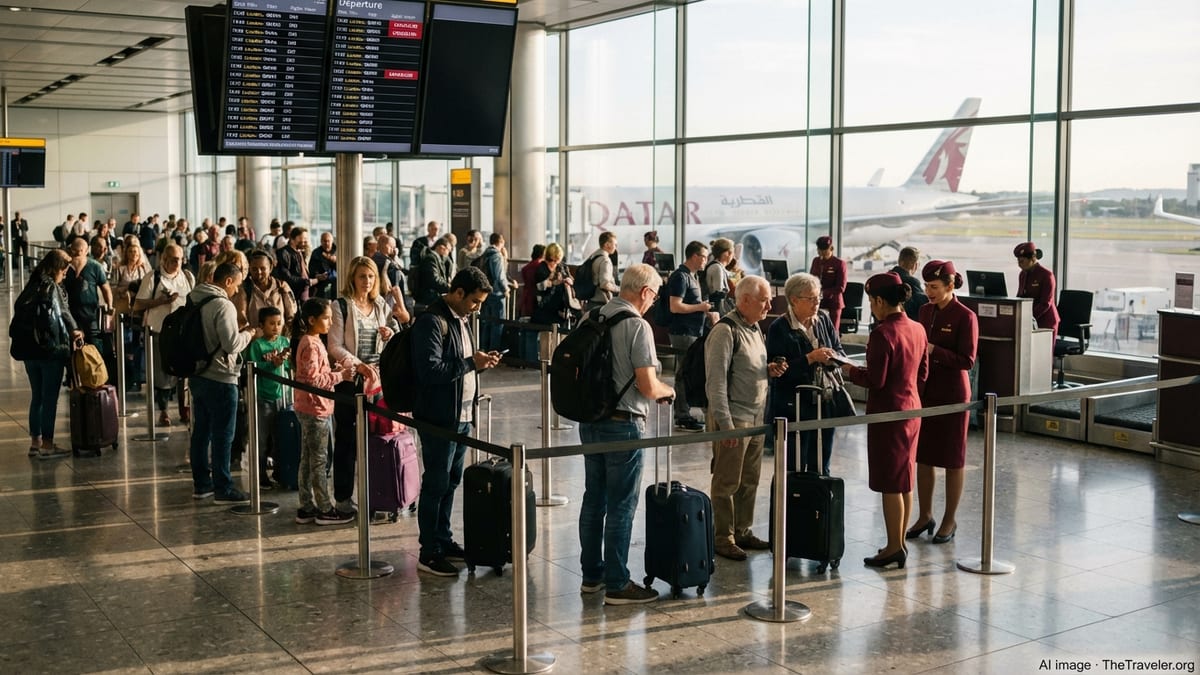
Spring 2026 Flight Reductions Hit London–Doha Corridor
Qatar Airways has filed significant schedule changes for its London operation in the April to June 2026 period, reducing the number of flights linking the UK capital with Doha. Industry timetable data shows that more than 130 departures originally planned from London to Qatar have been removed from the spring schedule, affecting both Heathrow and Gatwick. The move marks one of the most visible capacity cuts on a flagship trunk route in the airline’s recent history.
From early May, Heathrow will see weekly Qatar Airways departures pared back from close to 60 to the high 40s, while Gatwick will lose a number of rotations as its previously advertised double-daily pattern is thinned out. In total, analysts estimate that the carrier’s London departures during some weeks of late spring will be down by around 15 percent compared with initial filings, squeezing seat availability at a time when leisure and business demand is steadily recovering.
The cuts are part of a broader recalibration of Qatar Airways’ network as it moves from the post‑pandemic rebound phase into a more measured growth strategy. With aircraft utilisation high and competition intensifying on Europe–Gulf–Asia flows, the airline is selectively trimming capacity on routes where it believes frequencies overshoot demand or where alliance and codeshare partners can pick up some of the slack.
Heathrow Travellers Face Fewer Choices, Tighter Seating
For Heathrow passengers, the most immediate impact is a slimmer timetable to and from Doha. Qatar Airways, which in recent seasons has operated up to ten daily departures from Heathrow using a mix of Airbus A380s, A350s and Boeing 777s, will temporarily pull back some flights in the late spring 2026 window. While the carrier will still offer multiple daily options, particularly at peak times, the overall pattern becomes less forgiving for travellers seeking specific departure times.
Fewer flights translate into tighter seat availability, particularly in premium cabins that have been in strong demand from corporate accounts and affluent leisure customers. Travel agents in London report that some popular overnight services to Doha are already showing limited award and discount inventory for late spring and early summer dates, with higher fares emerging on remaining seats. With British Airways also operating Heathrow–Doha services under their partnership, some passengers may find themselves rebooked onto BA metal if their original Qatar Airways flight is withdrawn.
The experience on the ground at Heathrow may also change subtly. With slightly fewer Qatar Airways departures, the airline has more scope to consolidate check‑in counters and fine‑tune staff deployment, but busy early morning and late‑evening peaks are expected to remain crowded. Heathrow itself continues to operate close to its declared capacity, meaning that any freed‑up slots from Qatar Airways are likely to be reallocated quickly, possibly to British Airways or other long‑haul carriers, so the overall terminal congestion passengers experience is unlikely to ease.
Gatwick Cuts Underscore Shift in London Strategy
Gatwick, where Qatar Airways has built up a steady following among price‑sensitive long‑haul travellers, is seeing a more visible trim. The Doha service, which in previous seasons often operated twice daily, is being reduced to 11 flights a week in 2026, breaking the clean double‑daily pattern. Instead of two flights every day, the schedule spreads those 11 rotations across the week, preserving daytime flights on select days while dropping some less‑performing overnight sectors.
The change signals a strategic choice by Qatar Airways to concentrate its highest‑value capacity at Heathrow while using Gatwick as a flexible overflow and price‑led alternative. Aviation analysts note that the airline increasingly treats Gatwick as a tactical station, adjusting frequencies in response to specific demand swings, aircraft availability and competitive moves from rival Gulf and European carriers. The 2026 reductions therefore look more like targeted pruning than a retreat from the airport.
For passengers south of London and along the Sussex coast, the reduction means fewer non‑stop options to Doha without the need to cross the city to Heathrow. Some travellers are likely to be nudged toward connecting itineraries via European hubs or into British Airways and Qatar Airways joint services from Heathrow. Others may pivot to competing one‑stop offerings via Dubai or Abu Dhabi, where rival airlines continue to court UK travellers with high frequencies and aggressive pricing.
Doha Hub Connectivity Tightens Ahead of Busy Summer
The London cuts are being implemented just as Doha prepares for another busy year as a global transfer hub, with a packed calendar of sporting and business events drawing visitors to Qatar in 2026. Hamad International Airport has positioned itself as a key gateway linking Europe to the Indian subcontinent, Southeast Asia and Australasia, and London has long been one of its most important feeder markets.
With fewer nonstop flights from Heathrow and Gatwick in parts of spring and early summer, some itineraries that once offered multiple daily connection options via Doha will now narrow to fewer viable combinations. Travellers aiming to link London with destinations such as Bangkok, Manila, Johannesburg or Sydney through a short layover in Qatar may find that preferred connection windows disappear, replaced by longer waits or midnight transits.
Qatar Airways is attempting to mitigate the impact by fine‑tuning departure and arrival times so that surviving London flights still plug efficiently into banked waves of onward connections. Industry observers say the airline is leveraging its broad European network to backfill lost capacity as well, encouraging travellers from the UK regions to route via other European cities that retain robust Doha frequencies. Even so, the 2026 adjustment underscores the delicate balance Gulf hub carriers must strike between maintaining global connectivity and protecting yields.
Passengers Confront Rebookings, Fare Pressure and Longer Journeys
For individual travellers, the schedule changes are already translating into rebookings and altered plans. Customers who purchased tickets months in advance on now‑cancelled Qatar Airways departures are receiving updated itineraries that move them to alternative flights on the same day, shift travel by a day, or in some cases place them onto British Airways codeshare services between London and Doha. While aviation regulations and airline policies guarantee rerouting or refunds, the disruption can be particularly painful for those with tight onward connections or fixed event dates.
With capacity thinner on key days, airfare dynamics are also shifting. Analysts expect economy‑class sale fares on remaining peak‑time London–Doha services to become scarcer as summer 2026 approaches, while last‑minute business‑class purchases may climb in price. For some routes beyond Doha, especially heavily trafficked South Asian and African markets, the combination of London flight cuts and strong underlying demand could push passengers to book further in advance or accept less convenient routings via other hubs.
Travel management companies advising corporate clients say contingency planning is becoming essential. Recommendations include locking in critical summer itineraries earlier than usual, holding flexible tickets where budgets allow, and considering alternative gateways such as Manchester or European hubs that maintain generous capacity to the Gulf. Leisure travellers, particularly families aiming for school‑holiday departures, are being urged to double‑check connection times and layover durations when booking through Doha.
Partnership With British Airways Softens the Blow
Underlying the London capacity reshuffle is the deep partnership between Qatar Airways and British Airways through their shared membership in the Oneworld alliance and Qatar Airways’ minority stake in British Airways’ parent, IAG. Industry sources indicate that some Heathrow slots released by Qatar Airways could be operated instead by British Airways, with the two carriers coordinating schedules and fares to preserve overall London–Doha capacity as much as possible.
For travellers, this means that although there are fewer Qatar Airways‑branded flights on certain days, alternative options under the same alliance umbrella remain. Passengers can often earn and redeem the same loyalty currency, retain elite benefits and access similar lounges regardless of whether their trans‑Gulf sector is operated by Qatar Airways or British Airways. The joint network also offers more flexibility for complex multi‑segment itineraries that combine intra‑Europe legs on BA with long‑haul sectors on Qatar Airways.
However, the experience on board can differ meaningfully between the two airlines, particularly in premium cabins where Qatar Airways has built a reputation for its Qsuite business class. Some frequent flyers may therefore seek to avoid downgrades in comfort by selecting itineraries that remain on Qatar Airways aircraft, even if that means adjusting travel dates or accepting less ideal departure times. This preference could further concentrate demand on the remaining Qatar Airways‑operated Heathrow flights, deepening pressure on availability.
Network Rebalancing Reaches Beyond the UK
The London cuts form part of a wider pattern of route adjustments by Qatar Airways heading into the northern summer 2026 season. The carrier has also announced a roughly 30 percent reduction in frequency on its ultra‑long‑haul Doha–San Francisco route, which will move from daily to five weekly flights. In Europe, cities such as Venice and selected secondary markets are seeing capacity trimmed, while the airline adds codeshares and grows connectivity through partners to maintain global reach.
Qatar Airways’ leadership has signalled that the period of rapid, capacity‑led expansion is giving way to a more disciplined phase focused on profitability and service quality. With Hamad International Airport operating near its practical limits and new aircraft arriving more slowly than during earlier growth spurts, the airline is prioritising routes and schedules that deliver strong yields. That calculus is feeding into decisions about how many seats to deploy from London, even though the UK remains one of its largest and most lucrative markets.
At the same time, the competitive environment is evolving. Rival Gulf carriers are pressing ahead with fleet and network growth, while European airlines push regulators to scrutinise open‑skies agreements with Qatar. Against that backdrop, Qatar Airways’ London cuts can be seen as both a tactical response to short‑term demand signals and a strategic experiment in leveraging partnerships and connections to do more with slightly less capacity on the ground in the UK.
What London and Doha Travellers Should Do Now
For travellers who have already booked Qatar Airways itineraries between London and Doha for spring and early summer 2026, the first step is to monitor reservations closely. Any schedule changes filed by the airline should trigger notifications and updated e‑tickets, but passengers are advised to log into their booking profiles to confirm dates, times and connection windows. Those connecting onward via Doha should pay particular attention to minimum connection times, overnight stays and potential changes to aircraft type.
Prospective travellers still in the planning phase may want to move quickly. With capacity lower than initially expected on the London–Doha corridor, early booking can secure better fares and more convenient timings. When flexibility exists, comparing itineraries across both Heathrow and Gatwick, as well as British Airways‑operated services, will help identify the best combination of price, schedule and onboard experience. Travel advisers also recommend considering alternative departure points such as Manchester or major European hubs if London options prove too constrained.
Ultimately, while the cuts do not signal a withdrawal from London or a loss of Doha’s status as a global hub, they do mark a shift in how Qatar Airways intends to serve one of its most important markets in 2026. For passengers, that means adapting to a slightly leaner timetable, planning further ahead and weighing the trade‑offs between convenience, cost and comfort when choosing how to cross between the UK, Qatar and the wider world.