

More news on this day
Qatar Airways is preparing a significant step in its phased restart plan, with publicly available schedules indicating 41 confirmed flights on March 28, 2026, and additional services restoring connectivity to at least 33 more destinations by April 15 as the carrier rebuilds its global network after weeks of war-related disruption in Middle Eastern airspace.
Get the latest news straight to your inbox!
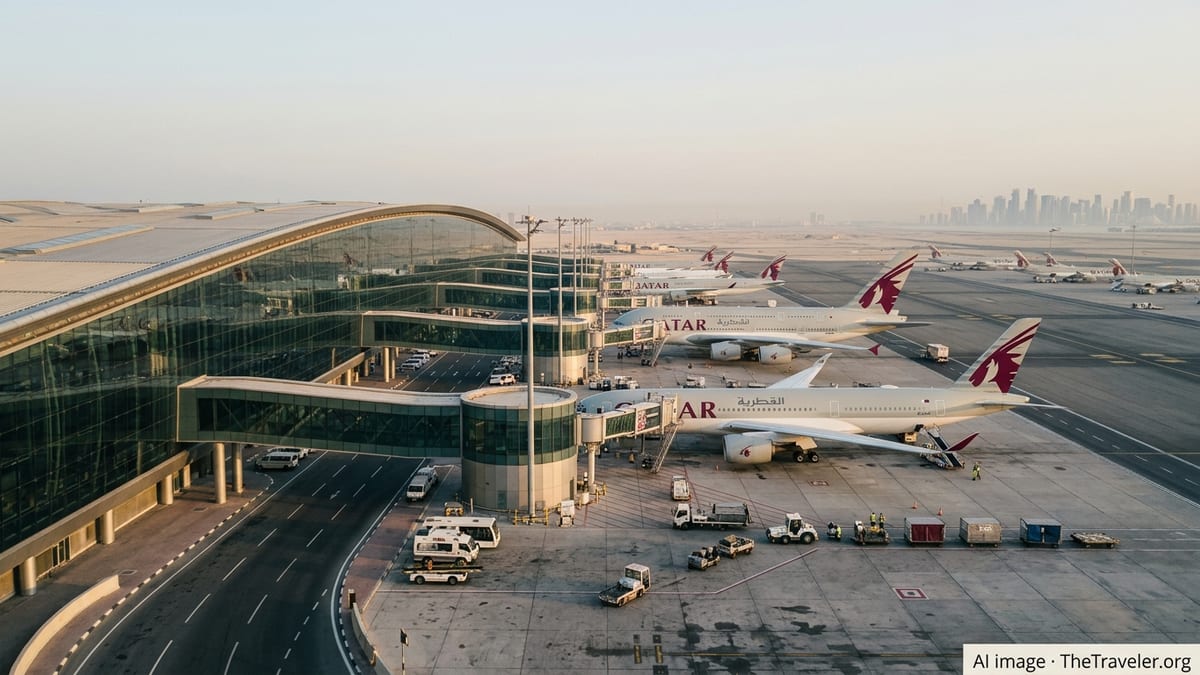
From Grounding to Gradual Reopening of Qatar’s Hub
The carrier’s limited March schedule follows the shutdown of Qatari airspace after the escalation of the Iran conflict in late February, which effectively halted regular operations through Doha and left hundreds of thousands of travelers across the region scrambling to reroute or delay journeys. Industry data shows that flights through major Gulf hubs fell sharply as airlines suspended services or diverted around conflict zones to comply with new airspace restrictions.
Service updates released in early March outlined a temporary suspension of most Qatar Airways passenger flights, followed by a carefully controlled restart framed as an “interim schedule” once selected air corridors were cleared. The airline has used these safe corridors to operate a small but growing set of services, focusing first on essential links and repatriation-style routes while continuing to offer flexible rebooking and refunds to affected passengers.
In the days leading up to March 28, published advisories emphasized that the revised schedule would remain “limited” and subject to ongoing review. The date has nonetheless emerged as a target for a more substantial return to operations, signaling a transition from emergency measures to a managed, medium-term network plan.
Travel industry observers note that the timing coincides with ongoing evacuation and rerouting efforts across the wider region, as governments and airlines work to move stranded travelers out of conflict-affected zones and restore at least a baseline level of long-haul connectivity between Europe, Africa and Asia.
Forty-One Confirmed Flights on March 28
Operational documents and booking-system snapshots reviewed by aviation analysts point to 41 Qatar Airways flights scheduled to operate on March 28, including both departures from and arrivals into Doha’s Hamad International Airport. These flights represent a curated subset of the airline’s pre-crisis schedule, prioritizing routes where aircraft and crew can be positioned safely and where demand for essential travel remains highest.
The 41-flight program appears to concentrate on high-volume trunk routes and key connecting points rather than a broad geographic spread. Long-haul services to major European cities, select North American gateways and a limited number of African and Asian destinations are expected to make up the core of the day’s operations, creating a skeleton hub structure that can support onward connections even with sharply reduced frequencies.
Analysts highlight that this approach reflects a balance between operational caution and the need to re-establish Qatar Airways’ role as a transfer carrier. By focusing on routes that can reliably feed and draw traffic through Doha in both directions, the airline can maximize the usefulness of each flight while minimizing exposure to volatile airspace and sudden regulatory changes.
The March 28 schedule is described as “subject to last-minute adjustment,” a reminder that conflict-related airspace closures or new security advisories could still force further cancellations. Travelers holding bookings on these flights are being urged by travel agents and online advisories to monitor status updates closely in the 24 hours before departure.
Network Rebuild to Reach 33 More Destinations by April 15
Beyond the single-day snapshot of March 28, forward schedules suggest that Qatar Airways is planning a broader network rebuild over the first half of April, reintroducing flights to at least 33 additional destinations by April 15. This expanding list reportedly includes a mix of regional Middle Eastern points, major European capitals, select South Asian cities and a handful of African and Asia-Pacific gateways.
The pattern mirrors earlier, smaller-scale restarts announced for mid-March, when the airline brought back a limited number of services to cities such as Cairo, Johannesburg, São Paulo, New York, London, Frankfurt, Madrid and Beijing as part of an interim schedule. Those routes served as early test cases for operating under new restrictions, helping to refine flight-planning choices and airport handling procedures before scaling up to a larger roster of destinations.
By mid-April, the aim is not a full return to Qatar Airways’ pre-crisis global footprint but rather a workable matrix of routes that reconnects major population centers and transit markets while allowing for tactical increases or cutbacks. Aviation specialists expect some destinations to see only a few weekly flights at first, with frequencies adjusted in line with evolving demand, aircraft availability and regulatory conditions.
Publicly available information from airport schedules and travel distribution systems indicates that many of these returning routes are being loaded into inventory with short booking windows, sometimes only a few weeks ahead. This strategy helps the airline retain flexibility in the event that airspace conditions deteriorate again or that additional security constraints are imposed on particular regions.
What the Restart Means for Stranded and Future Travelers
For travelers who have been stranded by the sudden collapse of Middle Eastern air connectivity, the 41 flights on March 28 and the subsequent ramp-up through April 15 offer a clearer path home or onward. Many passengers holding tickets for travel dates between late February and late March have already been offered voluntary changes or refunds, and the gradual restoration of services should increase the range of viable rebooking options.
Advisories circulating in the travel trade emphasize that ticket holders may be able to shift journeys forward into the April window at no additional charge, provided that revised dates fall within specific eligibility periods and that the new flights are operated by Qatar Airways on its own network. This flexibility has been framed as a key part of the airline’s response to the crisis, giving passengers more control over timing while the carrier works to rebuild its schedule.
Looking ahead, the reintroduction of 33 destinations by mid-April is expected to ease capacity constraints on some of the busiest Europe to Asia and Africa to Asia corridors, which have faced acute pressure due to detours around closed airspace and the temporary loss of key hub airports. However, travel experts caution that fares on many of these routes may remain elevated in the near term, reflecting both operational complexity and pent-up demand.
Travelers planning new trips that rely on connections through Doha are being encouraged by industry advisories to build in longer layovers, consider flexible or refundable fares and stay alert to schedule changes as the situation in the region continues to unfold. While the March 28 milestone and the April expansion signal meaningful progress for Qatar Airways, the broader operating environment remains fragile.
Competitive and Regional Implications in a Volatile Market
The measured return of Qatar Airways has broader implications for competition among Gulf carriers and for global network planning. With multiple airlines in the region forced to cut or reroute services during the Iran conflict, long-haul capacity between Europe, Africa and Asia has been reshaped, at least temporarily, and travelers have increasingly turned to alternative routings via non-Gulf hubs.
As Qatar Airways brings back 41 flights in a single day and grows to dozens more destinations by mid-April, analysts say the carrier is likely to recapture a share of connecting traffic that has been spilling over to rivals in Turkey, Europe and South Asia. The extent of that recovery will depend not only on safety and reliability perceptions but also on how quickly other Gulf carriers are able to restore their own operations.
Within Qatar, the restart is also seen as an important step for Hamad International Airport, which has built its reputation on high volumes of connecting passengers and efficient short transfers. A more robust Qatar Airways schedule supports airport utilization, retail and hospitality activity in the terminal, and the broader tourism push that includes sporting events and cultural festivals scheduled in Doha through 2026.
Still, industry commentary underscores that any forecast for the region’s aviation rebound is highly conditional. Continued military activity, shifting government advisories and the possibility of renewed airspace restrictions could yet force Qatar Airways and its competitors to revise their plans. For now, the 41 confirmed flights on March 28 and the planned addition of 33 more destinations by April 15 represent a cautiously optimistic roadmap rather than a guaranteed return to business as usual.