

More news on this day
Qatar Airways has introduced a broad temporary flexibility policy for passengers whose travel plans have been upended by the 2026 airspace closures and security-related disruption across Qatar, offering complimentary date changes or the option of a full refund for affected tickets.
Get the latest news straight to your inbox!
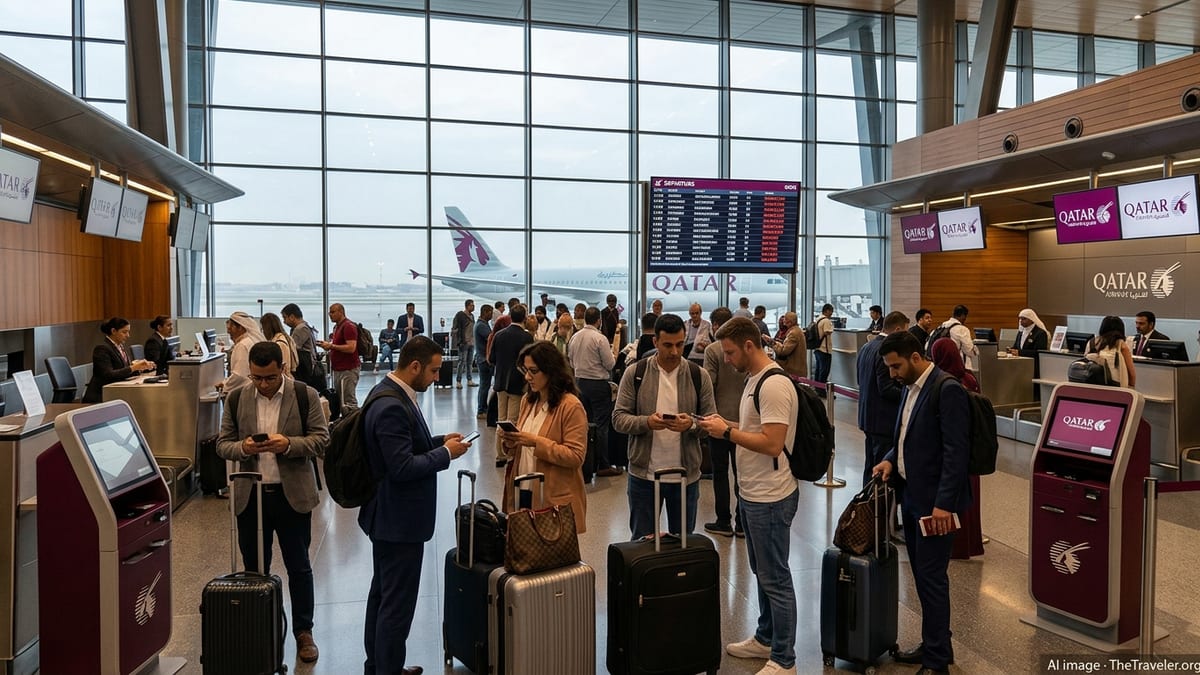
New Flexibility for Travelers Caught in 2026 Disruptions
Publicly available guidance from Qatar Airways and agency advisories indicates that the airline has activated a wide-ranging disruption policy tied to the sudden closure of Qatari airspace from 28 February 2026 and the subsequent suspension of regular commercial operations at Doha’s Hamad International Airport. As a result, many passengers with near-term departures have found their itineraries cancelled or heavily modified.
The airline’s updated disruption waivers, shared through trade portals and customer communications, state that customers with confirmed bookings during defined impact windows in late February and March 2026 can choose between complimentary date changes within a set period or a refund of the unused value of their ticket. Initial advisories referenced travel dates between 28 February and 6 March, before later extensions widened the eligible date range.
Recent documentation circulated to travel agents and reposted by travelers shows that the policy has gradually expanded to cover bookings with travel dates at least up to 22 March 2026, with some customer-facing materials now referring to flexibility for trips through 30 April under a “Journey with Confidence” framework. Reports suggest that the conditions remain broadly similar across these extensions, even as the validity period has been repeatedly updated.
The move places Qatar Airways among the more flexible full-service carriers responding to the latest Middle East security crisis, which has disrupted both regional and long-haul connectivity through Doha, a major global transit hub.
Who Qualifies for Free Date Changes or a Full Refund
Based on travel trade advisories and publicly shared passenger notices, the core of Qatar Airways’ 2026 disruption policy applies to travelers holding confirmed tickets with original travel dates that fall inside specified windows of disruption. For these bookings, the airline is offering at least one complimentary date change, in many cases allowing up to two changes, typically within 14 days of the original departure date, without charging standard change fees.
Within the eligibility window, passengers whose flights have been cancelled or whose journeys are no longer practical due to the airspace closure can alternatively request a refund of the unused value of their ticket. In these cases, refund penalties normally applicable under standard fare rules are being waived, according to information available from trade guidance and customer-facing FAQs. Some travelers report that the airline systems are gradually updating to remove refund fees in line with each new policy extension.
Separate from the disruption-specific waivers, Qatar Airways continues to maintain its regular flexible booking structures, including risk-free changes within 24 hours of ticket purchase and flexibility associated with higher fare classes. However, the 2026 disruption measures go further by temporarily aligning even more restrictive fare types with generous change and refund options, as long as travel dates fall within the stated disruption period.
Travelers booking through online agencies or corporate platforms are being advised by intermediaries to monitor both airline and agency channels, as refunds and rebookings must often be processed via the original point of sale. Reports indicate that, in many cases, tickets issued by third-party agents remain eligible for the same waivers, but processing times can vary.
Operational Context: Airspace Closure and Limited Repatriation Flights
The expanded flexibility comes against the backdrop of security-related tension in the Gulf region and a series of Iranian strikes reported around Qatar in early March 2026, which prompted the temporary closure of Qatari airspace. Civil aviation notices and media coverage describe how regular commercial flights through Doha were suspended, while only a limited number of emergency and repatriation services operated under special authorization.
Updates attributed to the Qatar Civil Aviation Authority indicate that a restricted operating corridor was gradually introduced to allow evacuation and cargo movements, with repatriation flights running on select dates to major European hubs such as London, Paris, Madrid, Rome and Frankfurt. Standard scheduled services, including many long-haul connections, remain curtailed or rerouted, prolonging uncertainty for passengers with itineraries booked months in advance.
This evolving situation has highlighted the importance of flexible ticketing for long-haul travelers who rely on Doha as a transit point between Europe, Africa, Asia and Oceania. With some passengers facing repeated rebookings and rolling extensions of disruption dates, the ability to cancel for a refund or shift travel several days forward or backward has become a critical safeguard.
Analysts following the aviation sector note that crisis-driven waivers of this kind can significantly reduce short-term revenue for airlines, but they also play a key role in preserving customer confidence in using major hubs that may be periodically exposed to geopolitical risk.
Key Details of Qatar Airways’ Temporary Flex Policy
While the precise wording of Qatar Airways’ disruption policy has shifted as new advisories are issued, the structure of the 2026 waivers shows several consistent elements. Passengers with confirmed bookings falling within the disruption window are generally entitled to at least one complimentary date change to another flight within 14 days of the original travel date, subject to seat availability in the same booking class.
Some passenger reports describe offers of up to two free date changes for itineraries between 28 February and mid-March, providing additional flexibility for those uncertain about when normal operations or personal travel plans will stabilize. Where alternative flights are not acceptable or feasible, the airline is allowing refunds of the unused portion of affected tickets, returning funds to the original form of payment rather than limiting compensation to vouchers or travel credits.
Travelers also note that while change fees are being waived under the disruption policy, fare differences may still apply if the rebooked flight is more expensive than the original itinerary. This approach is broadly in line with how many global carriers handle large-scale disruption waivers, balancing customer support with fare integrity on high-demand routes.
Agents and customers are being encouraged through public guidance to use digital self-service tools such as the airline’s “Manage booking” and mobile app functionality where possible. However, complex itineraries, multi-carrier tickets and group bookings may still require manual handling through call centers or travel management companies, especially when seeking full refunds.
What Passengers Should Do Next
For travelers scheduled to fly with Qatar Airways during the affected period in 2026, current guidance across travel forums, agency advisories and airline-facing documentation suggests a few immediate steps. First, passengers should verify whether their travel dates fall within the latest published disruption window, as eligibility for free changes or refunds depends on the original departure date listed on the ticket.
Second, those who wish to keep their travel plans but adjust timing are encouraged to search for alternative dates within the permitted range around their original trip, bearing in mind that availability may be limited on some long-haul routes. Rebooking early within the waiver rules may improve the chances of securing preferred dates and connections.
Third, travelers who no longer wish to undertake their journey, or whose purpose for travel has been overtaken by events, can consider requesting a refund under the disruption waiver rather than a standard voluntary cancellation. Documentation shared online suggests that, when processed correctly under the waiver, these refunds avoid the usual cancellation penalties and return a larger portion of the ticket value.
As the regional situation continues to evolve, observers expect Qatar Airways to keep reviewing its waiver dates and conditions. Passengers with trips scheduled beyond the currently published windows are watching for further updates, as any extension of the disruption period could bring additional cohorts of travelers into scope for complimentary date changes or full refunds.