

More news on this day
Qatar Airways has begun operating a limited relief corridor for repatriation flights out of Doha after days of airspace closures across the Gulf left thousands of travelers stranded in the Qatari capital and beyond.
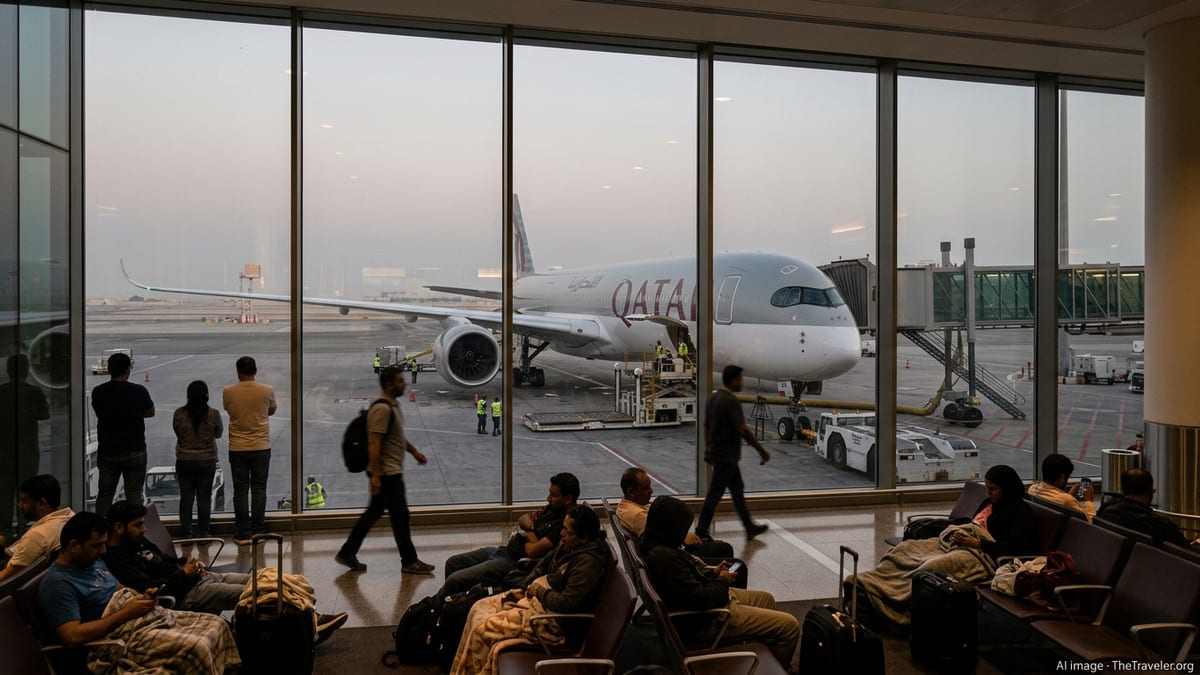
Safe Corridor Launched Amid Regional Airspace Shutdown
The national carrier confirmed on March 7 that it has received temporary authorization from the Qatar Civil Aviation Authority to use a dedicated safe operating corridor from Hamad International Airport. While regular commercial operations remain suspended due to the closure of Qatari airspace, the new corridor allows a narrow window for carefully controlled repatriation services.
Under the initial phase of the plan, Qatar Airways is operating repatriation flights from Doha on March 7 to five major European hubs: London Heathrow, Paris Charles de Gaulle, Madrid Barajas, Rome Fiumicino and Frankfurt. The services are designed to move some of the most urgently affected passengers out of Qatar after nearly a week of cascading cancellations triggered by the widening Iran war and associated airspace restrictions across the region.
Airline officials have stressed that the relief flights do not signal a full reopening of Hamad International Airport or a return to normal schedules. Instead, they are being treated as emergency operations within a tightly controlled air corridor agreed with regulators and air traffic authorities to mitigate the risks posed by nearby conflict zones.
Thousands Stranded as Conflict Disrupts Gulf Aviation Hub
The move comes as Doha, ordinarily one of the world’s busiest connecting hubs, has been transformed into a holding point for displaced travelers. With Qatari airspace closed since the first Iranian strikes earlier in the week, Qatar Airways suspended its global network, stranding passengers in transit hotels and terminals in Doha and in cities across Europe, Asia and Africa where onward sectors were suddenly canceled.
Regional airspace closures and reroutings have rippled far beyond Qatar. Neighboring states have imposed restrictions on overflights, and airlines throughout the Middle East have been forced to ground or divert aircraft. Aviation analysts estimate that hundreds of thousands of passengers have been affected across the wider region, with Qatar Airways among the hardest hit because of its heavy reliance on through-traffic via Doha.
For many travelers, the suspension of normal schedules has meant days of uncertainty with limited options to leave. Governments in Europe, North America and Asia have issued travel advisories urging their citizens to depart affected countries as soon as commercial options become available, increasing pressure on Gulf carriers to find safe pathways out of the region.
Controlled Repatriation and Strict Passenger Prioritisation
Qatar Airways has emphasized that seats on the relief corridor flights cannot be booked through its website, mobile app or travel agents. Instead, the airline is directly contacting eligible passengers whose original journeys were disrupted, assigning them specific flights and providing onward travel instructions. Travelers have been repeatedly urged not to go to the airport unless they have received an official notification confirming their place on a relief service.
According to the airline, priority is being given to passengers with the most urgent needs, including families with young children, elderly travelers and those requiring medical or compassionate travel. Consular missions from several European countries have been working with Qatar Airways to identify vulnerable citizens and coordinate manifests for the limited departures now operating out of Doha.
The carrier has deployed additional staff to designated hotels and customer assistance points in the city to manage queries about repatriation options. Stranded passengers who have already left the airport are being advised to keep their contact details updated in airline profiles and to monitor official communications closely, as seats on each relief flight are being allocated on short notice based on operational and safety criteria.
Inbound Relief Flights to Doha Planned for March 8
Alongside the outbound corridor, Qatar Airways has announced plans to operate a limited number of inbound relief flights to Doha on March 8. These services, which also fall under the temporary safe corridor authorization, are scheduled from London, Paris, Madrid, Rome and Frankfurt, with an additional service from Bangkok designed to bring stranded passengers and residents back to Qatar.
Like the outbound operations, these inbound flights are strictly controlled and are not open for regular sale. The airline is again contacting passengers directly, focusing on those whose original itineraries were interrupted when the airspace closure came into effect. Officials say the goal is to gradually reduce the number of travelers stuck mid-journey while avoiding congestion at Hamad International Airport.
Aviation observers note that the two way use of the safe corridor allows Qatar Airways to reposition aircraft and crew while also facilitating repatriation in both directions. However, they caution that the limited scale of operations means many travelers will still face days of disruption until a broader reopening of airspace is authorized by Qatari and regional authorities.
Uncertain Timelines for Full Reopening of Doha Airspace
Despite the launch of the relief corridor, there is still no confirmed timeline for the full resumption of scheduled flights to and from Doha. Qatar’s regulators are proceeding cautiously amid ongoing security concerns, even as pressure grows from travelers, foreign governments and the global aviation industry to restore one of the Gulf’s key transit nodes.
Officials have framed the current measures as an incremental step toward normality rather than a definitive turning point. The safe corridor is being continuously evaluated based on regional security assessments and coordination with neighboring air navigation authorities. Any expansion of destinations or frequencies is expected to depend on further regulatory approvals and a sustained improvement in the security environment.
For now, Qatar Airways is signaling that its network will remain in emergency mode for at least the coming days. The airline continues to advise customers not currently identified for relief flights to refrain from traveling to the airport and to rely only on official communications channels for updates. Until wider airspace access is restored, the new corridor offers a narrow but critical lifeline for a fraction of the thousands still waiting to get home.