

More news on this day
Qatar Airways is temporarily reducing the number of aircraft it keeps in active service and moving part of its fleet into long-term storage facilities in Spain, as the latest escalation in the Middle East injects fresh uncertainty into global travel demand and forces airlines to reassess capacity plans.
Get the latest news straight to your inbox!
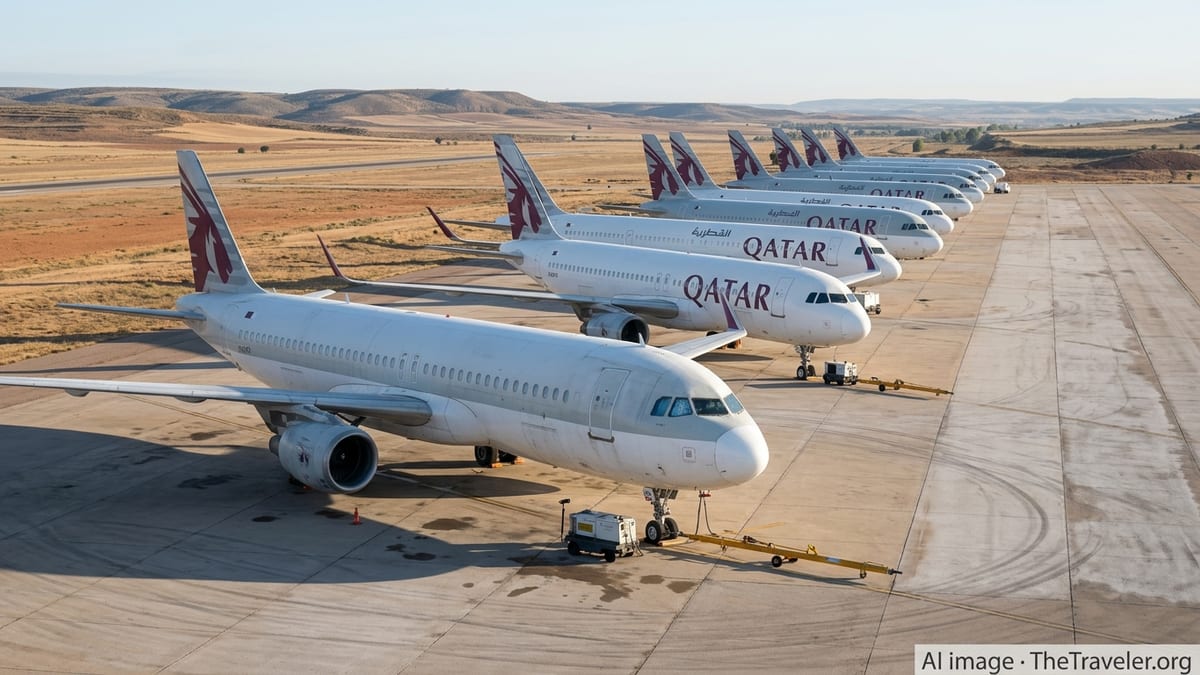
Safeguarding Aircraft Far From the Front Line
Publicly available information indicates that several Qatar Airways jets have recently been repositioned from Doha to storage and maintenance facilities in Spain, with a particular focus on Teruel Airport in Aragón. The inland site, known for its dry climate and extensive apron space, has developed into a major European hub for long-term aircraft parking and heavy maintenance, making it an attractive option for carriers seeking to protect assets from regional risk.
Spanish media reports describe Teruel as acting as a safe refuge for aircraft from Gulf-based airlines amid the latest phase of the Middle East crisis, highlighting Qatar Airways among the operators making use of the site. Local coverage notes that the airport has a track record of serving as a storage location during previous downturns and shocks to aviation demand, including the pandemic years, and is now again seeing increased arrivals from the region.
By stationing aircraft thousands of kilometers away from the core conflict zones, Qatar Airways is effectively insulating part of its fleet from potential disruptions tied to airspace closures, missile activity and fuel supply risks. The strategy also provides operational flexibility, allowing the airline to reactivate stored jets more quickly if security conditions and demand on key long haul routes improve.
Industry analysts point out that the use of Spanish storage facilities by Gulf carriers underscores how deeply interconnected the global aviation system has become. Decisions shaped by security concerns in the Gulf now directly influence activity at regional airports in Europe, which in turn benefit from parking fees, engineering work and associated economic activity.
Capacity Cuts Amid Volatile Demand
The relocation of aircraft to long-term storage comes as the latest Middle East crisis disrupts airspace and triggers significant schedule changes across the region. Recent attacks and retaliatory strikes involving Iran and Gulf states have led to temporary airspace closures, reroutings and widespread cancellations affecting major hubs such as Doha, Dubai and Abu Dhabi. Aviation data providers estimate that tens of thousands of passengers have been impacted on peak days, with knock-on effects spreading to Europe, Asia and Africa.
Qatar Airways, which relies heavily on its Doha hub to feed connecting traffic between continents, is particularly exposed when traffic flows through the Gulf are interrupted. Reports indicate that the airline has trimmed frequencies on select regional and long haul routes, consolidating services where demand has softened and where overflight restrictions have made operations less efficient or commercially viable.
The decision to park aircraft for an extended period rather than keeping them flying at low load factors points to a deliberate effort to protect yields and manage costs. Keeping widebody jets in the air with weak demand can quickly erode margins, especially at a time of elevated fuel prices and additional expenses tied to longer routings that avoid conflict zones. Storage, while not cost free, allows the carrier to align its active capacity more closely with realistic booking patterns.
Prior to the latest escalation, Qatar Airways had been reporting strong financial results and robust demand growth, helped by its position as a connecting hub between Europe, Asia and Africa. The current cutbacks are therefore being interpreted by aviation observers as a tactical response to a specific geopolitical shock rather than a reversal of the airline’s longer term growth ambitions.
Teruel’s Growing Role in Global Fleet Management
The increased presence of Qatar Airways aircraft in Spain also shines a spotlight on Teruel Airport’s evolving role in global fleet management. Located at high altitude with low humidity, Teruel offers conditions that are well suited to aircraft preservation, including slower corrosion rates and ample open space for parking. Over the past decade it has emerged as a key European node for storage, maintenance and end-of-life disassembly of commercial jets.
Operators typically place aircraft into long-term storage when they expect a significant period of underutilization but wish to retain the option of reactivating the jets at relatively short notice. The process involves detailed preservation work, from sealing openings and protecting engines to regular inspection cycles that keep airframes and systems within manufacturer tolerances. For a global carrier such as Qatar Airways, concentrating parked aircraft at a specialist site simplifies this technical workload.
Local authorities in Aragón have highlighted in recent coverage that Teruel has repeatedly acted as a refuge for aircraft in times of crisis, from economic downturns to the pandemic and now renewed geopolitical turmoil. Airlines from the Gulf, including Qatar Airways, are described as long-standing clients of the facility, reflecting ongoing demand for a European base that can support both storage and heavy maintenance needs.
The current influx of Middle Eastern aircraft is expected to bring additional work for engineering firms and service providers based at the airport. At the same time, the visibility of Qatar Airways livery on the Teruel apron offers a visual reminder to local communities of how distant geopolitical events can translate into tangible economic activity in a relatively remote corner of Spain.
Implications for Travelers and Global Connectivity
For passengers, the most immediate impact of Qatar Airways’ fleet adjustment is being felt in the form of altered schedules, longer journey times and, in some cases, suspended routes. Travelers connecting through Doha are facing more frequent rebookings as the airline consolidates flights and prioritizes higher demand markets. Travel industry reports suggest that flexible tickets and the ability to reroute via alternative hubs have become more important as the situation evolves.
At a network level, the temporary reduction in active aircraft limits the number of frequencies and destinations that Qatar Airways can offer at short notice. This may reduce competitive pressure on some routes, potentially affecting pricing and seat availability, particularly during peak travel periods. Other global carriers that would normally rely on overflying the Gulf are also adjusting, which compounds the overall squeeze on capacity between Europe, the Middle East and parts of Asia.
Nevertheless, experts note that the airline’s decision to store, rather than retire, aircraft signals an expectation that demand will eventually rebound once a measure of stability returns to the region. Stored jets can be progressively returned to service, allowing Qatar Airways to rebuild connectivity and restore frequencies as conditions permit. For frequent travelers and corporate clients, the key variable will be the duration and intensity of the crisis rather than the temporary capacity cuts themselves.
Travel insurers, corporate travel managers and tour operators are closely monitoring developments, updating risk assessments and advising customers on the most resilient routing options. The situation underscores how geopolitical events can quickly alter the calculus for long haul travel, even when origin and destination markets lie far from the immediate conflict zone.
A Test of Resilience for Gulf Aviation
The decision by Qatar Airways to scale back its active fleet and move aircraft into storage in Spain is being watched closely as a bellwether for the wider Gulf aviation sector. Carriers based in the region have built their business models on high connectivity and rapid growth, leveraging their geographic position between major population centers. A prolonged period of airspace disruptions and security concerns would challenge these assumptions and could accelerate a shift toward more cautious capacity planning.
Regional peers are facing similar dilemmas as they weigh the costs of maintaining pre-crisis schedules against the reality of fluctuating demand and elevated operational risk. Some have introduced temporary suspensions on select routes, while others are focusing on retaining core trunk services and deferring planned expansions. The mix of strategies reflects differing risk appetites, financial buffers and fleet profiles.
For Qatar Airways, the current measures form part of a broader effort to navigate an environment marked by geopolitical volatility, inflationary pressures and evolving passenger behavior. The airline must balance its reputation for extensive global coverage with the need to preserve financial strength and operational resilience. Parking aircraft in Spain and trimming schedules, though highly visible steps, fit within a pattern of tactical adjustments that large carriers have used in past crises.
How quickly those jets return from the dry air of Teruel to the busy ramps of Doha will depend on the trajectory of the Middle East crisis and the speed at which travelers regain confidence in transiting the region. Until then, the sight of Qatar Airways aircraft lined up on Spanish concrete will stand as one of the clearest symbols of how distant conflicts can reshape the global map of commercial aviation, at least for a time.