

More news on this day
Qatar Airways is accelerating a sweeping restoration of its global network, reconnecting more than seventy destinations and reasserting Doha’s role as a critical hub in the Middle East’s aviation recovery following recent disruptions.
Get the latest news straight to your inbox!
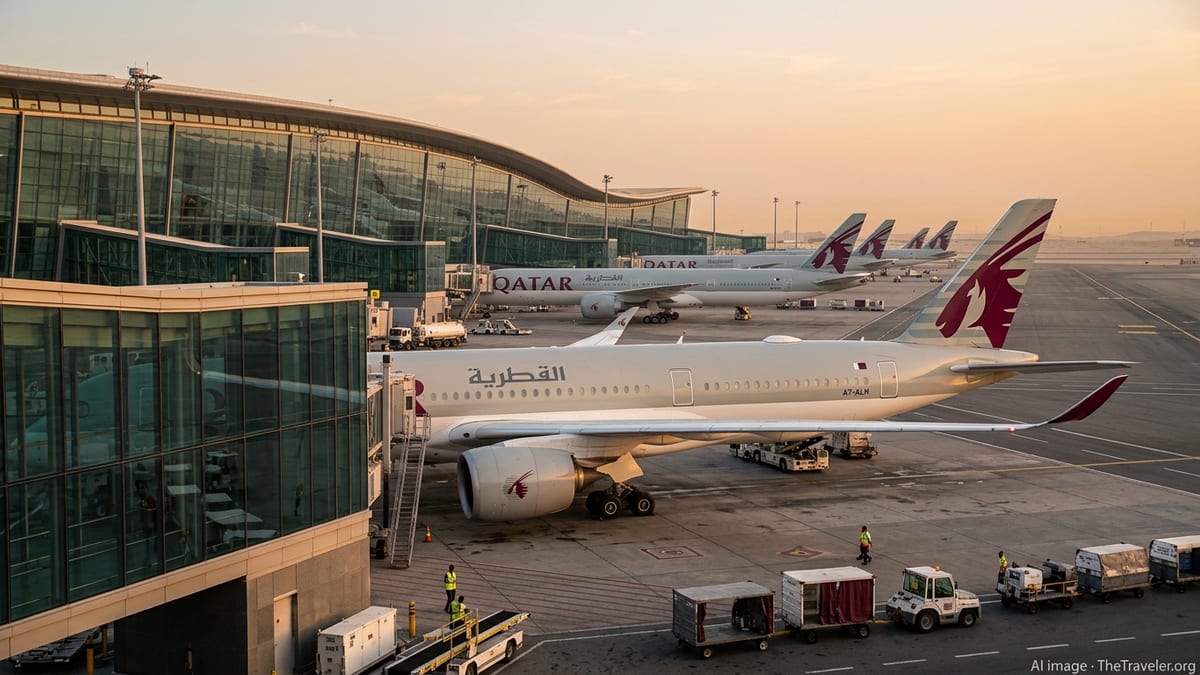
A Strategic Reboot of a Global Network
Publicly available information from Qatar Airways’ recent network updates and annual reporting indicates that the carrier has rapidly rebuilt its schedule from a sharply reduced operation to a network once again spanning dozens of cities across Europe, Asia, Africa, the Americas and the Middle East. From the early pandemic low point, when only a few dozen routes remained active, the airline has progressively restored services to well over seventy destinations and continues to move toward pre-crisis coverage.
The phased rebuild has involved careful matching of capacity with evolving demand and airspace constraints. Earlier recovery plans outlined targets of more than 50 destinations by late spring and as many as 80 by early summer in the initial phases of global reopening, setting the template for the current comeback. Since then, successive schedule expansions have seen frequencies increased on core trunk routes and additional cities brought back into the fold as conditions allowed.
Today, Qatar Airways’ network is again anchored by a ring of long haul routes linking Doha to major hubs such as London, Frankfurt, New York and São Paulo, alongside key regional gateways in the Gulf, North Africa and South Asia. The scale and speed of this rebuild have positioned the airline as one of the first Middle Eastern carriers to re-establish extensive intercontinental connectivity at a time when many competitors are still operating below historic capacity.
Doha’s Hub Reclaims Its Connector Role
Hamad International Airport in Doha, consistently ranked among the leading airports in the Middle East, has been central to the carrier’s renewed push. Passenger traffic and schedule data show that as Qatar Airways has restored flights, the airport has resumed its role as a major transfer point linking Europe and the Americas with Asia, Africa and Oceania.
The hub model has allowed the airline to reassemble a complex web of one-stop itineraries even as some point-to-point markets remain constrained. By funnelling traffic through Doha, Qatar Airways can serve thinner routes with fewer direct passengers, using connecting demand to sustain operations while markets recover. This strategy proved vital during the pandemic and is again underpinning the current phase of recovery after regional disruptions.
Airport expansion works completed in recent years, including upgraded concourses and expanded terminal space, have given the carrier additional flexibility to manage fluctuating passenger flows. Reports on airport performance indicate that facilities such as transit lounges, security lanes and boarding gates have been operating at increasing utilization levels as more destinations return to the network, without the severe congestion that has challenged some rival hubs.
Reconnecting Key Regions Amid Shifting Geopolitics
Schedule filings and industry coverage show that Qatar Airways’ comeback has not been limited to restoring its pre-crisis map. The airline has also focused on strategically important markets where connectivity is essential for trade, labor mobility and tourism. Recent expansions in Saudi Arabia, for example, have lifted the number of destinations served in the kingdom into double digits, including newer points such as Red Sea International Airport alongside established cities like Riyadh, Jeddah and Dammam.
In parallel, the carrier has worked to re-establish full services to politically sensitive markets in Iraq, Syria, Lebanon and Jordan, according to regional aviation reporting. These routes support significant flows of workers, students and visiting family, as well as niche tourism segments, and their restoration has been viewed by analysts as a marker of broader regional normalization.
The recovery has unfolded against a complex geopolitical backdrop, including temporary airspace and corridor restrictions affecting parts of the Gulf. Publicly available flight tracking and regulatory updates indicate that Qatar Airways has responded with interim routings, selective use of alternative airports and limited repatriation services, while planning a staged return to full commercial schedules. The carrier’s ability to keep a skeleton network in place during periods of disruption has made it easier to scale back up quickly once conditions improve.
Competitive Positioning in the Middle East Recovery
As Middle Eastern aviation emerges from multiple overlapping shocks, industry analysts note that Qatar Airways has used the recovery to reinforce its competitive standing against regional rivals. Financial disclosures and independent analysis highlight that the airline has regained market share on some key corridors, supported by strong demand from both leisure and corporate travelers once border and testing restrictions eased.
Compared with some Gulf competitors that grounded large portions of their fleets for extended periods, Qatar Airways maintained a higher proportion of active aircraft and routes through the downturn. This continuity has been cited in trade publications as a factor in the airline’s swift rebound, helping it retain brand visibility and customer loyalty among passengers who needed to travel even at the height of disruption.
The restored network also supports the broader economic ambitions of Qatar, from tourism growth beyond the 2022 FIFA World Cup to ongoing infrastructure and energy projects that rely on efficient air links. With more than seventy destinations now reconnected and further expansions underway, observers see the carrier as both a beneficiary and a driver of the region’s aviation recovery, setting benchmarks for service resumption and network depth.
Looking Ahead: From Recovery to Growth
Recent annual reports and forward-looking statements from the group outline a shift in emphasis from pure recovery to calibrated growth. Capacity on high-demand routes is being increased, partnerships with other carriers are being deepened, and the fleet plan is being refined to prioritize fuel-efficient aircraft that can be deployed flexibly across the restored network.
In practice, this means more frequencies on major city pairs, improved connection times through Doha and renewed focus on emerging tourism and business destinations. Analysts expect that as geopolitical constraints ease and additional corridors reopen, Qatar Airways will be positioned to move beyond the seventy-destination recovery threshold toward a broader map exceeding pre-crisis reach, supported by resilient demand for one-stop links between continents.
For travelers, the airline’s bold comeback translates into a growing choice of routes and schedules at a time when global connectivity remains uneven. For the Middle East aviation sector, it underscores how a hub-and-spoke strategy, underpinned by a strong home airport and flexible fleet, can accelerate recovery and restore a region’s role at the heart of international air travel.