

More news on this day
Qatar Airways is gradually reinstating flights to a reported 80 destinations from today, using temporary air corridors through restricted Middle East skies as the regional airspace crisis continues to disrupt normal schedules and force significant capacity cuts.
Get the latest news straight to your inbox!
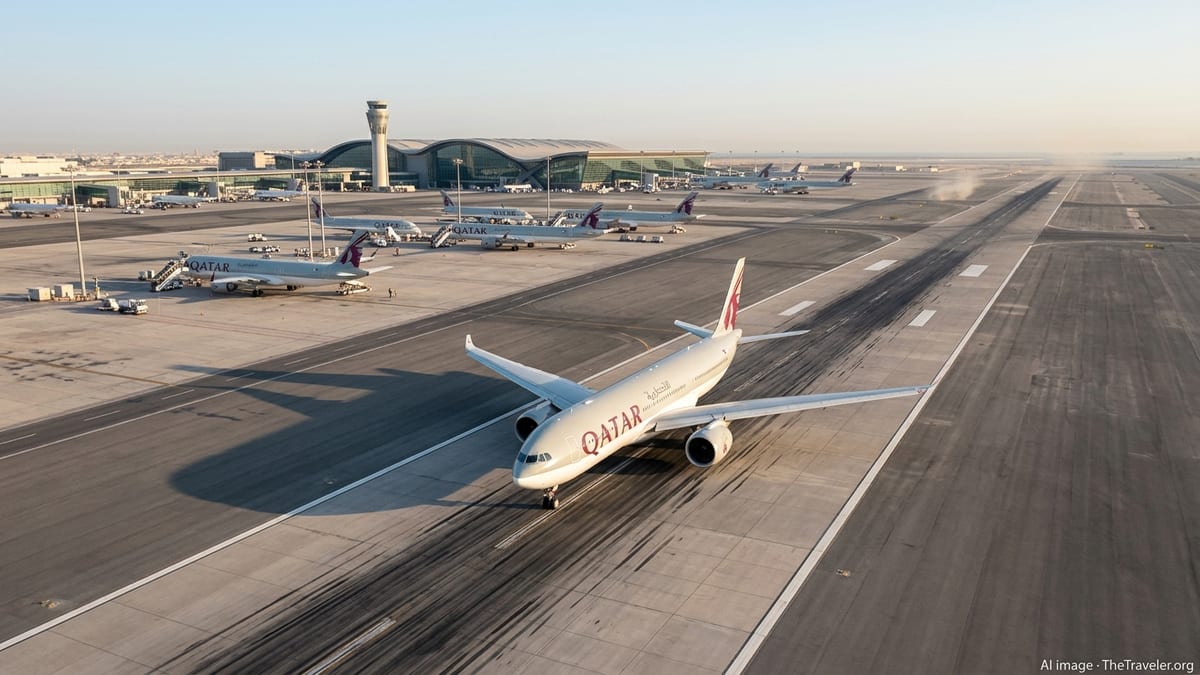
Carefully Managed Restart Through Emergency Corridors
Publicly available operational updates indicate that Qatar Airways has shifted from a near-total suspension of scheduled services to a tightly controlled restart using emergency corridors approved by Qatari aviation authorities. Partial reopening of Qatari airspace has enabled a limited number of departures and arrivals at Hamad International Airport, framed explicitly as an interim network rather than a full restoration of hub operations.
Industry coverage describes the new pattern as a hybrid between relief operations and scheduled flying, with priority given to routes that can be served safely within the constrained airspace structure. Flights are being routed along designated contingency paths that avoid high-risk zones, increasing track length and fuel burn but allowing some connectivity to resume for stranded travelers and essential journeys.
Reports on recent days of operation suggest that the airline is balancing these constraints with pressure to reconnect key long-haul markets. Services toward Europe, North America, Africa and major Asian hubs are among those being reinstated in phases, although frequencies remain far below pre-crisis levels and many city pairs are still suspended or reduced.
Travel advisories continue to emphasize that all movements remain subject to rapid change, with regional security conditions and air navigation notices closely monitored before each wave of departures. Passengers are being directed to check individual flight status rather than rely on historic timetables or previously published seasonal schedules.
Network Rebuild Targets Around Eighty Destinations
According to published schedules and trade-media analysis, the revised Qatar Airways program clusters around approximately 80 destinations worldwide, a sharp reduction from the carrier’s usual reach but a significant expansion on the initial handful of relief flights operated earlier in the crisis. The emerging network centers on high-demand trunk routes where aircraft can be filled efficiently despite reduced frequencies.
European cities such as London, Frankfurt, Madrid and Paris feature prominently in the restarted schedule, alongside major Asian gateways including Delhi, Mumbai, Jakarta and Manila, as well as select African and Americas destinations. Coverage from regional news outlets notes that some services are configured as one-off or short-series rotations designed to clear backlogs rather than permanent restorations to pre-crisis patterns.
The number of weekly frequencies on most reinstated routes remains constrained, often with just a small number of rotations scheduled over several days. This pattern reflects continued caution about airspace availability and security, as well as the need to sequence aircraft and crews through the limited access corridors that remain open to Qatari traffic.
Analysts point out that focusing on roughly 80 destinations allows the airline to concentrate resources on routes where demand is strongest and operational complexity is manageable under current conditions. Secondary and seasonal points are largely absent from the interim network, with future reintroduction depending on how quickly regional airspace stabilizes.
Fleet Cuts, Longer Routings and Operational Constraints
The partial restart is accompanied by visible fleet cuts and redeployments. Aviation data providers and specialist media note that Qatar Airways is operating a smaller subset of its widebody and narrowbody fleet, parking or underutilizing aircraft that cannot be efficiently scheduled within the reduced network and elongated routings required by the emergency corridors.
With key overflight regions severely restricted, many flights are following longer paths around closed or high-risk zones. This increases block times and fuel consumption per sector, which in turn limits how many rotations each aircraft can perform in a 24-hour period. The result is a compressed timetable with fewer daily frequencies, even on routes that previously supported multiple departures.
Capacity on board individual flights is also being managed more tightly, reflecting a combination of operational and commercial factors. Reports indicate that payloads may be restricted on certain long-haul sectors to account for extra fuel requirements on detoured routings, which can affect both passenger seat availability and cargo space.
Ground operations at Hamad International Airport have been reshaped around this leaner schedule. Terminal activity is reportedly concentrated around specific departure and arrival banks that align with corridor availability, instead of the continuous wave pattern that characterized the hub in normal times. This has implications for minimum connection times, with travelers advised to plan for less predictable transfer windows.
Passenger Experience and Ongoing Uncertainty
For travelers, the restart to 80 destinations marks a welcome step toward normality but falls short of restoring the seamless transfer experience that Qatar Airways built its brand around. Recent travel reports and passenger accounts describe a patchwork of rebookings, last-minute flight changes and extended layovers as the airline works through a substantial backlog of disrupted journeys.
Customer communications are being channeled primarily through online schedules, mobile apps and airport displays, with clear guidance that only flights explicitly confirmed in the latest timetables should be treated as operating. Many previously booked itineraries are being rerouted, split or shifted to alternative dates as seats become available on the limited services now running through Doha.
Travel industry bulletins advise passengers with imminent departures to maintain flexible plans, build in extra time at origin airports and be prepared for short-notice adjustments to routing. Those whose flights are further in the future are being encouraged to monitor developments closely, as the pace of network expansion will depend on both security assessments and the reopening of additional airspace sectors.
Tourism stakeholders in Qatar and across the airline’s network are watching the restart closely, viewing the gradual rebuilding of Doha’s connectivity as a bellwether for broader regional recovery. Hotel bookings, conference activity and inbound tour operations remain sensitive to any further escalation that could tighten airspace again or disrupt the newly established corridors.
Global Aviation Impact and Next Steps
Qatar Airways’ constrained restart is part of a wider recalibration across Middle East aviation, with multiple carriers rerouting or reducing services in response to the same airspace crisis. The loss of overflight options across key parts of the region has contributed to longer transcontinental journeys, higher operating costs and a measurable reduction in overall global seat and cargo capacity.
Industry commentary suggests that further adjustments to Qatar Airways’ interim schedule are likely in the coming days and weeks as corridor availability evolves and demand patterns become clearer. Additional destinations may be added to the 80-strong list, frequencies could increase on certain trunk routes, or specific services might be withdrawn again if security conditions deteriorate.
Airlines, airports and tourism bodies are also assessing the longer-term implications of the disruption. A protracted period of constrained airspace could reshape traditional hub structures, shift connecting traffic toward alternative gateways and influence aircraft acquisition and deployment strategies across the region.
For now, the restart of limited flights through Doha represents a cautiously optimistic step within a still-fluid situation. The scale and speed of any further expansion will hinge on regional diplomacy, air navigation decisions and traveler confidence, all of which remain subject to rapid change.