

More news on this day
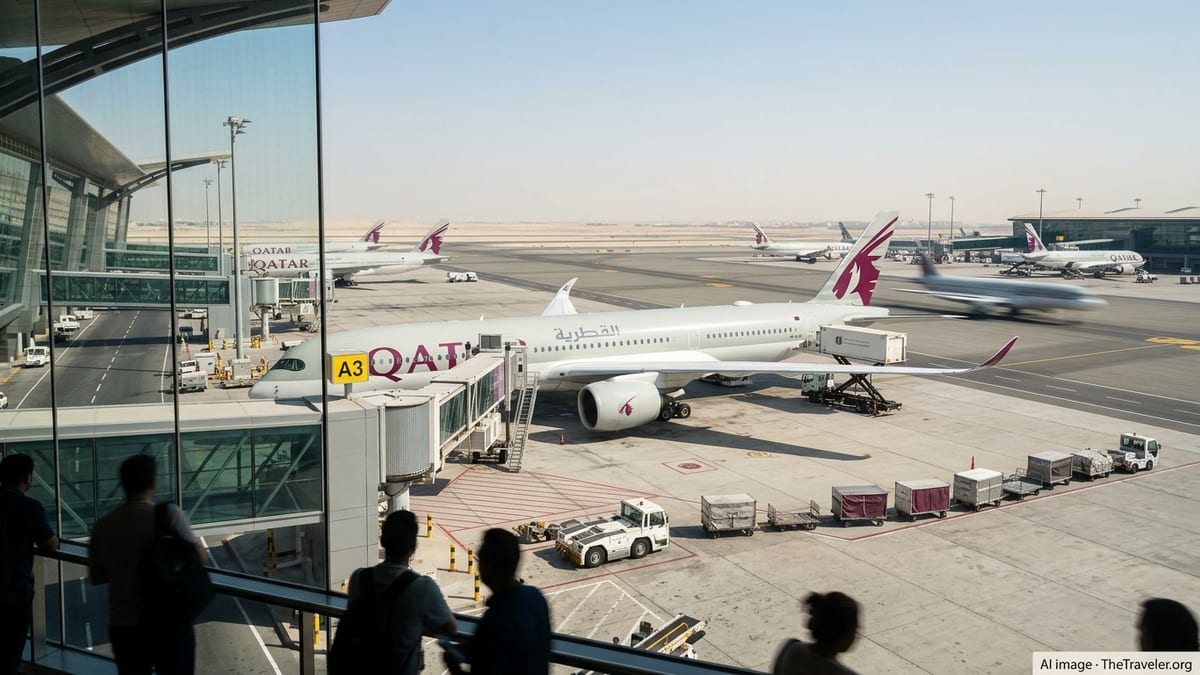
Qatar Airways is restoring a significant portion of its global network today, resuming scheduled passenger services between Doha and 80 major destinations as the airline moves from emergency repatriation flying back toward regular commercial operations.
Get the latest news straight to your inbox!
From Emergency Schedule to Rebuilt Global Network
Publicly available information shows that Qatar Airways has spent recent weeks operating on a highly restricted, day-by-day approval system, running limited flights from Doha to clear backlogs and help stranded travelers reach home. Those flights were authorized individually under a temporary regime while Qatari airspace safety was reassessed.
Industry coverage now indicates that the airline is transitioning from that interim pattern to a structured schedule serving 80 destinations. The move represents the most substantial restoration of its global network since the disruption began in late February 2026, and marks a turning point for passengers who have been juggling cancellations, rebookings, and last-minute routing changes.
The updated schedule focuses first on re-establishing Doha as a long-haul transfer hub, with a strong emphasis on trunk routes in Europe, Asia, Africa, and the Americas. Capacity remains below pre-crisis levels on many city pairs, but the breadth of the network being restored is intended to give travelers a workable range of options rather than a handful of oversubscribed corridors.
While airline timetables remain subject to operational and regulatory changes, today’s expansion to 80 destinations signals that Qatar Airways is planning for sustained, rather than purely ad hoc, connectivity out of Hamad International Airport.
Key European Gateways Back on the Map
Among the most closely watched developments is the return of key European gateways that function as feeders to the wider continent. Recent interim schedules already pointed to services linking Doha with London, Paris, Frankfurt, Madrid, Milan and Rome, and these cities now anchor a broader European restart that adds capacity and more regular frequencies.
Reports from aviation outlets describe a pattern in which these major hubs are prioritized for daily or near-daily service, giving both point-to-point travelers and connecting passengers more predictable options. London and Paris in particular are expected to serve as primary bridges between the Gulf and secondary airports across the United Kingdom and mainland Europe, thanks to onward connections on partner and interline carriers.
Other European cities returning to the network include Istanbul and Moscow, which provide additional connectivity into Eastern Europe and Central Asia. Even where full pre-disruption schedules are not yet in place, restoring these hubs allows passengers to access a larger constellation of destinations by combining Qatar Airways flights with regional partners.
For travelers who have spent weeks cycling through waitlists and partial itineraries, the publication of an 80-destination schedule is being interpreted as a sign that Europe-to-Asia and Europe-to-Africa journeys via Doha are becoming practical again, albeit with reduced flexibility on travel dates and times.
Asia-Pacific Reconnected from Mumbai to Melbourne
Across Asia, the focus of the resumed network is on high-demand megacities and long-haul links that underpin both business and leisure flows. Interim March schedules already featured services between Doha and major South Asian cities such as Mumbai, Delhi, Islamabad and Colombo, as well as Southeast Asian hubs including Jakarta, Manila and Kuala Lumpur. With the shift to a broader 80-city network, these routes are being folded into a more stable timetable.
Coverage of the airline’s plans also points to the reinstatement of flights to East Asian centers such as Beijing, Hong Kong and Seoul, which are critical for both corporate travel and family visits. These destinations play a key role in reconnecting manufacturing, finance and technology corridors that rely heavily on Middle East hub connections.
In the Pacific region, services to Melbourne are returning as part of a gradual rebuilding of long-haul connectivity between Australia and Europe via Doha. While frequencies remain constrained compared with typical peak-season schedules, the presence of a continuous Doha link gives Australian passengers a renewed option alongside competing Gulf and Asian carriers routing through other hubs.
Travel industry analysis suggests that Qatar Airways is prioritizing Asia-Pacific routes that carry a mix of corporate, visiting-friends-and-relatives, and premium leisure demand, in order to stabilize revenues while overall capacity ramps up more slowly.
Africa and the Americas Regain Vital Links to Doha
The restored 80-destination network also strengthens Qatar Airways’ footprint in Africa and the Americas, where connectivity through Doha has become a key part of long-distance travel patterns in recent years. Interim flight lists in early March already highlighted services to Johannesburg and Casablanca, signaling that southern and northern Africa would feature prominently in any broader restart.
Recent network planning updates describe continued growth in South African operations, with Johannesburg, Cape Town and Durban all benefitting from added frequencies in February and March 2026. These services feed not only point-to-point travel between Qatar and South Africa, but also onward journeys to Europe, the Middle East and Asia for passengers originating across the African continent.
In the Americas, publicly available schedules show that New York remains a core gateway, joined by São Paulo as a principal South American hub. Earlier March approvals also included flights to Toronto and Dallas, and today’s wider network resumption is expected to reinforce North American connectivity even as some routes, such as San Francisco, operate at reduced weekly frequencies compared with earlier plans.
For travelers in these regions, the return of multiple Doha services per week can be the difference between a workable itinerary and a multi-stop detour via alternative hubs. The combination of African and American gateways within the 80-city roster helps restore the global reach that underpins Qatar Airways’ business model.
What Today’s Restart Means for Travelers
For passengers, the shift from emergency operations to an 80-destination schedule will be most visible in the booking experience. Instead of scattered one-off flights appearing and disappearing at short notice, reservation systems are beginning to display more consistent patterns of service, allowing travelers to plan beyond a narrow two or three day window.
Travel advisories and airline statements continue to emphasize that schedules remain subject to change, particularly while regional airspace conditions evolve. However, the breadth of today’s restart indicates that Qatar Airways and aviation regulators are working on the basis of sustained operations, rather than a purely temporary corridor approach.
Industry analysts note that seat availability on some routes may remain tight in the short term, as demand from previously stranded or deferred travelers overlaps with new bookings. Passengers are being encouraged by travel agents and public guidance to monitor their reservations closely, remain flexible on travel dates where possible, and check for alternative routings through the newly restored city pairs.
For Doha itself, the resumption of flights to 80 major destinations represents an important step in re-establishing its role as a global transit hub. As more aircraft return to regular patterns of service and additional cities are gradually added back to the map, the Gulf state’s flagship carrier is positioning itself to regain the network strength that has been central to its growth over the past decade.