

More news on this day
Qatar Airways is shifting more of its grounded fleet into storage in Spain as the Iran war and related missile threats continue to disrupt Qatar’s airspace and throttle normal operations from Doha, raising fresh questions for travelers with tickets in the coming weeks.
Get the latest news straight to your inbox!
Middle East Tensions Force Continued Rethink of Qatar Airways Network
Since the Iran war escalated on February 28, 2026, with United States and Israeli strikes on Iranian targets followed by Iranian missile attacks across the Gulf, Qatar’s skies have become one of the conflict’s pressure points. Publicly available information shows that Qatar’s airspace was temporarily closed after the first barrages, with only limited emergency and relief flights allowed in and out of Doha’s Hamad International Airport.
Although authorities later reopened navigation under restricted conditions, regular commercial schedules have not fully returned. Flight-tracking data and passenger accounts indicate that Qatar Airways has been operating a patchwork of point to point and repatriation services, then gradually layering back selected transit routes on a slimmed down timetable rather than restoring its prewar global hub pattern.
This volatile backdrop explains why the airline is now repositioning aircraft away from Doha. With far fewer daily departures than normal and uncertainty over future airspace interruptions, Qatar Airways does not need its full long haul fleet at home and is increasingly using distant airports as safe parking lots.
Industry commentary and regional press coverage suggest that previous Middle East flare ups also forced the Doha based carrier to divert and park aircraft around the region. The Iran war has added another, more acute chapter to that pattern, combining security concerns with complicated overflight restrictions affecting routes between Europe, Asia, and Africa.
Remote Spanish Airport Becomes Parking Lot for Qatar Airways Jets
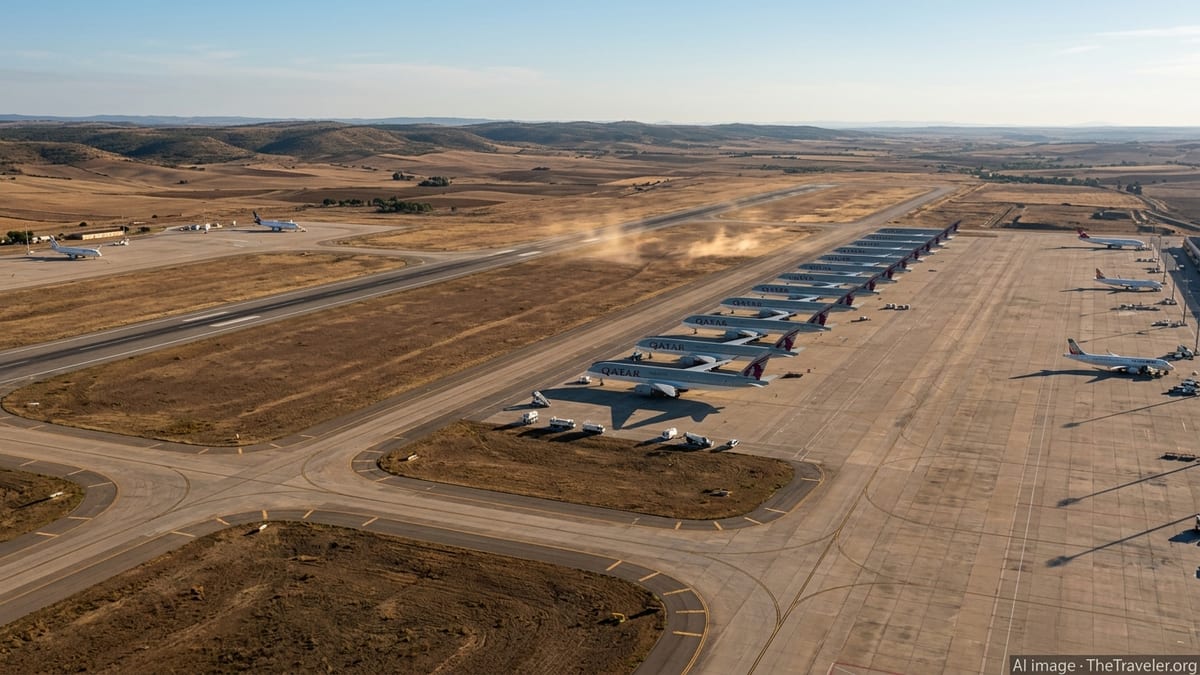
One of the clearest signs of this shift is in Spain. Recent aviation coverage and social media posts highlight that a little known Spanish airfield has once again filled up with inactive airliners, this time largely because of the Iran war’s impact on Gulf carriers. Travelers have noted that multiple Qatar Airways widebodies, including long range Boeing and Airbus types, are now sitting on the ground there rather than cycling through Doha.
Reports indicate that five more Qatar Airways aircraft have recently been ferried to Spain, bringing the total number of the airline’s jets stored at that location and other facilities in the country to roughly 20. Analysts describe the airfield as attractive for long term storage because of its dry climate, uncongested airspace, and abundant apron space, factors that help preserve aircraft during extended downtime.
Publicly available aircraft movement logs suggest a steady trickle of Qatar Airways arrivals into this Spanish storage hub over March, coinciding with the most severe phase of Qatar’s airspace disruption. In many cases, these repositioning flights have operated without passengers, routing from Doha or diversion points in Europe and Latin America to Spain purely to park the aircraft.
The scene on the ground evokes early pandemic memories: multiple jets from different carriers lined up nose to tail, engines covered and windows taped, waiting for a clearer operational horizon. This time, however, the trigger is geopolitical rather than health related, and the key choke point is a single national airspace rather than worldwide border closures.
Why Qatar Airways Is Parking Around 20 Aircraft
The decision to place about 20 aircraft into storage in Spain reflects several intersecting pressures. First, Qatar’s restricted airspace and the risk of further missile activity have made it harder to run a dense connecting bank of departures from Doha. With fewer flights, the airline no longer requires its full complement of widebody aircraft on a daily basis.
Second, running underutilized aircraft in an uncertain security environment is expensive. Industry data and past financial results across the sector show that widebody jets only make economic sense when they can be filled to commercially viable levels and flown frequently. Parking aircraft cuts operating and maintenance costs in the short term while preserving assets for a future ramp up.
Third, storage in Spain gives the carrier flexibility. If conflict conditions ease and Qatar’s airspace stabilizes, aircraft can be reactivated relatively quickly and ferried back to Doha or directly onto new routes. If the crisis deepens or restrictions spread, parked jets can be held longer without clogging scarce space at Hamad International or older Doha facilities that may be needed for relief operations.
Aviation observers also note that concentrating parked aircraft at a few remote airports allows maintenance providers and lessors to manage preservation checks more efficiently. Rather than dispersing grounded jets across dozens of busy hubs, Qatar Airways can rely on specialized storage crews in Spain to keep the fleet airworthy until it is needed again.
What Travelers Can Expect for Upcoming Flights
For passengers, the storage of 20 Qatar Airways jets in Spain is a visible sign that capacity has been cut back and is likely to remain constrained for some time. A reduced active fleet generally translates into trimmed frequencies on many routes, more connections instead of nonstop options, and a higher risk of last minute aircraft swaps or schedule changes.
Recent interim timetables published on airline and industry platforms show that Qatar Airways is focusing its available aircraft on a core set of destinations in Europe, Asia, and Africa, along with selected long haul routes such as London and Miami. Some services have returned at lower weekly frequencies than before the war, while others remain suspended or are only available as special relief flights for stranded travelers.
Travel forums and booking data point to increasing load factors on the flights that are operating, as passengers displaced from cancelled services are rebooked onto remaining options. This can make alternative routings harder to secure at short notice, particularly over peak travel dates such as Easter and early summer holiday periods.
Travelers holding Qatar Airways tickets in the next few weeks are being advised by consumer advocates to monitor reservations closely, check for schedule changes within the airline’s app or through their travel agent, and consider more flexible itineraries that can be rerouted via alternative hubs if necessary. Public guidance from aviation regulators in Europe also reminds passengers that standard consumer protections continue to apply when departing from or arriving in the European Union.
How This May Evolve and What Signals to Watch
Looking ahead, the number of Qatar Airways aircraft parked in Spain could shift in either direction depending on the trajectory of the Iran war and the stability of Qatar’s airspace. A sustained de escalation and reliable air defense regime around Doha would make it easier for the airline to rebuild its wave structure of connecting flights and call parked jets back into service.
Conversely, additional missile incidents or broader airspace closures in the Gulf could prompt Qatar Airways to send even more aircraft to Spain or other storage centers, amplifying the current squeeze on capacity. Analysts are watching for signs such as extended closure notices from civil aviation authorities, further adjustments to interim timetables, and a rise in long term parking contracts at storage airfields.
For now, the presence of around 20 Qatar Airways jets sitting idle in Spain underscores how quickly Middle East tensions can ripple through global travel. Passengers connecting between continents on what was once one of the world’s most reliable long haul hubs are being reminded that even the most sophisticated airline operations remain vulnerable when key airspace corridors fall within a conflict zone.
As the situation develops, travelers planning journeys through Doha or on Qatar Airways from Europe and the Americas may find it prudent to build in extra flexibility, whether through refundable fares, travel insurance with robust disruption coverage, or backup routing options on other carriers that do not depend on Qatari airspace.