

More news on this day
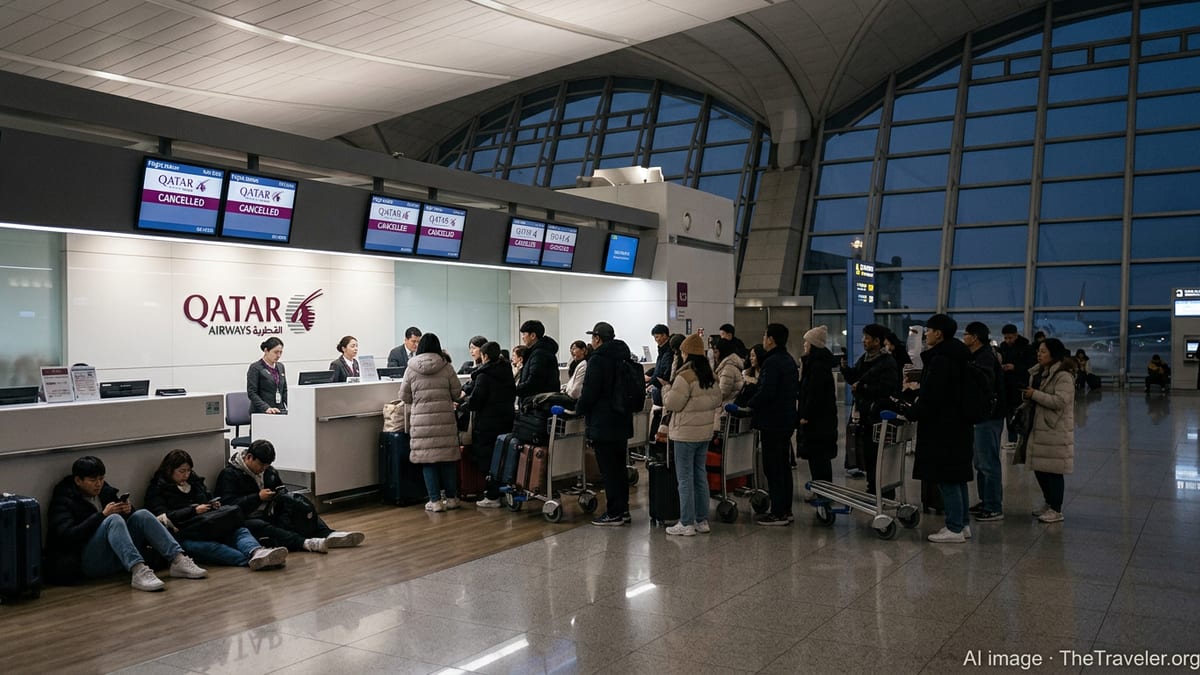
Evening passengers at Seoul’s Incheon International Airport faced mounting uncertainty this week after Qatar Airways abruptly cancelled a key Seoul–Doha service, underscoring how ongoing airspace restrictions around Qatar are rippling across South Korea’s outbound travel network.
Get the latest news straight to your inbox!
Evening Qatar Airways Departure Axed Amid Ongoing Gulf Airspace Turmoil
The cancelled service, operating from Seoul Incheon to Hamad International Airport in Doha, was among the latest casualties of continuing disruption linked to the closure and subsequent partial reopening of Qatari airspace following recent regional security tensions. The flight, typically used by business travelers and long-haul transit passengers heading on to Europe, the Middle East and Africa, was pulled from the schedule with limited advance warning for many ticket holders.
Passengers arriving for the evening departure reported learning of the cancellation via last minute app notifications or airport display boards, with some saying they had received no direct contact from the airline until they were already en route to Incheon. For travelers connecting onward from Doha, the move effectively broke multi-leg itineraries, forcing urgent rebookings onto other hubs such as Istanbul, Singapore or Hong Kong.
Airport staff and ground agents were left managing long queues at the Qatar Airways counters as stranded passengers sought clarification, meal vouchers and hotel accommodation. With Hamad International still operating under constrained capacity and prioritizing repatriation and essential connections, options for same-day rerouting from Seoul were sharply limited.
The cancellation highlights how even a single lost departure can have outsized effects in a hub-and-spoke network. A full widebody outbound from Incheon feeds dozens of onward Qatar Airways flights; when that link fails, the impact cascades across multiple continents and return rotations.
Impact on Incheon Operations and Passenger Experience
At Incheon, the sudden schedule change added pressure to an already busy evening wave of international departures. Check in halls saw pockets of congestion around the Qatar Airways desks, where passengers queued for rebooking advice, documentation for insurance claims and confirmations of compensation eligibility. Some travelers described waiting hours for definitive guidance, as agents fielded calls to overseas operation centers that were themselves overwhelmed by regional flight changes.
Airport announcements urged affected passengers to remain calm while airline teams “reviewed available alternatives,” but the lack of clear timelines led many to seek same-day seats on rival carriers serving Europe and the Gulf. With several airlines already operating near full capacity due to earlier disruptions in the Middle East, walk up fares were high and availability thin, especially for those needing to reach onward destinations by fixed dates.
Incheon’s transit hotels and nearby off-airport accommodation reported a spike in last minute bookings as travelers resigned themselves to an unplanned overnight stay in South Korea. Families with children and older passengers queued for hotel and transport vouchers, while solo travelers often opted to self fund nearby stays in order to secure more flexible arrangements the following day.
While core airport operations such as security screening and immigration continued without major incident, the episode renewed questions about how well prepared airlines and hub airports are to handle rolling disruption caused by geopolitical shocks far from the point of departure.
Regional Context: Airspace Closures and a Staggered Restart
The Seoul–Doha disruption is the latest visible symptom of a broader, still unfolding aviation shock centered on Qatar’s airspace. Following missile strikes targeting sites in and around Qatar in late February, authorities temporarily closed the country’s skies, forcing a sweeping halt to standard commercial services at Hamad International and triggering widespread cancellations and diversions across the Qatar Airways network.
Qatari regulators later authorized a controlled partial resumption of navigation using limited contingency routes, prioritizing evacuation, essential travel and cargo. However, full scale commercial traffic has not yet returned to precrisis levels, and airlines continue to adjust schedules day by day as capacity and routing options evolve. For passengers, that has translated into a moving target of operational updates, revised waivers and shifting eligibility for refunds or no fee changes.
South Korean travelers have felt the effects both directly and indirectly. Those booked on Qatar Airways from Seoul have faced outright cancellations or extended connection times, while others flying on non Gulf carriers have encountered crowded alternatives as displaced passengers seek seats via different hubs. The Korean outbound market to Europe in particular has tightened, with some travelers reporting they booked backup itineraries on other airlines weeks in advance in anticipation of continued uncertainty.
Industry analysts note that while global aviation has improved its resilience since earlier pandemic era shocks, concentrated hub disruptions like those affecting Doha still expose structural vulnerabilities. When a single major transfer point reduces capacity, the knock on impact to far flung origin airports, including Incheon, can appear days or weeks later as schedule changes work their way through fleets and crew rosters.
What Affected Travelers From South Korea Need to Know Now
For passengers booked on forthcoming Qatar Airways services between Seoul Incheon and Doha, the situation remains fluid. The airline has been operating under an expanded disruption policy window, allowing eligible customers to request date changes, rerouting or refunds if their flights fall within defined affected periods. However, exact options depend on ticket type, original travel dates and whether journeys involve codeshare or partner segments.
Travel agents in Seoul advise customers with imminent departures to monitor their booking status closely in the 24 to 48 hours before departure. If a cancellation notice appears, contacting the airline or point of sale as quickly as possible improves the chances of being reprotected on an alternative routing or receiving timely documentation for a refund. Passengers transiting Doha to reach a third country are encouraged to pay particular attention to minimum connection times and any schedule compressions that might make legal connections impractical.
Travel insurance coverage varies, but many comprehensive policies treat official airspace closures and resulting cancellations as covered events. Policyholders are typically required to keep all receipts, boarding confirmations, cancellation notices and correspondence with the airline to substantiate claims for additional accommodation, meals and replacement flights. Insurers also stress the importance of following carrier instructions, as self rebooking without consulting the airline can complicate reimbursement.
South Korea’s own consumer protection regulations around flight disruptions primarily cover carriers based in or operating under Korean jurisdiction, but international agreements and airline contracts of carriage still grant travelers certain baseline rights to refunds or rebooking in the event of cancellation. Consumer advocates urge passengers to familiarize themselves with those terms rather than relying solely on informal social media updates when making on the spot decisions at the airport.
Strain on Alternative Routes and Outlook for the Seoul–Doha Corridor
With uncertainty hanging over the full restoration of normal traffic through Hamad International, competing long haul carriers serving Incheon have started to feel the strain. Flights to major European hubs such as Frankfurt, Paris, London and Istanbul from Seoul have seen increased demand from travelers who would previously have connected via Doha. Some airlines have deployed larger aircraft or added ad hoc capacity, but industry sources caution that aircraft and crew availability limit how quickly carriers can respond.
Korean outbound tour operators report a surge in inquiries about rerouting group trips away from Gulf hubs for departures through late March and into April. Corporate travel managers, wary of further last minute cancellations, are similarly shifting high priority business travelers onto itineraries that avoid the most affected airspace, even at higher cost.
For now, aviation planners describe the Seoul–Doha link as operating in a transitional phase, with schedules subject to rapid adjustment as security assessments, regulatory decisions and operational constraints evolve. While there is cautious optimism that controlled corridors and layered defenses will allow for a gradual normalization of flights, most industry observers expect weeks of intermittent disruption rather than an immediate snapback to precrisis patterns.
For evening travelers at Incheon looking to reach Doha and beyond, that means planning for contingencies: allowing greater time buffers, considering flexible ticket options, and being prepared for the possibility that a confirmed booking may still not translate into an on time departure. As the latest cancellation shows, events thousands of kilometers away can still dictate whether a flight leaves the gate in Seoul.