

More news on this day
South Korea is grappling with fresh travel disruption after Qatar Airways cancelled its evening Seoul Incheon to Doha service, forcing last-minute rebookings, leaving some passengers stranded at Incheon International Airport and underlining how Middle East airspace restrictions are rippling through major Asian hubs.
Get the latest news straight to your inbox!
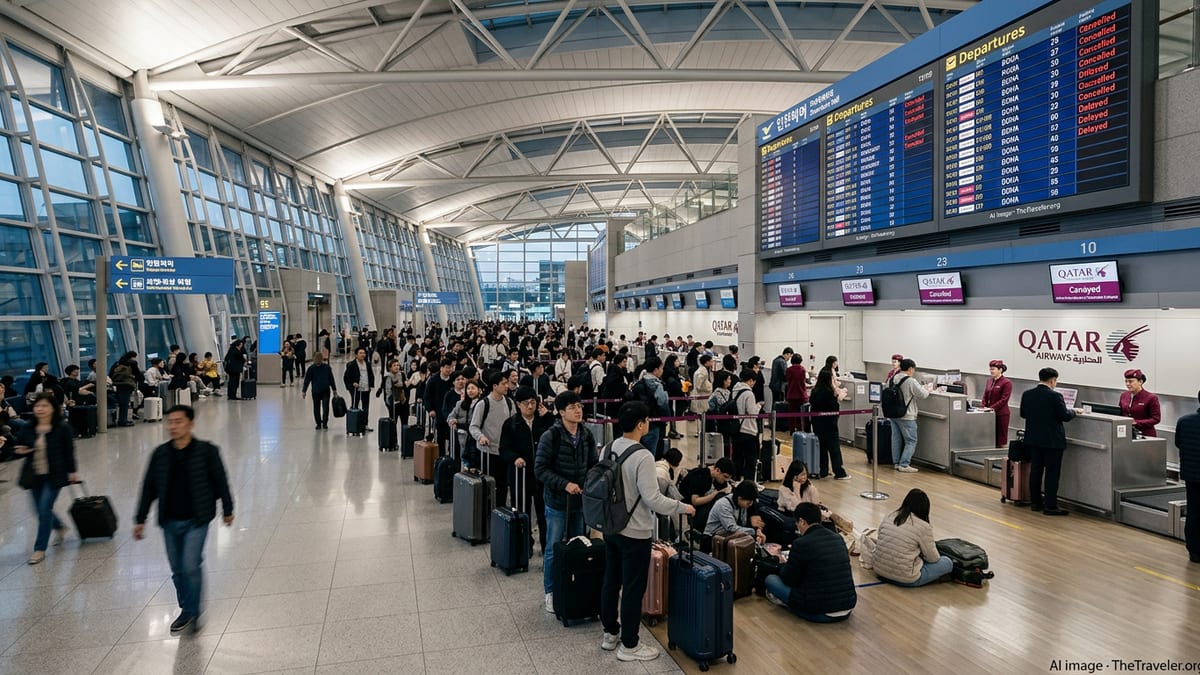
Evening Qatar Airways Service From Incheon Scrubbed
Passengers booked on Qatar Airways’ Seoul Incheon to Hamad International Airport route reported on Friday that their evening departure had been cancelled, in what appears to be the latest in a rolling series of schedule cuts tied to restricted airspace over the Gulf. Many only discovered the change when their flight disappeared from airline apps or airport departure boards, prompting confusion at check-in counters and information desks at Incheon.
Airport staff said the affected departure was among a small number of long-haul services to the Middle East that were either cancelled outright or subject to significant delays, with travelers advised not to proceed to the airport unless they had been directly notified that their flight would operate. The last-minute nature of the decision left little time for passengers to secure alternative routings on other carriers.
The cancelled flight is part of a broader pattern of disruption as Qatar Airways operates a sharply reduced schedule into and out of Doha while its hub functions under limited capacity. South Korean aviation officials said they were monitoring the situation closely but stressed that operational decisions rested with the airline and Qatar’s aviation authorities.
Regional Airspace Crisis Reaches South Korean Travelers
The cancellation comes against the backdrop of an escalating aviation crisis centered on the Gulf, where airspace closures and restrictions connected to regional conflict have triggered hundreds of flight suspensions and delays. Hamad International Airport has been operating only partial services, with Qatar Airways announcing short-term, tightly controlled schedules across selected dates while many regular routes remain off the board.
Data from regional aviation trackers show that Asia-Pacific gateways have been hit hard as airlines adjust or suspend routes that rely on Doha as a connecting hub. In recent days, industry analyses have counted well over a hundred cancellations across major Asian airports linked to Middle East operations, with Seoul now joining a growing list of cities experiencing knock-on effects.
For South Korean travelers, the impact is particularly acute on Europe, Africa and Middle East itineraries that traditionally route via Doha. With Qatar Airways’ frequency from Incheon constrained, passengers are being pushed onto alternative hubs such as Dubai, Abu Dhabi, Istanbul and Singapore, often at higher fares and with limited seat availability.
Scenes of Confusion and Long Queues at Incheon
At Incheon International Airport, the abrupt cancellation generated familiar scenes that have been playing out across the region in recent weeks: long lines at transfer and ticketing counters, families camped out in seating areas with luggage piled around them, and business travelers urgently reworking itineraries on phones and laptops. Many passengers said they had not received timely SMS or email notifications from the airline, learning of the disruption only after arriving at the terminal.
Ground staff and handling agents were left to manage a wave of rebooking requests, arranging hotel vouchers for those with long layovers and assisting travelers in securing seats on other airlines where possible. However, with capacity to Europe and the Middle East already tight during the current disruption, options were limited, particularly for those needing to depart the same night.
Airport authorities deployed additional staff to information desks in the international departures hall to answer questions and direct passengers toward their airlines. Public announcements reminded travelers to verify their flight status with carriers before setting out for the airport, underscoring how quickly schedules are changing in response to developments in the Gulf.
What Affected Passengers Can Expect
Qatar Airways has introduced a temporary disruption policy for customers whose travel dates fall within the affected period, offering the option to change travel dates or request refunds in many cases. Travelers with tickets originating in jurisdictions that enforce strong passenger-rights rules, such as the European Union, may also be entitled to additional protections on itineraries that start or end in those regions, though compensation often depends on the exact circumstances and governing law of the booking.
For passengers departing from South Korea, the first line of action is to check their booking through the airline’s website or mobile app and look for any rebooking proposals or vouchers that may have been automatically issued. Contact centers and local ticket offices remain under heavy pressure, and industry experts advise using digital channels wherever possible to avoid long hold times and queues.
Travel advisers also recommend documenting all communications, keeping receipts for meals, transport and accommodation incurred due to the disruption, and staying alert for schedule changes even on flights that currently appear confirmed. With Qatar Airways’ operations out of Doha still evolving day by day under the oversight of Qatar’s aviation regulator, further adjustments to Seoul services in the short term cannot be ruled out.
Broader Impact on South Korea’s Air Connectivity
The Qatar Airways cancellation highlights the vulnerability of South Korea’s international connectivity to external shocks in distant regions, particularly given the country’s reliance on one-stop connections through Middle Eastern and Southeast Asian hubs for long-haul travel. While Korean carriers continue to operate their own networks to Europe and North America, the sudden loss or reduction of a major Gulf hub constrains options for travelers seeking certain city pairs or price points.
Travel industry analysts in Seoul warn that if the disruption at Doha persists, it could temporarily shift traffic flows toward other carriers and hubs, with competitive implications once normal operations resume. In the meantime, tour operators and corporate travel managers are racing to rework itineraries, often stitching together complex routings via multiple stops to keep trips viable.
For now, authorities and airport operators in South Korea are emphasizing communication and contingency planning. As the situation in the Middle East remains fluid, passengers booked on the Seoul Incheon to Doha route in the coming days are being urged to monitor their flight status closely and to prepare for the possibility of last-minute changes, even if their tickets have not yet been formally reissued.