

More news on this day
As global air travel accelerates into the second half of the decade, Qatar Airways is entering 2026 from a position of strength, consolidating a run of industry awards with a series of cabin, digital and inflight connectivity upgrades that are reshaping expectations of what a full-service carrier can offer.
Get the latest news straight to your inbox!
From Serial Award Winner to De Facto Industry Benchmark
In the run-up to 2026, Qatar Airways has translated strong industry recognition into a wider claim on global leadership. The Doha-based carrier was named World’s Best Airline at the 2025 World Airline Awards, described in coverage as among the most influential rankings in commercial aviation. Reports indicate that the airline secured the top title for a record ninth time, alongside wins for World’s Best Business Class, World’s Best Business Class Lounge for its Al Mourjan Garden facility at Hamad International Airport, and Best Airline in the Middle East.
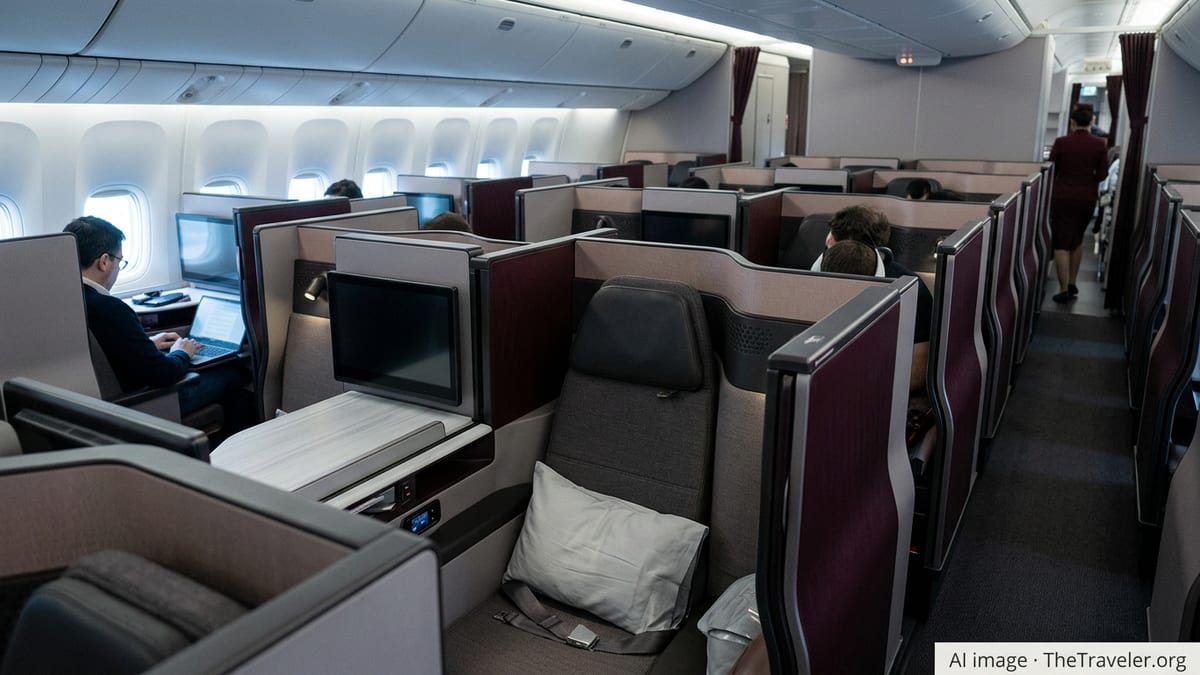
Those accolades followed earlier World Airline Awards in 2024, when published rankings again placed Qatar Airways at or near the top of key global and regional categories, particularly for premium cabins and service consistency. Industry commentary has repeatedly highlighted the Qsuite business-class product as a major factor in the carrier’s performance, with privacy doors, flexible seating configurations and tailored service keeping it at the forefront of long-haul competition.
By early 2026, this track record has positioned Qatar Airways not only as an awards leader but as a reference point against which rival carriers’ premium products, digital innovations and hub developments are being compared. For frequent flyers and corporate travel buyers, the airline’s steady dominance in independent rankings is becoming a proxy for reliability in an environment where service standards still vary widely as aviation recovers and expands post-pandemic.
Next-Generation First and Business Class Drive a New Comfort Race
Alongside its established Qsuite product, Qatar Airways is moving to redefine the top end of the market with a new first class. Coverage of airline industry events in 2024 and 2025 noted that the carrier has been developing an all-new first-class cabin to be launched on future widebody aircraft, with senior leadership describing it as heavily focused on technology integration and digitalisation.
Reports from regional business media in early 2025 indicated that the new first class is being designed around more private suites, larger personal space, and embedded controls for lighting, seat functions and entertainment, all accessed through updated touch interfaces and personal devices. This is expected to sit above Qsuite in the cabin hierarchy, targeted at ultra-long-haul routes and high-yield corridors linking Doha with major financial and political centres.
In business class, Qatar Airways is continuing to refine Qsuite rather than replace it outright. Industry analysis in 2025 highlighted a program of incremental improvements, including refreshed soft furnishings, adjusted lighting schemes, upgraded inflight dining concepts and expanded on-demand entertainment libraries. On select aircraft, Qsuite layouts are being fine-tuned to balance privacy with the ability to create family- or group-friendly quads, an approach that has resonated strongly with both leisure and business travellers.
These cabin developments are unfolding as competitors in the Gulf and Asia-Pacific roll out their own next-generation premium products. With some rival airlines now debuting all-aisle-access business cabins and updated first classes, Qatar Airways’ moves in 2026 are widely seen as part of an escalating comfort race in which seat innovation and cabin customisation are central to winning high-value passengers.
Digital Travel, AI and Personalisation Take Center Stage
Qatar Airways’ 2026 positioning is being shaped as much by digital initiatives as by physical cabin upgrades. Over the past two years, the airline has accelerated investment in data-driven personalisation, artificial intelligence and immersive digital tools designed to simplify booking and elevate the onboard experience.
According to airline and travel-technology reports from late 2024 and 2025, Qatar Airways has introduced an AI-powered digital human assistant known as Sama, initially showcased for conversational booking and trip support. Publicly available information describes the system as capable of handling natural-language queries, surfacing tailored itineraries and guiding customers through ancillary options, reflecting a broader industry shift toward interactive, always-on digital service layers.
At trade shows in the Middle East and Europe, coverage noted that the carrier has also experimented with virtual reality experiences that allow travellers to preview cabins, seat layouts and airport lounges before flying. These tools, presented as part of a wider digital engagement strategy, are aimed at demystifying complex itineraries and helping customers make more informed choices about seat selection, cabin class and connection times through Doha.
Behind the scenes, analysts say that the airline is leveraging customer data, historical travel patterns and real-time operational information to refine everything from targeted offers to disruption management. As 2026 progresses, observers expect further integration of AI into customer-facing applications, from more precise upgrade bidding and tailored promotions to proactive service recovery when irregular operations occur.
Connectivity and Hamad International Hub Upgrades Redefine the Journey
While cabin and digital innovations attract attention, Qatar Airways’ leadership in 2026 is also underpinned by its home hub at Hamad International Airport. The airport’s expansion program has continued in phases, with reports indicating that a major second-phase development was completed in 2025, adding capacity, retail and green spaces that support the carrier’s growth trajectory.
A focal point of this expansion has been the Al Mourjan Business Lounge – The Garden, a large premium space integrated into the airport’s indoor garden concourse. Industry coverage highlights the lounge’s scale, natural-light design and amenities as differentiators in the global premium-travel landscape, contributing to its recognition in lounge-focused award categories and reinforcing Doha’s appeal as a connecting hub.
Onboard, inflight connectivity is emerging as another pillar of Qatar Airways’ 2026 strategy. Aviation trade publications have reported that the carrier has been among the early adopters in its region of next-generation satellite broadband services, with plans to equip a significant share of the widebody fleet with high-speed Wi-Fi capable of supporting streaming, real-time messaging and more bandwidth-intensive tasks.
Such connectivity upgrades are increasingly seen as integral to the passenger experience, particularly for business travellers who expect seamless digital access from airport to aircraft. As more Qatar Airways aircraft come online with enhanced Wi-Fi in 2026, analysts suggest that the airline’s ability to combine strong ground infrastructure at Hamad International with robust onboard connectivity could further differentiate its long-haul proposition.
Network Growth and Competitive Pressures Shape the 2026 Outlook
Qatar Airways’ bid to lead in 2026 is unfolding against a backdrop of intensifying competition and shifting travel patterns. Global demand has rebounded strongly on many long-haul corridors, while new aircraft deliveries and reconfigured fleets are allowing rival carriers to push into markets that were previously dominated by a small group of network airlines.
Industry data through 2025 shows that Qatar Airways has continued to rebuild and expand its network, with particular emphasis on emerging markets in Africa and South Asia, as well as secondary cities in Europe and North America that can feed its Doha hub. Capacity growth has been supported by the deployment of fuel-efficient aircraft types and the gradual introduction of cabins aligned with the airline’s latest design standards.
At the same time, aviation analysts note persistent challenges. Cost pressures, volatile fuel prices and geopolitical tensions in key regions remain structural risks. Consumer expectations have risen markedly, with travellers now comparing service details across multiple premium carriers that are all pursuing similar digital and cabin-upgrade agendas. Social media and traveller forums have also amplified scrutiny of operational consistency, including occasional criticism of service pacing and economy-cabin standards.
Despite these headwinds, Qatar Airways enters 2026 with a combination of award recognition, product innovation and hub strength that places it among the most closely watched airlines in the world. How effectively it converts those advantages into a consistently superior, technology-enabled experience across all cabins will be central to whether it can sustain its leadership narrative as the decade advances.