

More news on this day
Qatar Airways has begun operating a sharply reduced emergency flight schedule to and from Doha after the closure of Qatari airspace forced the suspension of regular services, leaving tens of thousands of passengers stranded across key global hubs.
Limited Corridors Open as Regular Schedule Remains Suspended
The carrier confirmed on March 8 that its scheduled commercial operations remain temporarily suspended while Qatari airspace is closed on security grounds, a move that has rippled across international networks and snarled long haul connections between Europe, Asia and Africa.
Following temporary authorisation from the Qatar Civil Aviation Authority, Qatar Airways has been granted the use of tightly controlled operating corridors in and out of Doha. These routes are being used to run a small number of relief flights, described by the airline as an exceptional measure and not a full resumption of normal service.
In an evening update on March 8, the airline detailed an emergency schedule for the coming days, stressing that it will only ramp up operations once regulators declare it safe to fully reopen national airspace. Until then, capacity remains severely restricted and subject to short notice adjustment.
Qatar Airways has reiterated that passengers should not proceed to airports unless they hold a valid, confirmed ticket on one of the designated flights, as walk up travel and standby options are effectively unavailable under the current operational constraints.
Emergency Relief Flights Connect Key Hubs With Doha
Under the initial corridor plan, Qatar Airways is prioritising high demand gateways to move stranded travelers in and out of Doha. Flights arriving at Hamad International Airport on March 9 are scheduled from Amsterdam, Berlin, Frankfurt, London Heathrow, Zurich and Muscat, focusing on passengers whose final destination is Doha.
Repatriation flights have also been operated in the opposite direction. On March 8, the airline dispatched services from Doha to a series of European hubs, including Amsterdam, Berlin, Frankfurt, London and Zurich, to relieve congestion at Hamad International and reconnect travelers with onward options on other carriers.
The updated schedule released late on March 8 goes further, listing a broader set of destinations for flights departing Doha on March 9 and 10. These include Seoul, Moscow, Beijing, Perth, Nairobi, Islamabad, Delhi, Mumbai, Cairo, Jeddah, Manila, Kochi, Muscat, Istanbul, Madrid, Frankfurt, Colombo and Milan, reflecting an effort to restore critical links across Asia, the Middle East, Europe and Africa.
Even with these additions, the emergency network represents only a fraction of Qatar Airways' usual global schedule. Seats are limited and many flights are operating as one way relief services rather than part of a continuous bank of timed connections.
Conflict-Linked Airspace Closure Sends Shockwaves Through Global Travel
The sudden grounding of Qatar Airways' regular operations followed a closure of Qatari airspace that began on February 28, part of a wider security crisis tied to regional conflict and missile activity across parts of the Gulf. The move forced one of the world's largest long haul carriers to halt most flights to and from its Doha hub, severing a major artery between continents.
Travelers transiting the region have faced cascading disruption as cancellations mounted. With Qatar sitting at the crossroads of Europe to Asia routes, the shutdown has had knock on effects well beyond the Gulf, affecting itineraries that never intended to stop in Doha but relied on its role as a connecting hub.
Other regional carriers have also cut or rerouted services in response to risk assessments and evolving airspace restrictions, compounding pressure on already tight long haul capacity. Aviation analysts say it could take weeks for global schedules to fully stabilise, even if Qatari airspace reopens in the coming days under normal conditions.
Authorities in Doha have moved cautiously, initially authorising only limited emergency navigation under tightly managed contingency routes. These allow for evacuation, essential passenger movements and cargo operations, but they do not support the density of traffic required for a full banked hub operation.
What Stranded Passengers Can Expect in the Coming Days
For travelers, the immediate reality is uncertainty. Qatar Airways has said it is directly contacting affected passengers with rebooking options and has urged customers to monitor official channels rather than rely on third party travel apps, where outdated schedules may still appear active despite the suspension of regular services.
The airline has introduced temporary flexibility policies for tickets due to be used between late February and mid March, including options for date changes or refunds in many cases. However, the sudden loss of capacity and high demand for the limited emergency flights mean that not all customers will be able to travel on their original dates, even with priority given to humanitarian, medical and family reunification cases on some routes.
Travel agents in key markets report that alternative routings via other hubs are increasingly difficult to secure, particularly for peak travel days, as passengers displaced from Doha connections seek to rebook on rival carriers. Some travelers have faced multi day delays as they wait for seats on available services or for additional relief flights to be added.
Qatar Airways has indicated that its emergency schedule will be updated frequently as airspace conditions and regulatory approvals evolve. Another operational update is expected on March 9, which could either expand the list of destinations served or prolong the current limited pattern of relief flights, depending on the security situation.
Hamad International Airport Adjusts to Reduced but Critical Operations
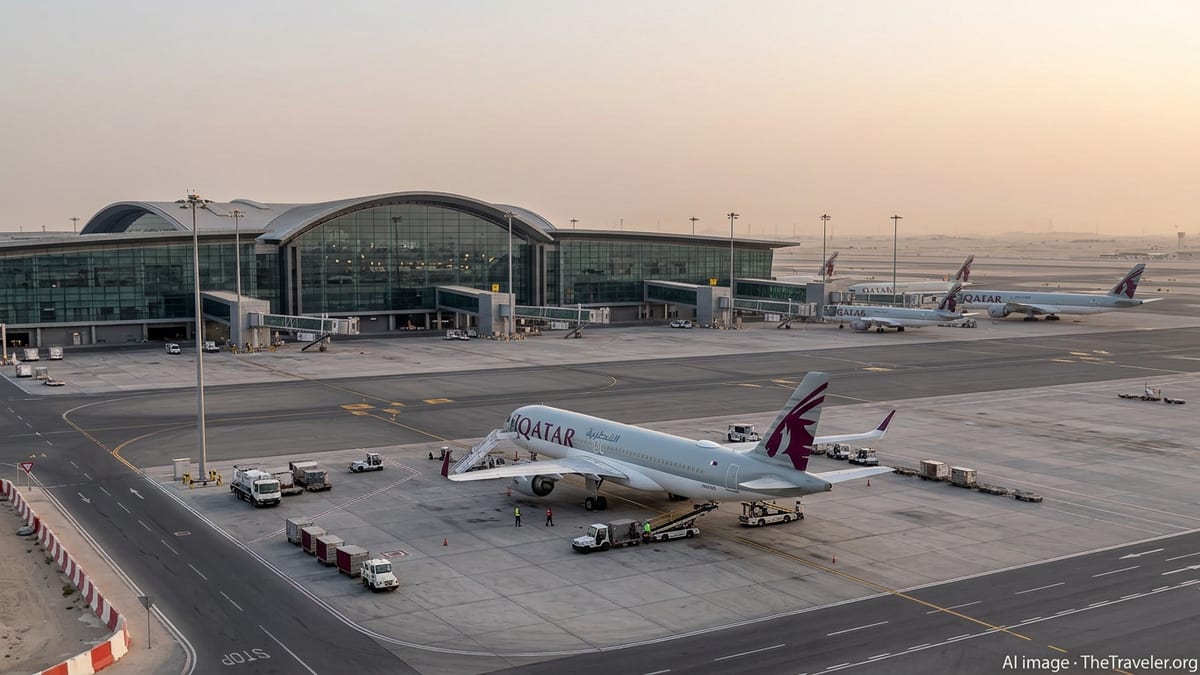
At Hamad International Airport, typically one of the busiest hubs in the region, scenes have shifted from the usual dense waves of transfer passengers to a more controlled, essential service environment. Airport authorities have focused on managing stranded travelers, repatriation flights and critical cargo movements while much of the regular commercial schedule remains on hold.
Terminals that normally operate around the clock with continuous departure and arrival banks have seen large sections of check in and security infrastructure idled, with staffing and resources redeployed to support disrupted passengers, including those needing accommodation, visa assistance or medical support.
Cargo and logistics operators are also feeling the impact as freighter movements are squeezed into the same narrow operational windows as the emergency passenger flights. For Qatar, a key global player in air freight, maintaining even a limited flow of essential goods has become a strategic priority alongside the safe movement of people.
While the atmosphere at the airport has been calmer than at the height of the initial shutdown, officials and airline staff caution that conditions could change quickly with each new update from aviation and security authorities. For now, Hamad International remains in an interim state, functioning as a relief and repatriation hub rather than the fully fledged global connector travelers are used to.