

More news on this day
Qatar Airways has begun operating a limited number of relief flights from Muscat and Riyadh to help thousands of passengers stranded by the ongoing closure of Qatari airspace, as regional conflict continues to choke off normal air travel across the Gulf.
Airspace Closure Keeps Doha Hub Offline
Qatar Airways confirmed on March 6 that all scheduled passenger services through Doha remain temporarily suspended following the closure of Qatari airspace imposed in the wake of regional military escalation. The disruption, which began on February 28, has effectively shut down one of the world’s busiest long-haul transfer hubs, leaving travelers unable to connect through Hamad International Airport.
The airline reiterated that full operations will only resume once the Qatar Civil Aviation Authority declares it safe to reopen national airspace. Until then, aircraft movements in and out of Doha are limited to essential and security-related operations, with no regular commercial departures or arrivals. The suspension has affected passengers across Asia, Europe, Africa and the Americas who were relying on Qatar Airways’ global network for onward connections.
Industry analysts say the grounding underscores how central Gulf hubs are to global aviation. With neighboring states also restricting airspace, wide swathes of the region’s skies have effectively gone dark to commercial traffic, forcing airlines to cancel, divert or reroute flights and stranding hundreds of thousands of passengers well beyond the immediate conflict zone.
Relief Flights From Muscat and Riyadh
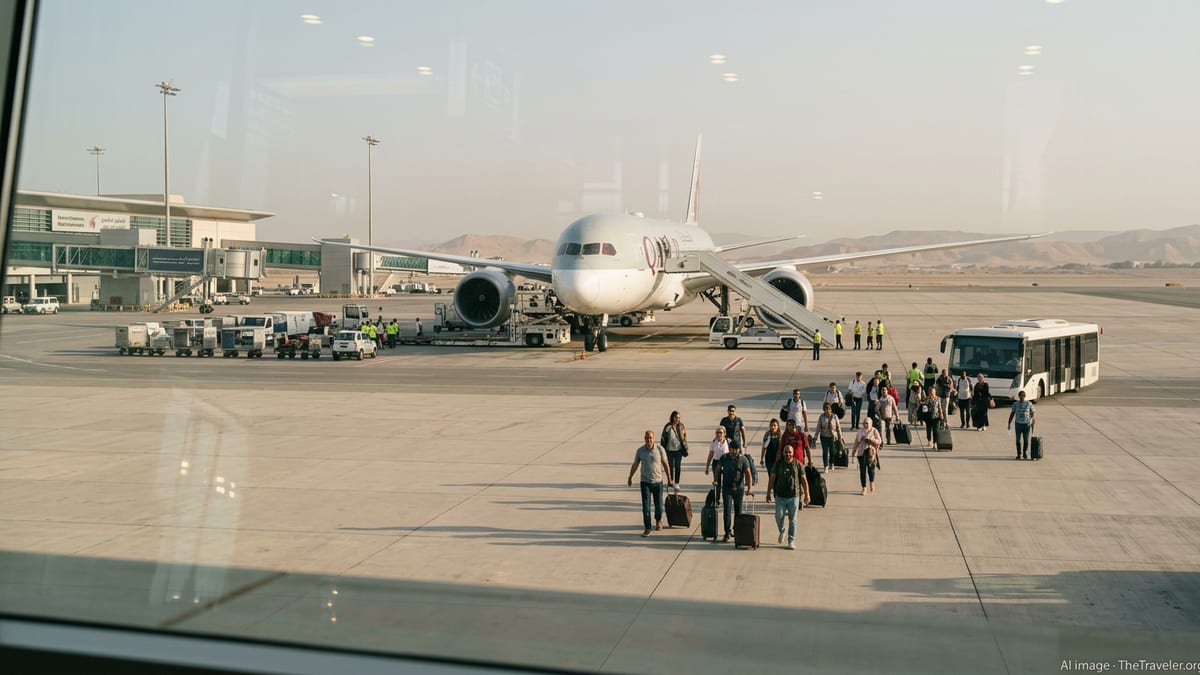
In an effort to ease the backlog, Qatar Airways has launched a small but growing program of relief flights beginning March 5, using Muscat in Oman and Riyadh in Saudi Arabia as temporary departure points. These services are designed to move passengers who were originally booked to travel via Doha but became stranded when flights were diverted or cancelled after the airspace closure.
From Muscat International Airport, the carrier has scheduled special flights to key European gateways including London Heathrow, Berlin, Copenhagen, Madrid, Rome and Amsterdam. Additional services via Muscat to destinations such as Calicut, Hyderabad, Lucknow, Istanbul and Karachi have been organized in partnership with other airports and operators, though capacity remains tight and many early flights are already fully booked.
Riyadh is being used as a secondary staging point, providing another exit route for passengers who can reach Saudi Arabia by land or on limited regional services that remain operational. Travel across borders, however, is complicated by security considerations and fast-changing advisories, meaning that overland journeys from Doha to Muscat or Riyadh can be lengthy and are not suitable for all travelers.
Who Can Board the Relief Flights
Qatar Airways has stressed that these relief flights are not open for general sale and are intended specifically for passengers disrupted by the airspace closure. The airline is prioritizing customers with existing bookings who were due to travel through Doha between late February and the coming days, including those stranded in third countries after diversions and cancellations.
Affected travelers are being contacted directly by email, text message or through travel agents with details of alternative itineraries, including new departure airports, dates and times. In many cases, the airline is rebooking passengers at no additional cost, sometimes using partner carriers where feasible, in line with its security-situation guidelines for tickets scheduled to transit Doha.
Seats on the special services are limited and in high demand. Travel agents report that some relief flights from Muscat on March 5, 6 and 7 were fully booked within hours of being announced. Qatar Airways has indicated that it will review capacity and may add further services if airspace restrictions persist and aircraft and crew availability permit.
Key Instructions for Stranded Passengers
The airline has repeatedly urged customers not to travel to airports in Doha, Muscat or Riyadh in the hope of securing space at the last minute. Only passengers who receive an official notification confirming a seat on a specific relief flight are being accepted for check-in, a policy intended to avoid overcrowding at terminals and to comply with heightened security protocols.
Travelers currently in Doha have been advised to liaise with Qatar Airways representatives stationed at designated hotels across the city. Staff there are handling rebooking requests, explaining eligibility for relief flights and assisting with documentation issues such as expiring visas or onward travel deadlines, which are emerging as a concern for some long-stay transit passengers.
Those stranded outside Qatar are encouraged to stay in regular contact with the airline via its mobile app, website, call centers or booking agents. Where relief flights are not immediately available, customers may request rerouting on other airlines or deferment of travel, subject to the conditions in Qatar Airways’ special security-situation policy. Many travelers are weighing whether to wait for additional relief capacity or seek alternative itineraries through hubs not directly affected by the conflict.
Uncertain Timeline for Full Resumption
As of March 6, neither Qatar Airways nor the country’s aviation regulators have provided a firm date for the full reopening of Qatari airspace. The airline has committed to issuing further operational updates on a daily basis, with the next formal communication expected on March 7. However, officials caution that any decision will depend entirely on security assessments and coordination with neighboring states and international aviation bodies.
The prolonged disruption is already reshaping global flight paths, with some carriers suspending services to the Gulf region altogether and others adding hours of flying time to avoid restricted skies. For Qatar Airways, which built its business model around high-frequency connections through Doha, the closure represents a significant operational and commercial shock, even as the airline focuses on repatriating stranded passengers.
Travel experts say that, while limited relief flights from Muscat and Riyadh offer a vital pressure valve, they are no substitute for a fully functioning hub at Doha. Until airspace restrictions ease, passengers can expect continued cancellations, last-minute changes and constrained availability, particularly on long-haul routes linking Europe and Africa with Asia and Australasia.