

More news on this day
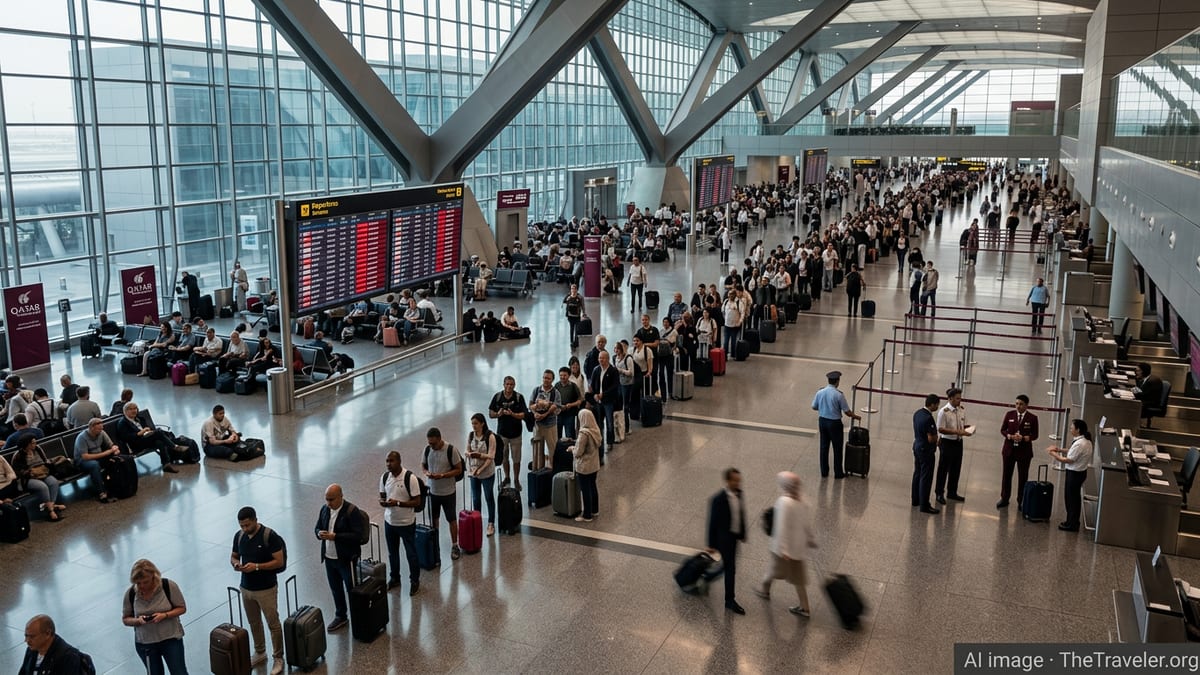
Qatar Airways is grappling with one of the most severe operational crises in its history, with more than 250 flights reportedly canceled and around 41 percent of its global schedule delayed in recent days, leaving tens of thousands of travelers stranded or scrambling to rebook itineraries worldwide.
Get the latest news straight to your inbox!
Airspace Closures Push Qatar Airways Into Emergency Mode
The current wave of disruption stems from the closure and partial reopening of Qatari and regional airspace following heightened tensions and security concerns across the Gulf and broader Middle East at the end of February and into early March 2026. Authorities restricted key corridors around Doha, forcing Qatar Airways, one of the world’s largest long-haul carriers, to suspend most scheduled operations for several days.
As airspace shut down, Hamad International Airport in Doha, the airline’s main hub, saw an unprecedented number of cancellations and rolling delays. Industry tracking data and airport statistics from the last week indicate that more than 250 Qatar Airways flights have been canceled, while delays have affected roughly four in ten flights in some 24-hour periods, a level of disruption on par with major global weather or air traffic control crises.
Qatar Airways confirmed that normal commercial operations remain temporarily suspended, apart from a limited relief schedule operating under special authorization from the Qatar Civil Aviation Authority. The carrier has been gradually adding select services as restricted corridors reopen, but the network is still far from normal, and schedule changes continue to be announced on short notice.
Regional knock-on effects have spread well beyond Doha. Airports in Europe and Asia that rely on Qatar Airways connections, from London and Paris to Kuala Lumpur and Singapore, have reported clusters of cancellations and late arrivals tied directly to the Doha hub shutdown and subsequent rerouting of traffic around closed airspace.
Global Travelers Stranded as Cancellations and Delays Mount
The disruption has left passengers across multiple continents facing missed connections, unplanned stopovers, and lengthy queues for rebooking. Over a 24-hour period earlier this week, data from consumer-rights platforms showed hundreds of flights arriving to or departing from Doha either canceled outright or delayed by several hours, with Qatar Airways accounting for the majority of impacted services.
Travelers connecting through the Gulf have reported last-minute notices that their flights were scrubbed, sometimes after they had already reached their departure airport. Others described flights that remained on airport boards as “on time” for hours before eventually being delayed or canceled, adding confusion to an already stressful situation.
In Europe, airports such as Paris Charles de Gaulle and major hubs in Germany and the United Kingdom recorded waves of late-running Qatar Airways services as aircraft and crews became stuck out of position. In Asia-Pacific, key gateways including Kuala Lumpur and Singapore reported cancellations and rerouted services on Middle East routes as the airline reshuffled scarce aircraft and navigated evolving airspace restrictions.
For many long-haul passengers, particularly those traveling between Europe, Africa, and Asia or Australasia, the disruption has severed one of the most important east–west transit bridges. Families headed for holidays, business travelers, and migrant workers returning home all report being forced to wait days for replacement flights or being rebooked via alternative airlines and circuitous routings.
Qatar Airways Response: Limited Relief Flights and Flexible Policies
Qatar Airways has launched a program of limited relief and repatriation flights in a bid to clear the backlog of stranded passengers while full commercial services remain on hold. Operating under temporary operating corridors approved by regulators, the carrier has been mounting flights from Doha and select regional cities such as Muscat and Riyadh to major European hubs including London, Berlin, Copenhagen, Madrid, Rome, Amsterdam, and Frankfurt.
These flights are primarily being used to move passengers who were already in transit or whose original journeys were disrupted by the airspace closures. Seat availability on many routes remains tight, and the airline is prioritizing travelers with earlier cancellations and those facing the longest delays. Passengers are being advised not to go to the airport unless they have received formal confirmation of a seat on a specific relief flight.
To manage the crisis, Qatar Airways has also extended flexible rebooking and refund options for affected tickets. Passengers whose flights have been canceled are generally being offered complimentary rebooking for later dates, rerouting via alternative gateways where operationally feasible, or refunds. However, travelers who booked through online travel agencies or third-party platforms report additional layers of complexity and longer processing times than those who booked directly with the airline.
Customer-service channels, including call centers and social media support, continue to experience extremely high demand, with many passengers reporting long waits to speak to an agent. Travel advisors are urging passengers to use multiple channels simultaneously, including the airline’s manage-booking tools and official travel alerts page, to secure updated itineraries as soon as they appear.
What Affected Passengers Should Do Now
For travelers with upcoming trips on Qatar Airways in the next several days, the situation remains fluid. Industry experts and travel agents stress that the most important step is to monitor flight status frequently, as schedules are being adjusted in near real time as airspace availability and operating permissions change.
Passengers whose flights have already been canceled should expect the airline to contact them directly by email or text message with rebooking or refund options, though delays in communication are possible due to the volume of affected bookings. If a reasonable alternative is not offered automatically, customers are encouraged to proactively request rerouting onto other Qatar Airways services or, where available, partner airlines, especially if they are traveling for time-sensitive purposes such as medical appointments or family events.
Those who have not yet received a cancellation notice but are scheduled to travel through Doha in the coming days face a more difficult decision: wait and hope the flight operates, or seek voluntary changes. Some passengers are opting to secure backup tickets on other carriers, particularly on routes where multiple Gulf or European airlines compete, while keeping their original Qatar Airways booking in place until its status becomes clear.
Travel insurance and credit card protections may offer additional recourse, depending on the policy wording and how the disruption is classified. Because this event is linked to regional security and airspace decisions, coverage for extra hotel nights, new tickets, or lost connections can vary significantly by insurer and jurisdiction, prompting calls for travelers to read their policies carefully and document all extra expenses.
How Long Will the Disruption Last?
With Qatar’s airspace only partially reopened under tight restrictions and many regional corridors still constrained, aviation analysts caution that it may take days or even weeks for Qatar Airways to fully restore its complex global network to normal operations. Even once regular schedules resume, aircraft and crews will need to be repositioned, and residual delays and ad hoc cancellations are likely as the airline rebalances capacity and clears the backlog of displaced passengers.
Authorities in Doha and neighboring countries have signaled that safety and regional security remain the overriding priorities in determining when and how to reopen critical air routes. That means timetables could continue to shift on short notice if the political or security situation changes, leaving airlines and passengers with limited visibility beyond the immediate travel window.
For now, experts say passengers should treat any Qatar Airways itinerary passing through Doha in the near term as subject to change. Flexible planning, including allowing extra time for connections, securing refundable accommodation where possible, and staying in close contact with the airline or travel agent, will be key to minimizing disruption.
What is clear is that this episode has underlined how quickly regional airspace decisions can ripple across global travel. With more than 250 cancellations and a delay rate touching 41 percent at the height of the crisis, the Qatar Airways disruption has become a stark reminder of the fragility of the world’s long-haul hub-and-spoke systems, and of the importance for travelers of understanding their rights and options before they fly.