

More news on this day
Thousands of passengers across the Gulf were left stranded on Friday as Hamad International Airport in Doha canceled 287 flights and delayed one, the latest dramatic disruption to regional air travel amid escalating tensions that have forced multiple Middle Eastern countries to curtail or close their airspace.
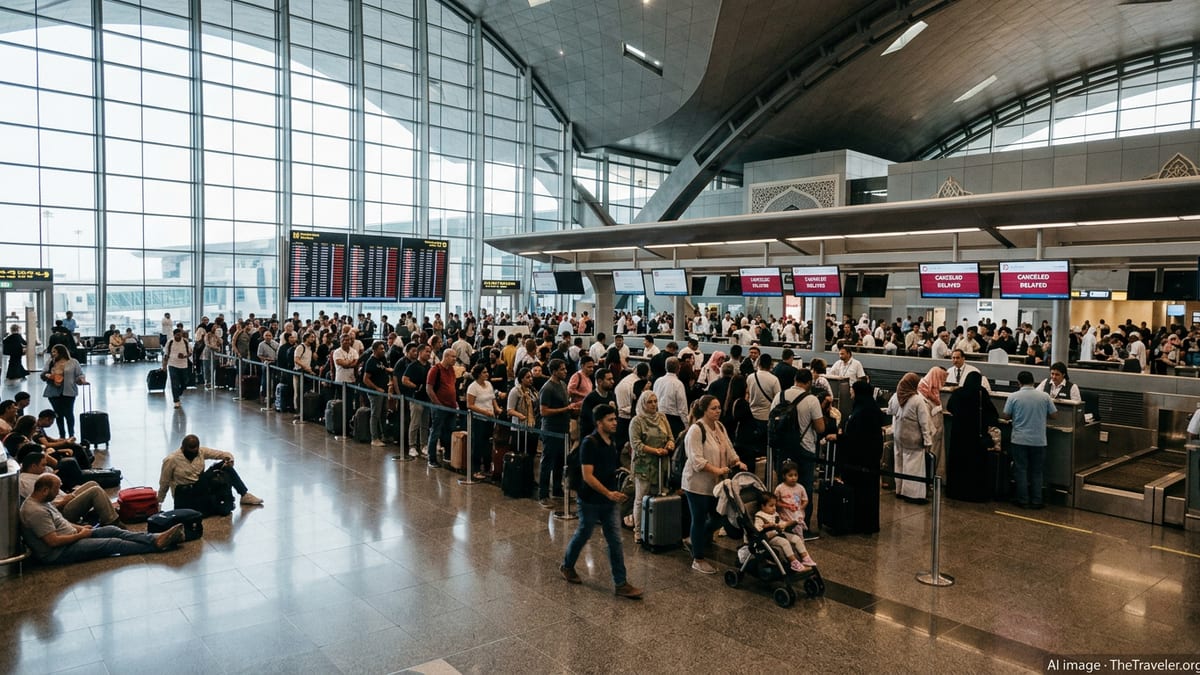
Hamad International Becomes Flashpoint in Regional Airspace Crisis
The sweeping disruptions at Hamad International Airport mark one of the sharpest single-day shocks yet in a week of cascading aviation turmoil across the Middle East. Flight-tracking data and airport operations summaries show that 287 flights linked to Doha’s hub were canceled in a 24-hour window, with just a single service officially recorded as delayed, underscoring how quickly schedules collapsed as authorities reassessed airspace safety.
The cancellations hit a mix of regional and long-haul routes, affecting connections between Doha and major global cities from London and Amsterdam to Bangkok and Melbourne. Instead of the usual seamless transfers through one of the Gulf’s most important hubs, many transit passengers found themselves unable to leave secure zones, queueing at overburdened service desks or attempting to rebook via call centers already overwhelmed by demand.
Airport authorities and airlines have repeated that passenger and crew safety remains the overriding priority. Public advisories in Doha now explicitly urge travelers not to travel to the airport unless they have been contacted by their airline and provided with a confirmed departure time, a striking shift for a hub that typically encourages early arrivals and smooth, continuous flows of connecting traffic.
Knock-On Disruptions for Flydubai, Saudia, Etihad and Oman Air
The Doha shutdown is reverberating far beyond Qatar’s borders, entangling a wide network of carriers that rely on Gulf airspace as a bridge between continents. Regional airlines including Flydubai, Saudia, Etihad Airways and Oman Air have all reported significant disruption to their schedules as they juggle suspended routes, diverted aircraft and stranded crew.
Industry data compiled over recent days shows that Qatar, the United Arab Emirates, Saudi Arabia, Oman and other states have together canceled well over a thousand flights since the latest phase of the crisis began, with Qatar’s Hamad International among the hardest-hit. While some airports in the region have started cautiously restoring limited operations, many services that would ordinarily cross or skirt conflict-affected airspace remain grounded.
For carriers such as Saudia and Oman Air, Doha’s role as both a destination and a crucial waypoint has created additional complexity. Aircraft and crew that would normally rotate through Qatar have been forced into unplanned layovers or rerouting, compressing already tight schedules and reducing spare capacity that might otherwise have been deployed to rescue stranded passengers.
Stranded Travelers Face Long Waits, Patchy Information
For travelers caught mid-journey, the statistics translate into hours or days of uncertainty. At Hamad International, passengers described departure boards dominated by red "canceled" notices and repeated public announcements urging travelers to seek updates from their airlines rather than queue at check-in counters that could not offer firm answers.
Many transit passengers have found themselves marooned without entry visas to Qatar, limiting their ability to leave the terminal and seek alternative accommodation. Hotels in Doha and in secondary gateways across the Gulf have reported a sudden influx of unexpected guests as airlines scramble to secure rooms for those eligible to enter, and many passengers without guaranteed vouchers have resorted to booking whatever limited inventory remains at short notice.
Communication has emerged as a central frustration. With call centers jammed and airline apps struggling to keep up with rolling schedule changes, passengers report receiving conflicting or last-minute updates about whether flights will operate. Some have accepted rebookings that route them through other Gulf hubs, only to see those onward legs canceled as the crisis shifts from one airport to another.
Airlines Deploy Relief Flights and Contingency Hubs
In response to the mounting backlog of stranded travelers, several Gulf carriers are rolling out emergency measures designed to move at least some passengers out of the region. Etihad and other airlines have announced limited relief flights from relatively less affected airports, including selected Saudi and Omani gateways, while continuing to suspend regular passenger services on higher-risk routes.
Operational updates indicate that some carriers are prioritizing travelers with imminent connections to long-haul services, medical needs or expiring visas for the earliest available outbound seats. However, with aircraft and crew scattered across multiple countries and overnight duty limits constraining how long staff can work, capacity remains far below normal levels and many passengers are being told to expect extended stays.
Alternative routings via airports that retain more stable operations, such as Muscat and selected Saudi hubs, are emerging as crucial escape valves. Yet these workarounds often involve complex itineraries, overland transfers and additional security screening, placing extra strain on passengers and airport infrastructure alike. For many, the choice is between waiting in Doha for their original carrier to resume service or attempting a highly uncertain multi-leg journey through a patchwork of open corridors.
Escalating Tensions Turn Gulf Into Global Bottleneck
The disruption at Hamad International is only the latest sign of how geopolitical tensions have transformed the Gulf from a hyper-efficient aviation crossroads into a bottleneck that is rippling across global travel. With large swaths of airspace in and around the region subject to restrictions or closures, airlines have been forced to choose between lengthy detours that add hours and cost to flights or outright cancellations to protect safety.
Before the current crisis, Middle Eastern hubs such as Doha, Dubai and Abu Dhabi handled tens of thousands of connecting passengers every day, linking Europe and the Americas with Asia and Africa. The sharp reduction in capacity at these airports has already led to knock-on delays and equipment shortages as far afield as Europe, India and Southeast Asia, where aircraft that would normally cycle rapidly through the Gulf are now tied up on the ground.
Aviation analysts warn that even if tensions ease and airspace gradually reopens, it could take weeks for schedules to normalize. Airlines will need to reposition aircraft, realign crew rosters and clear backlogs of disrupted passengers, while travelers remain wary of booking new itineraries that depend on volatile routes. For now, the canceled 287 flights at Hamad International stand as a stark measure of how swiftly the region’s critical air links can seize up when politics and security overshadow the open skies on which global tourism depends.