

More news on this day
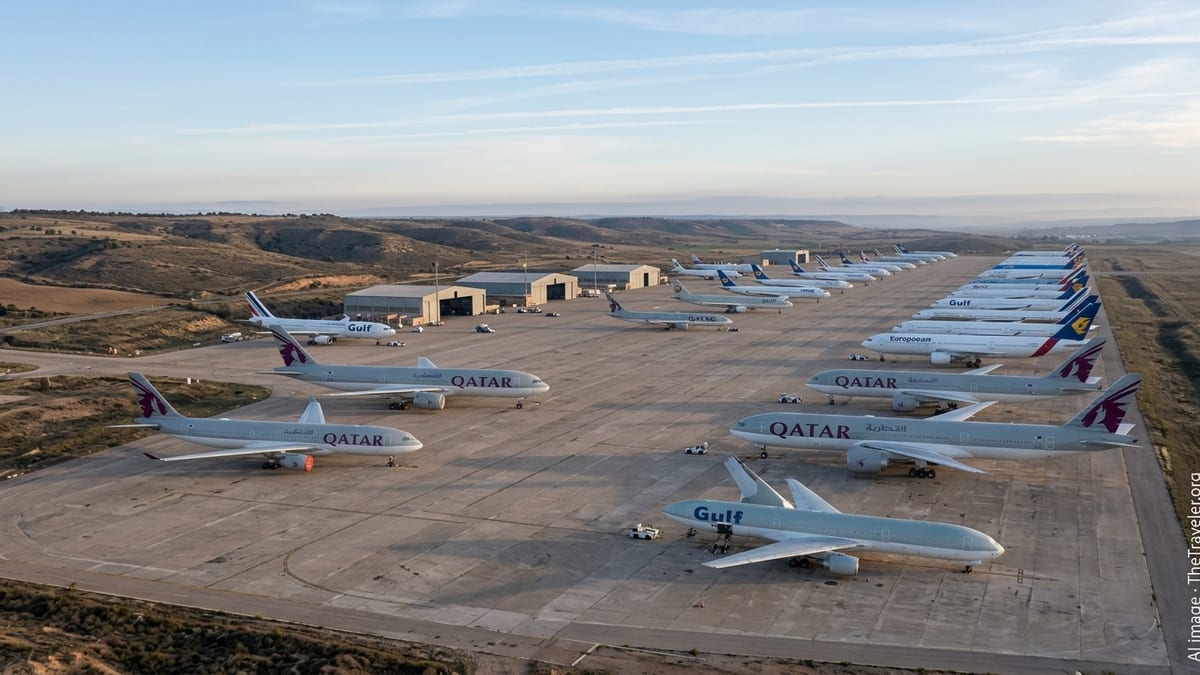
Escalating tensions and airspace closures around Qatar and the wider Gulf region are reshaping global flight patterns, with a growing number of widebody aircraft now being ferried to Teruel Airport in eastern Spain for safe parking and maintenance amid ongoing aviation disruptions.
Get the latest news straight to your inbox!
Gulf Airspace Closures Push Airlines to Seek Distant Havens
Since late February 2026, missile strikes and rising military activity involving Iran and Gulf states have led to sweeping airspace closures across Qatar, the United Arab Emirates, Kuwait, Bahrain and parts of Iran. Publicly available information shows that Hamad International Airport in Doha, a major global hub, has experienced significant disruption as airlines suspend or curtail operations in and out of the region.
According to international media coverage of the conflict’s economic fallout, thousands of daily flights across the Middle East have been cancelled or rerouted, affecting leading Gulf carriers such as Qatar Airways, Emirates and Etihad. With commercial timetables slashed and long-haul networks temporarily reduced, airlines are facing the challenge of where to position idle widebody aircraft safely and efficiently while uncertainty persists.
In this context, Spanish and international reports indicate that a growing number of aircraft are being repositioned from the Gulf region to long-term parking facilities in Europe. Chief among them is Teruel Airport, a high-altitude storage and maintenance hub in the Spanish region of Aragon, which has previously played a central role in housing grounded fleets during earlier global aviation crises.
Teruel Airport Emerges Again as a Strategic Aircraft Refuge
Teruel Airport, situated near the provincial capital of the same name, has no regular passenger traffic and is dedicated almost entirely to aircraft storage, maintenance and dismantling. Over the past decade it has become one of Europe’s largest “aircraft graveyards,” though its role extends far beyond scrapping, with extensive facilities for conservation, overhaul and eventual reactivation of large commercial jets.
Public information from Spanish authorities and aviation companies highlights Teruel’s advantages for long-term storage: dry continental climate, relatively high elevation and expansive paved aprons. Operators such as TARMAC Aerosave have used the site to host hundreds of aircraft, including Airbus A380s and other widebody models, particularly at the height of the 2020 pandemic when global air travel ground to a halt.
Recent Spanish press coverage indicates that Teruel is once again filling with aircraft, this time driven by geopolitical conflict rather than a health emergency. The facility’s scale, dedicated maintenance hangars and experience handling long idle periods are turning it into a strategic asset for carriers needing to move jets rapidly out of conflict-affected airspace while preserving their value for a future return to service.
Qatar Airways Leads Relocation as Regional Disruptions Deepen
Reports from Spanish news outlets describe Qatar Airways as one of the most active users of Teruel Airport during the current crisis. Coverage indicates that the airline has ferried multiple widebody aircraft from Doha and long-haul destinations to the Aragonese airfield in recent days, seeking a secure location away from the risks associated with operating in and out of the Gulf.
According to those reports, the aircraft involved include Airbus A330s and A350s historically deployed on high-density international routes. Some arrivals are described as coming directly from Doha, while others are repositioned from long-haul city pairs such as Los Angeles, reflecting a broader reshaping of Qatar Airways’ intercontinental network as schedules are thinned and connections via Doha are reduced.
Other carriers are also featured in local coverage linked to the current wave of relocations, including at least one Boeing 787 from a major European airline making use of Teruel’s storage facilities. These movements add to the airport’s already diverse tenant list, which over previous years has included aircraft from European, Asian and Middle Eastern operators using the site for both long-term parking and heavy maintenance.
The sudden influx underscores how concentrated the impact of Gulf disruptions can be on specific nodes far from the Middle East. As aircraft vacate congested or vulnerable airports around the Gulf, specialized facilities like Teruel absorb the displaced capacity, effectively becoming an extension of the region’s aviation infrastructure in times of crisis.
Aviation Supply Chain in Spain Responds to Crisis-Driven Demand
The renewed use of Teruel by Gulf carriers coincides with a period of expansion for the airport and its resident maintenance providers. Spanish regional media and industry publications have reported new investments in large hangars capable of handling Airbus A380s and other widebody aircraft, as well as plans to increase staffing and technical capabilities in 2026.
These projects were initially conceived to serve a growing global fleet and rising demand for heavy checks, painting and end-of-life recycling. The current crisis is accelerating that trajectory, with conflict-related relocation of aircraft boosting activity levels and testing the capacity of Teruel’s infrastructure to manage a surge in arrivals while maintaining high standards of preservation and safety.
The situation also highlights Spain’s broader role within the aviation supply chain. Facilities such as Teruel and other long-term parking sites in the country have become important buffers, able to absorb large numbers of aircraft when sudden shocks hit demand in other regions. For local economies, this translates into specialized employment and investment, while for airlines it offers a way to protect assets until conditions allow for a gradual restart of routes through the Gulf.
Industry observers note that the concentration of storage and maintenance in a few large sites raises questions about resilience and diversification. However, Teruel’s track record across multiple crises positions it as a proven option when airlines must react quickly to external shocks that are beyond their control.
Global Travel Networks Adjust as Carriers Wait for Stability
The movement of Qatar Airways and other Gulf-region aircraft to Teruel is one visible element of a wider recalibration of global travel. With airspace closures affecting key corridors between Europe, Asia and Africa, airlines are redesigning routings, consolidating frequencies and relying more heavily on alternative hubs outside the immediate conflict zone.
Travel industry reports suggest that passengers are already experiencing longer journeys, more complex itineraries and increased use of secondary hubs in Europe and Asia as carriers avoid affected skies. For many long-haul travelers, the temporary absence or reduction of Doha as a transit point is reshaping common one-stop options between continents.
How long aircraft will remain parked in Teruel and similar facilities depends on the evolution of the regional crisis and the pace at which airspace restrictions are eased. If tensions persist, airlines may opt to keep a portion of their fleets in storage to limit operating costs and exposure, while slowly rebuilding schedules through safer corridors.
For now, the rows of Qatar Airways and other Gulf-based jets lined up on the dry plateau of eastern Spain have become a stark illustration of how political shock waves in one region can displace aircraft, passengers and economic activity thousands of kilometers away, leaving global aviation once again in a holding pattern.