

More news on this day
Qatar has begun restoring limited flight services from Doha under emergency operating conditions, cautiously reopening a key slice of Middle East airspace while maintaining stringent safety restrictions amid an unresolved regional crisis.
Get the latest news straight to your inbox!
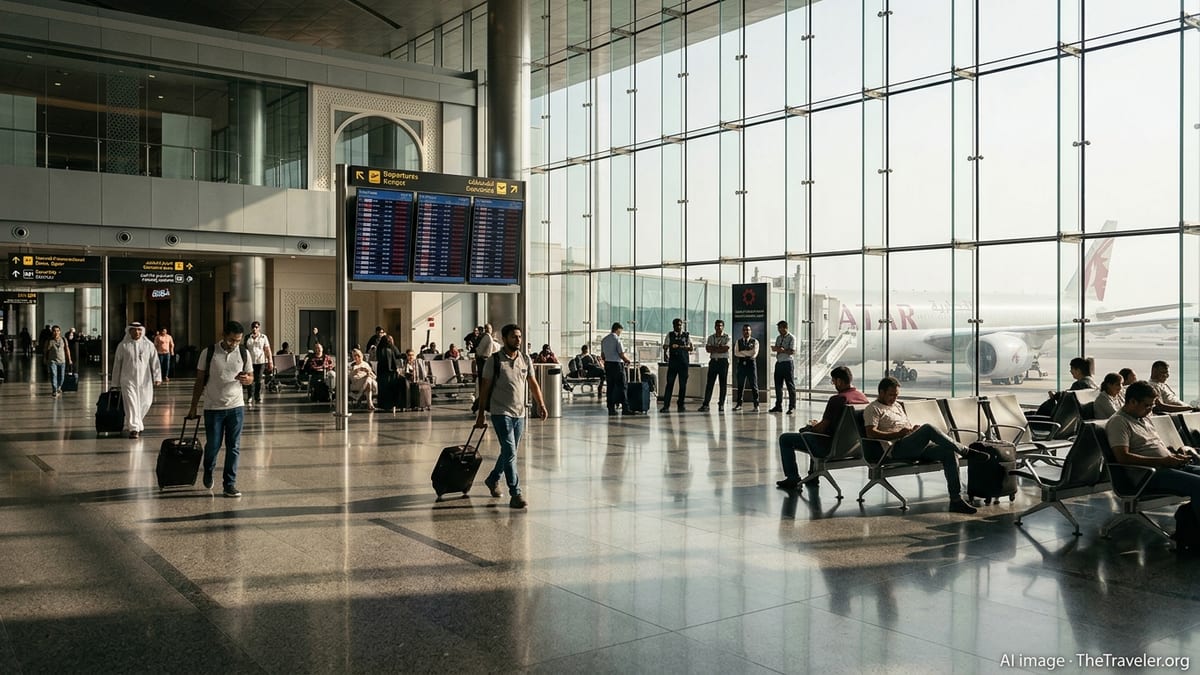
From Full Shutdown to Controlled Reopening
Qatar’s gradual move to restart flights follows one of the most acute disruptions to Gulf aviation in recent years, triggered by escalating conflict involving Iran, Israel and the United States. In late February and early March 2026, reports from international news agencies and aviation trackers indicated that Qatar joined several neighboring states in closing its airspace, forcing mass cancellations at Doha’s Hamad International Airport and diverting traffic across the wider region.
Publicly available information shows that the latest closure built on a pattern of earlier interruptions. In June 2025, Qatar temporarily halted air traffic after Iranian missile strikes linked to the broader regional confrontation, before reopening under tight restrictions and revised routings. Industry analyses at the time described the episode as a stress test for how quickly Gulf hubs could shut down, absorb stranded passengers and then restart operations while avoiding active conflict zones.
The new reopening phase, announced in March 2026 by Qatar’s civil aviation authorities, is more limited in scope. Air navigation has resumed on a restricted basis, prioritizing evacuation and essential cargo flights, with most regular commercial services still suspended or heavily reduced. Available documents describe the framework as an “emergency” operating posture rather than a return to normal connectivity.
For passengers, this has translated into a patchwork of resumptions rather than a clear-cut restart. Some travelers with existing tickets are being rebooked onto reduced schedules or alternative routings via third countries, while others are being offered refunds or open-dated options as airlines wait for more clarity on regional airspace stability.
Safety-First Airspace Management and Rerouting
Qatar’s cautious approach is closely tied to a wider safety recalibration across Middle East airspace. Aviation safety advisories and NOTAMs issued since 2025 have highlighted elevated risks to civil aviation posed by long-range missiles, drones and military operations over or near traditional commercial corridors spanning Iran, Iraq, Syria, Israel and surrounding waters.
According to industry monitoring services, much of the long-haul traffic that previously overflew the Gulf and northern Middle East has been rerouted either north over the Caspian region or south via Egypt, Saudi Arabia and the Red Sea. These adjusted routings, already common after earlier phases of the conflict, have become even more important as Qatar and several neighbors impose partial closures or altitude restrictions along sensitive segments.
Operational updates from logistics and freight operators indicate that Qatar Airways and other carriers using Doha are layering multiple risk controls onto these detours. Measures include avoiding specific flight levels near potential missile trajectories, widening separation from military zones, and building in contingency holding points and diversion airports farther from the core conflict. Flight times on key Europe–Asia corridors have lengthened by two hours or more in some cases, increasing fuel burn and crew time but reducing exposure to unstable airspace.
Public aviation data also suggests that Qatar’s authorities are sequencing departures and arrivals more conservatively during the limited reopening phase, spacing movements to preserve flexibility for rapid rerouting should threat assessments change. This approach has reduced capacity at Hamad International compared with pre-crisis levels, but it has also given air traffic controllers more room to adjust to fast-changing conditions.
Qatar Airways Adjusts Network Under Ongoing Constraints
Qatar Airways, the country’s dominant carrier and one of the world’s largest long-haul operators, remains at the center of the disruption. The airline had already suspended services to high-risk destinations such as Iran, Iraq and Syria at various points since 2024, according to airline advisories and freight market reports, before gradually restoring selected routes in mid-2025 as conditions briefly improved.
Those restorations included the resumption of flights to Iraq, Lebanon, Jordan and Syria during 2025, framed in press statements as compliant with international safety rules and based on updated risk assessments. The new wave of conflict in late 2025 and early 2026, along with missile activity affecting Qatari territory itself, has again forced the airline to scale back, particularly on routes that would cross or approach contested airspace.
Recent operational summaries compiled by cargo and travel advisory firms suggest that Qatar Airways is now focusing its limited schedules on relatively lower-risk corridors, using Doha primarily as a controlled transit point for evacuation passengers and essential freight. Services into certain parts of South Asia, Africa and Europe continue but are subject to last-minute time changes, extended routings and equipment swaps as the airline adapts to evolving restrictions.
Network decisions are being shaped not only by the immediate security situation but also by regulatory guidance from international aviation bodies and insurance considerations. Underwriters and safety analysts have flagged sections of Middle East airspace as higher risk, affecting what coverage airlines can secure for particular routes and altitudes. Qatar’s incremental restart appears aligned with these external parameters, emphasizing flights where risk and insurance thresholds remain manageable.
Regional Ripple Effects on Global Travel
Qatar’s limited reopening is taking place against the backdrop of a much broader airspace squeeze stretching from the eastern Mediterranean to the Gulf of Oman. Recent coverage by global news outlets and aviation specialists indicates that Iran, Iraq, Israel, Jordan, Lebanon, Bahrain, Kuwait, Qatar, the United Arab Emirates, Oman and Saudi Arabia have all imposed varying degrees of closure or restriction at times during the latest escalation.
This has effectively narrowed the primary east–west air corridors that connect Europe and Africa with South and East Asia. Carriers that previously relied heavily on Gulf hubs such as Doha, Dubai and Abu Dhabi are being pushed to spread traffic across alternative waypoints in Central Asia, southern Africa and even transpolar routes, often at significantly higher operating cost.
For travelers, the impact is visible in longer journey times, reduced flight options and higher fares on certain dates and city pairs. Publicly available booking and fare data point to sharp price spikes on some itineraries that still offer relatively direct routings, along with a rapid sell-out of seats on flights that bypass the Middle East altogether. Even as Qatar tentatively restores a sliver of capacity, the region remains far from its previous role as a seamless global transit bridge.
Industry observers note that the situation has also strained airport infrastructure in alternative hubs hastily absorbing diverted passengers and aircraft. Airports in Turkey, Egypt and parts of southern Europe have experienced crowding and operational bottlenecks, underscoring how deeply intertwined Qatar’s airspace and its Doha hub are with the wider international network.
Traveler Guidance and Outlook for the Coming Weeks
With Qatar’s flight services returning only in a limited, safety-first configuration, travel experts are advising passengers to plan for ongoing volatility. Guidance from airlines, travel agencies and government advisories emphasizes the need to monitor bookings closely, arrive early at airports and prepare for sudden schedule changes, particularly for journeys that involve transit through the Middle East.
Publicly accessible notices from airlines serving Doha encourage passengers to use digital channels to track real-time flight status and to ensure that contact details in reservations are up to date for receiving last-minute alerts. Many carriers are maintaining flexible change and refund policies for itineraries touching high-risk areas, reflecting recognition that conditions and regulations can shift rapidly.
In the short term, aviation analysts see little prospect of a quick return to pre-crisis traffic flows. Even if a durable ceasefire takes hold, restoring confidence in overflight safety typically lags behind political developments, as regulators, insurers and airline safety teams require sustained evidence that missile and drone threats have diminished. Qatar’s choice to move cautiously, reopening only a subset of operations under enhanced safeguards, is being interpreted as a signal that the country expects a protracted period of heightened vigilance.
For now, Qatar’s controlled restoration of air traffic offers a limited but symbolically important sign that some connectivity can be maintained even amid an unstable security environment. How quickly that partial reopening can expand will depend on both the trajectory of the Middle East crisis and the global aviation community’s assessment of when the skies above the region are safe enough for a broader return.