

More news on this day
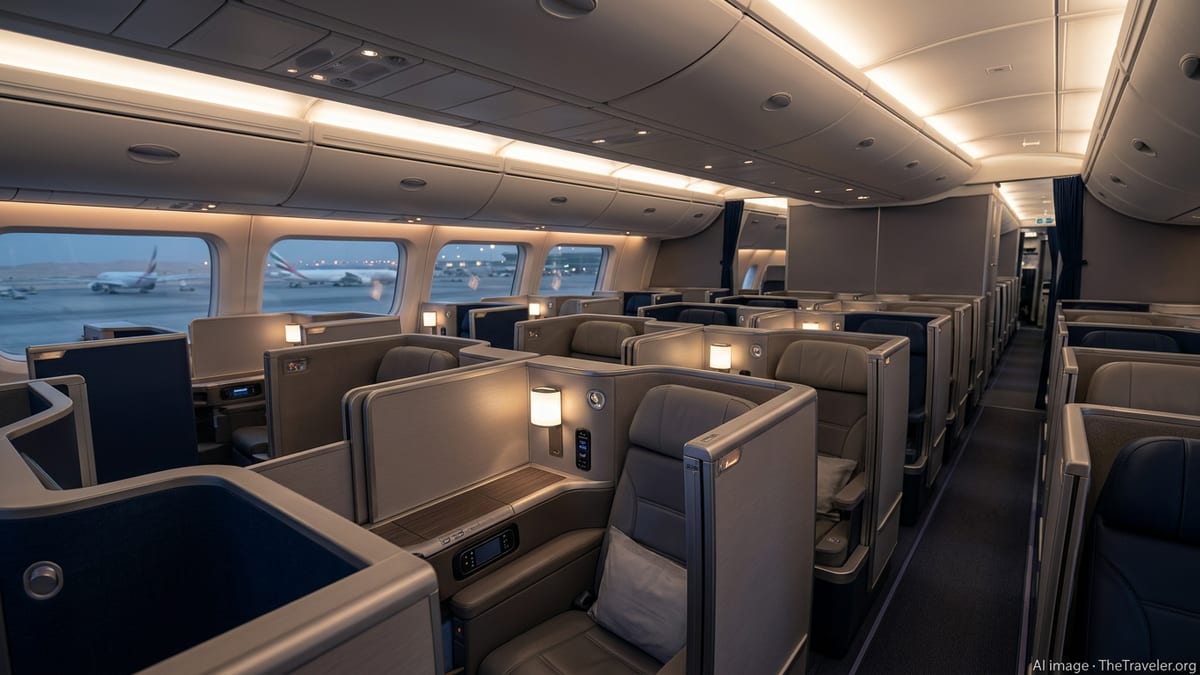
In the middle of geopolitical turbulence and shifting travel patterns, the Gulf’s three heavyweight carriers are doubling down on comfort at the front of the cabin, turning business class into a showcase for design, technology and soft-product extravagance that is redefining expectations on long-haul routes.
Qatar Airways Sets the Benchmark With Suites and Awards
Doha-based Qatar Airways continues to set the pace in the region’s premium cabin contest, leveraging its high-profile Qsuite product and a stream of industry accolades. In 2025 the airline was once again named World’s Best Business Class by Skytrax and took the title of World’s Best Airline, reinforcing its status as the benchmark many rivals seek to match. The carrier’s strategy has been to standardise a suite-style experience on key long-haul routes, with closing doors, staggered seating and couples’ configurations that blur the line between business and first class.
Qsuite, first launched in 2017, remains central to that positioning, but Qatar Airways is now working on a next-generation version aimed at maintaining its lead as competitors catch up with their own all-aisle-access, doored suites. While detailed specifications have yet to be widely rolled out, the airline has confirmed that future deliveries will continue the emphasis on privacy, storage and high-definition entertainment, supported by high-speed connectivity and upgraded bedding and dining. The message is that Qatar intends to stay ahead not just through hardware, but by continuously elevating the overall experience, from lounge to limousine.
Network strategy plays a role too. With a dense web of flights between Europe, Asia and Africa, Qatar Airways can maximise the utilisation of its most advanced cabins on routes popular with corporate travellers and high-yield leisure passengers. Even as parts of regional airspace experience intermittent closures and detours, the airline has been careful to protect the integrity of its premium schedule, banking on the idea that business-class travellers will tolerate longer routings if the on-board environment feels more like a private office or bedroom than a traditional airline seat.
The carrier’s repeated wins at the World Travel Awards as the Middle East’s Leading Airline for Business Class underscore how strongly its approach resonates with frequent flyers. For rivals in Dubai and Abu Dhabi, Qatar’s success has added urgency to their own cabin renewal programmes, setting up a three-way contest that has effectively turned the Gulf into a global test bed for what business class can become.
Emirates Retires Middle Seats and Rolls Out a New 777 Cabin
Dubai-based Emirates, long associated with opulent first class suites and extensive A380 service, is now pushing hard to refresh its core business class product. The airline has begun phasing out the unpopular 2-3-2 layout on its Boeing 777-300ER fleet in favour of a 1-2-1 configuration, eliminating middle seats and ensuring direct aisle access for every passenger. Recent reviews of the refitted cabins note calmer colour palettes, larger personal screens and more intuitive seat controls, making the hard product feel closer in spirit to the airline’s latest A380 business cabin.
The retrofit programme is already visible on routes across North America, Europe, Asia and Africa, where refurbished 777s are operating with the new staggered layout and an updated soft product including refreshed diningware and revised menus. For many frequent travellers, the change addresses a long-standing inconsistency in the Emirates experience, where the airline’s flagship A380s offered competitive fully flat, all-aisle-access seats, while some 777s still required climbing over a neighbour to reach the aisle. Aligning the fleet narrows that gap just as competitors move to enclosed suites.
Emirates is also positioning the revamped business class as part of a broader premium strategy built around its Dubai hub. With the UAE investing heavily in airport infrastructure and preparing for the eventual arrival of Boeing’s delayed 777X aircraft, the airline is effectively future-proofing its core cabin for the next decade. The refreshed 777s will bridge the gap until new-generation widebodies arrive, and the design language of today’s seats is expected to influence what comes next.
For corporate buyers and travel managers, the removal of middle seats and the promise of consistent all-aisle access are powerful selling points. They make it easier to justify premium fares on key trunk routes between Europe, the Middle East and Asia, particularly as journey times fluctuate due to rerouted flight paths around closed airspace in parts of the region. Emirates is betting that a reliable, comfortable business cabin, backed by dense frequencies and a vast network, will keep its planes full at the front even as competition intensifies.
Etihad Bets on All-Doored Suites Across its Long-Haul Network
Abu Dhabi’s Etihad Airways, once seen as the smallest of the Gulf’s big three, has quietly repositioned itself as a boutique-style carrier with a sharp focus on premium consistency. Central to that shift is a roll-out of next-generation Business Suites on both Airbus A350-1000 and refreshed Boeing 787-9 aircraft. The seats, arranged in a 1-2-1 layout with sliding doors, convert into 79-inch fully flat beds and feature 4K entertainment screens, Bluetooth audio, wireless charging and upgraded storage.
In recent months Etihad has completed a major cabin upgrade on its Australian routes, moving to an all-Doored Business Suite offering from both Sydney and Melbourne to Abu Dhabi. Sydney is now served exclusively by the A350-1000, while Melbourne has transitioned to the latest 787-9 configuration, allowing the airline to market a harmonised premium product across its key Australian gateways. The upgrade significantly increases the number of business class seats on those routes, signalling confidence in sustained demand from corporate clients and premium leisure travellers.
Beyond Australia, the same cabin concept is appearing on services to North America, Europe and major Asian cities, gradually phasing out Etihad’s older Pearl Business Class. The airline is pairing those hardware improvements with elevated soft touches, including Armani-branded amenities and refined inflight dining, in an effort to carve out a distinctive, design-led identity distinct from its larger neighbours.
For Etihad, the move to make doored suites the standard rather than the exception is a way to punch above its size. While it lacks the sheer network breadth of Emirates or the award track record of Qatar Airways, offering a consistently private, high-tech business seat on long-haul flights allows the airline to compete on perceived quality. It also fits neatly with Abu Dhabi’s broader ambition to grow as a premium tourism and business hub, supported by an airport designed around quick, comfortable connections.
A Region Using Luxury Cabins to Ride Out Turbulence
The simultaneous push by Qatar Airways, Emirates and Etihad to refine their business cabins comes at a time of heightened operational complexity in the Middle East. Airspace closures linked to regional tensions have forced airlines to reroute services through narrow corridors, adding flying time and fuel burn on some long-haul routes. For passengers paying premium fares, that extra time in the air becomes more palatable inside a private suite with fast connectivity and restaurant-style dining than in an older, more cramped cabin.
In that context, investment in business class is about more than bragging rights. It is a hedge against volatility, helping carriers protect yields even when schedules are disrupted or flying becomes less predictable. By ensuring that their headline products are genuinely differentiated, the Gulf airlines hope to keep high-value travellers loyal, rather than losing them to European or Asian rivals that may offer more direct routings but less competitive onboard comfort.
The strategy also reflects shifting economics in long-haul aviation. As modern widebodies allow airlines to serve more point-to-point routes, connecting hubs must work harder to justify an extra stop. One way to do that is to make the transfer experience, from lounge to lie-flat bed, so comfortable that the inconvenience of a connection fades into the background. In that race, the Gulf carriers’ willingness to experiment with suites, doors and advanced seat technology has made them global trendsetters.
For travellers, the result is a golden era of choice at the sharp end of the cabin. Whether it is the award-winning Qsuite at Qatar Airways, the freshly reconfigured 777s at Emirates, or Etihad’s all-Doored Business Suites on A350s and Dreamliners, the Middle East has become the frontline of a rapidly escalating business class arms race, one that shows few signs of slowing even as the skies above the region grow more crowded and complex.