

More news on this day
Travel across Qatar and beyond has been hit by a fresh wave of disruption as more than 60 flights to and from Doha were cancelled, affecting routes to Bahrain, Ahmedabad, Amritsar, Manchester, Tokyo, Beijing, Singapore, Bali, Sydney, Melbourne and other major cities, according to published schedules and airport information.
Get the latest news straight to your inbox!
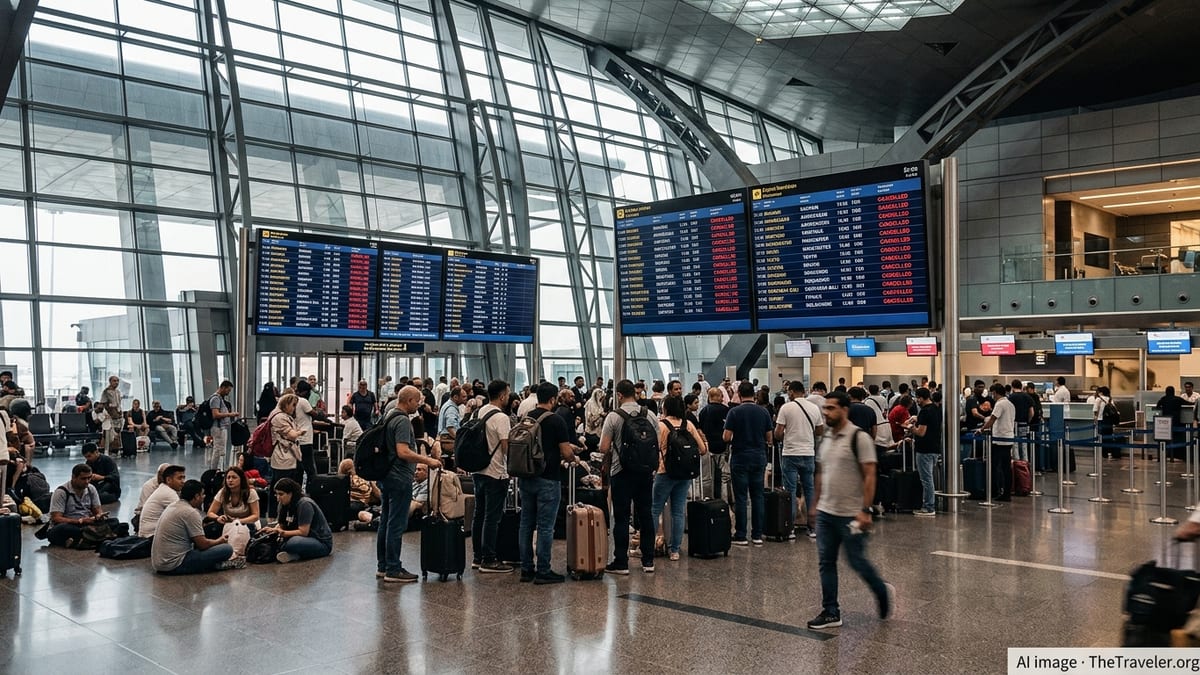
Wide Ranging Cancellations Centered on Doha
The latest round of disruption is focused on services linked to Doha’s Hamad International Airport, a key hub for traffic between Europe, Asia and Oceania. Publicly available airport boards and schedule data show that more than 60 flights have been removed from operation over a short time window, with a mix of outright cancellations and consolidations.
Among the most affected are Qatar Airways operated services and codeshare routes involving partners such as Gulf Air and Malaysia Airlines. The cuts span both short haul Gulf connections and long haul intercontinental flights, underlining the central role Doha plays in regional and global connectivity.
While some cancellations involve single daily rotations, others affect multiple frequencies on the same city pair. This has left passengers with fewer alternatives on busy corridors at short notice, particularly those using Doha as a transit point between South Asia, East Asia and Australia.
The pattern of disruption follows earlier periods in which capacity to and from Qatar was already constrained, meaning the latest schedule changes compound existing pressure on seats during a period of heightened travel demand.
Key Routes Hit Across the Gulf, South Asia and Europe
Within the Gulf, flights between Doha and Bahrain are among those most visibly affected. These short hops are typically used by business travelers and onward connecting passengers, and any reduction in frequencies can quickly ripple across wider networks because of tight banks of connections.
South Asian routes have also seen significant impact, with cancellations on services linking Doha to cities such as Ahmedabad and Amritsar. These flights are important for large expatriate communities working in the Gulf who rely on frequent services for family visits and seasonal travel.
In Europe, Manchester has emerged as one of the key long haul links affected by the changes. The Doha Manchester route is often used for one stop itineraries between the United Kingdom and destinations across Asia and Australia, so disruption there can lead to missed onward connections and rebookings across multiple carriers.
The breadth of affected destinations highlights how even a concentrated set of cancellations in Qatar can alter travel options across several continents, especially for passengers who booked itineraries built around short minimum connection times in Doha.
Long Haul Asia Pacific Links to Tokyo, Beijing and Australia
Published route information indicates that a number of high profile Asia Pacific services are part of the disruption, including flights touching Tokyo and Beijing. These routes connect major Asian capitals with the Gulf and onward to Europe and Africa, and typically operate with widebody aircraft that carry large numbers of transfer passengers.
In Southeast Asia and the Indonesian archipelago, services associated with Singapore and Bali feature among the cancellations. These destinations have historically been strong performers in terms of leisure and premium demand, and reduced frequencies can tighten capacity for holiday periods and school break travel.
Flights to Australia are also affected, with Sydney and Melbourne appearing in lists of disrupted routes. These long haul sectors are central to the strategy of Gulf based carriers, which market one stop connections between Australian cities and a range of European and Asian destinations via Doha.
Travel agents and online booking platforms are beginning to reflect the new reality, with fewer flight options displayed on key city pairs and some itineraries disappearing entirely when underlying segments through Doha are cancelled or retimed.
Impact on Travelers and Options for Rebooking
The immediate impact for travelers is a mix of same day cancellations, significant delays and re routings through alternative hubs. Passengers booked on affected Qatar Airways, Gulf Air or Malaysia Airlines itineraries involving Doha are facing schedule changes that may add extra connections or overnight layovers.
According to publicly available information from airline customer notifications and booking engines, most affected travelers are being offered rebooking on the next available flight on the same carrier or, where possible, on alliance or codeshare partners. However, the concentration of cancellations over a limited period is putting pressure on remaining seats.
Travelers connecting from secondary cities in South Asia or Southeast Asia through Doha to Europe and Australia may experience particular difficulty because alternatives often require backtracking or connecting through additional hubs such as Dubai, Abu Dhabi, Muscat or Kuala Lumpur.
Passenger rights and compensation vary depending on point of origin and jurisdiction, with different rules applying to itineraries that start in the European Union or United Kingdom compared with those that originate in Asia or the Middle East. Travelers are being advised in public travel advisories and media coverage to check the latest status of their flights and to monitor airline apps closely before heading to the airport.
Airlines Adjust Networks Amid Ongoing Regional Volatility
The wave of cancellations comes against a backdrop of heightened regional tension and already complex airspace conditions affecting Qatar and its neighbors. Recent events have led to intermittent restrictions and rerouting across parts of the Middle East, forcing airlines to reassess schedules, block times and aircraft deployment.
Qatar Airways, Gulf Air, Malaysia Airlines and associated partners regularly publish updates to schedules in response to shifting operational and commercial pressures. Industry analysts note in recent coverage that carriers are simultaneously dealing with higher fuel costs, evolving security considerations and changing demand patterns on key routes.
For hub based airlines, even small adjustments to flight banks can cascade across the network, especially where tight connections are central to the business model. The latest Qatar centered disruptions illustrate how quickly such changes can be felt by travelers far from the Gulf, including in cities like Tokyo, Beijing, Singapore, Bali, Sydney and Melbourne.
As airlines refine their plans, further short notice adjustments to Qatar related flights remain possible. Passengers planning to travel through Doha in the coming days are being encouraged by publicly available advisories and media reports to build in additional buffer time, verify transit requirements and remain flexible about routing if circumstances change again.