

More news on this day
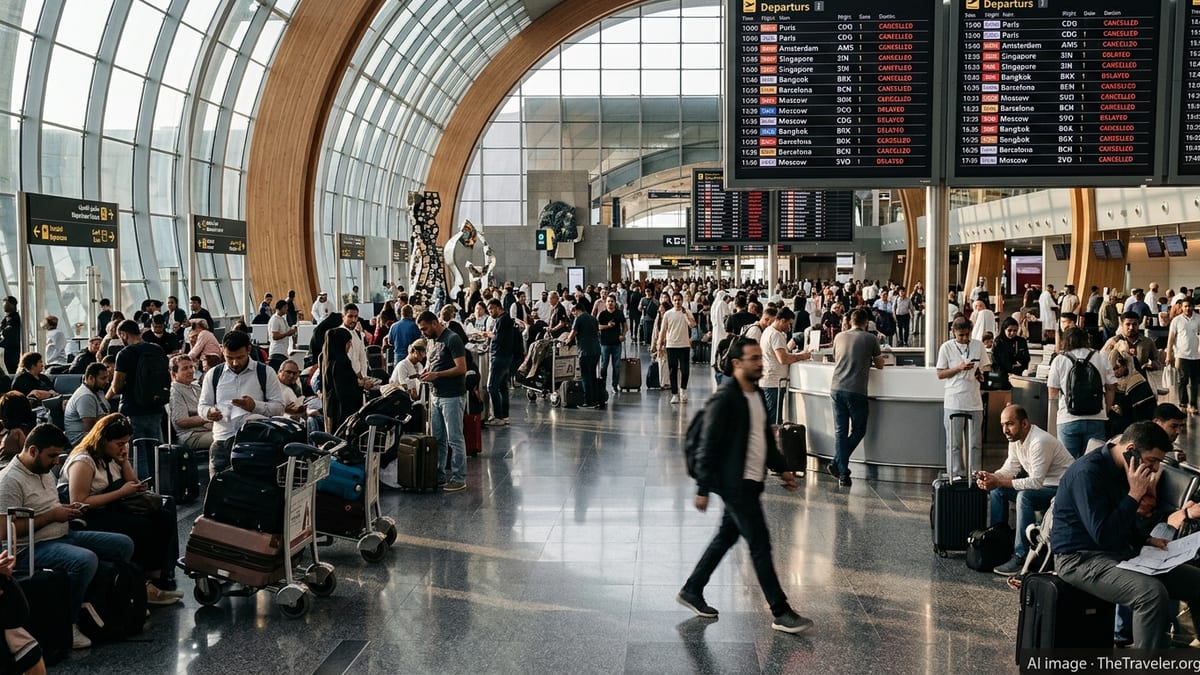
Qatar’s fragile air links are under renewed strain as more than 80 flights to and from Doha are cancelled or suspended, with Qatar Airways, Gulf Air and other regional carriers sharply reducing services on key routes to Europe and Asia amid ongoing security tensions and restricted Gulf airspace.
Get the latest news straight to your inbox!
Expanded Cancellations Hit Major Long-Haul Gateways
Publicly available flight data and airline advisories indicate that the latest round of schedule cuts has concentrated on major long-haul and connecting hubs, including Paris, Moscow, Munich, Barcelona, Dublin, Amsterdam, Kuala Lumpur, Singapore, Bangkok and Shanghai. These cities form part of the core global network radiating from Doha’s Hamad International Airport, and reductions there signal a deepening disruption rather than a short-term schedule trim.
Reports from passenger tracking tools and airport departure boards show numerous Qatar Airways services from Doha to European capitals either listed as cancelled or removed from sale, particularly around late March. Travellers scheduled to connect via Doha to cities such as Paris, Amsterdam, Dublin and Barcelona are increasingly finding their flights rebooked on alternative routings or shifted several days later, if options exist at all.
In Asia, routes to Singapore, Kuala Lumpur, Bangkok and Shanghai have seen a mix of outright cancellations, downgauged frequencies and last-minute timetable changes. Aviation forums tracking the situation describe a pattern in which some destinations retain limited service while others see entire days of operations wiped out, complicating efforts for passengers and travel agents to plan around the disruption.
Moscow and Munich, both important connecting points for traffic flowing between Europe, the Middle East and Asia, have also recorded fresh cancellations. The uneven pattern of cuts, varying by date and time of day, is adding to the uncertainty for travellers who rely on Doha as a one-stop gateway between continents.
Security Crisis and Airspace Limits Continue to Shape Operations
The cancellations are unfolding against the backdrop of the wider regional conflict that erupted in late February 2026, when Iranian strikes targeted multiple Gulf states, including Qatar. Public reporting on the situation notes that Qatari airspace initially closed and later reopened only in a restricted, emergency configuration, prioritising limited evacuation and cargo flights over routine commercial services.
Travel advisories compiled by risk consultancies and government agencies as of early March describe Hamad International Airport as operating with sharply reduced capacity, with regular schedules effectively suspended or heavily curtailed. While some relief and repatriation flights have operated, the overall volume of traffic remains far below normal, constraining how many passengers Qatar Airways and partner airlines can move through the hub on any given day.
As the conflict has dragged on, airspace closures and routing constraints across the wider Gulf have continued to complicate flight planning. According to recent analytical coverage of the Iran war’s economic impact, thousands of daily cancellations across multiple Gulf hubs have become a sustained feature rather than a brief shock, with airlines forced into rolling schedule revisions as risk assessments and regulatory restrictions evolve.
Operational decisions at Qatar Airways and Gulf Air appear to be closely tied to these shifting parameters. With some air corridors intermittently available and others effectively off-limits, carriers have favoured ad hoc relief services and a skeletal interim network over a rapid restoration of normal timetables, resulting in repeated short-notice changes for passengers.
Qatar Airways, Gulf Air and Regional Peers Tighten Interim Schedules
Qatar Airways has already been operating on a reduced interim schedule for much of March, and community-sourced schedule tracking suggests that the airline has made several further revisions to its planned operations between 18 and 28 March. Passengers report that routes previously announced as operating with limited frequencies have seen additional cancellations, particularly around the weekend of 23 to 24 March, pushing the total number of affected flights well beyond 80.
Gulf Air, which normally funnels traffic through Bahrain to and from Doha and other Gulf points, has also pared back operations in response to regional airspace uncertainty. Recent updates circulating in passenger forums reference efforts to re-route some customers via alternative airports in Saudi Arabia, indicating that constraints around Bahrain and Qatar are prompting broader network reshuffles across the Gulf.
Other regional carriers, including major Gulf network airlines, have been referenced in international economic analyses as facing extensive operational suspensions since the onset of the Iran war. The combined effect is a thinning of capacity across a swath of East-West trunk routes, with Doha’s disruptions closely intertwined with those at neighbouring hubs.
While some long-haul destinations from Doha are still appearing in booking systems, passengers report that flight numbers, aircraft types and departure days are changing frequently. In many cases, itineraries touching Qatar are being converted to open tickets or rerouted via alternative hubs in Europe or Asia, further eroding confidence in near-term travel plans.
Thousands of Travellers Scramble to Reroute and Rebook
For travellers, the practical impact of the new cancellations has been mounting uncertainty and fragmented information. Public discussion threads dedicated to the crisis are filled with reports of itineraries being cancelled one sector at a time, often without simultaneous notification across all booking channels. Some passengers say they only discover that their Doha connection has been dropped when they attempt to manage their reservation or select seats online.
Others describe being offered rebooking options on partner or rival airlines, in some cases at comparable cabin class and without additional charges, while a significant number report long waits before receiving clear guidance on their alternatives. With departures around 24 March particularly affected, travellers returning from Asia to Europe via Doha have been scrambling to secure scarce seats on other routes through Istanbul, Dubai or major European hubs.
Flexible change and refund policies advertised by airlines during the crisis are easing the financial hit for some customers, but the lack of predictable schedules is prompting many would-be visitors and business travellers to postpone or cancel trips entirely. Travel agents and tour operators are meanwhile attempting to rework itineraries that hinged on Qatar’s historically reliable connectivity between Europe, the Middle East and Asia.
The strain is especially acute for passengers with onward connections operated by other carriers, who must coordinate changes across multiple tickets and conditions of carriage. Publicly available commentary from consumer advocates warns that travellers should document all communications and keep careful records of cancellations, as disrupted journeys may span several different jurisdictions and compensation regimes.
Outlook: Prolonged Disruption Likely as Conflict Persists
Analytical coverage of the broader Iran war suggests that the shock to Gulf aviation and global connectivity is likely to persist for months if hostilities and associated security restrictions continue. Economic modelling cited in recent reports projects that air travel to, from and across the region could remain significantly depressed into the summer, affecting both leisure and corporate demand.
For Qatar, the extended disruption threatens to undermine years of investment in building Doha into a high-reliability super-connector. Industry observers note that while passengers may initially accept cancellations and reroutings as unavoidable in a fast-moving security crisis, repeated last-minute changes can erode trust and drive travellers to seek routings that bypass the region entirely when alternatives exist.
In the near term, the pattern of rolling schedule adjustments suggests that further cancellations are possible, particularly on routes where demand can be consolidated onto a handful of flights or shifted to partner networks. With airspace conditions still fluid and diplomatic efforts yet to produce a durable de-escalation, travellers planning to pass through Qatar and neighbouring hubs in the coming weeks are likely to face a volatile operating environment and should be prepared for additional last-minute changes.