

More news on this day
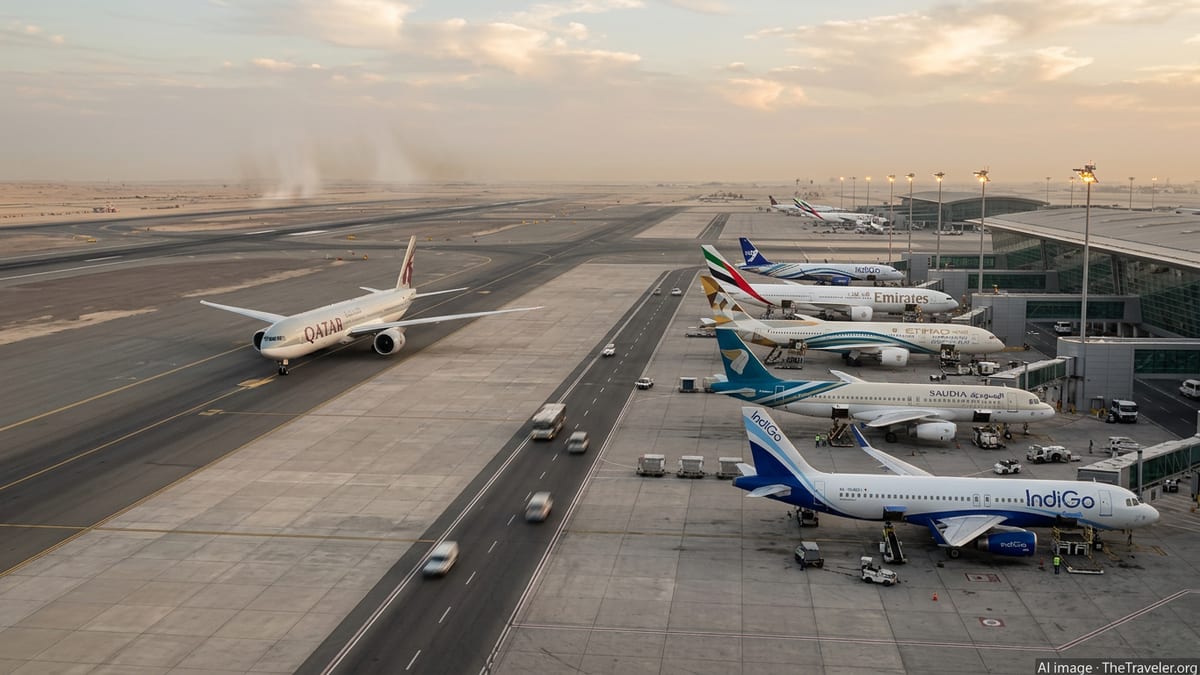
After nearly ten days of rolling airspace closures and missile threats that severed the Gulf from the world, Qatar Airways has joined Emirates, Etihad, Saudia, Oman Air, IndiGo and other carriers in cautiously reopening thin corridors in and out of the Middle East, offering a fragile lifeline to hundreds of thousands of stranded travelers.
From Sudden Shutdown to Sliver of Reconnection
The latest phase of the Iran war, triggered by coordinated United States and Israeli strikes on Iran on February 28, effectively shut some of the world’s most important aviation crossroads almost overnight. Airspace across Iran, Iraq, the Gulf and parts of the Levant was either closed outright or restricted to military and emergency movements, cutting off the core corridor linking Europe and Africa with South and Southeast Asia.
On March 1 alone, analysts estimate that close to 19,000 flights worldwide were affected, with several thousand outright cancellations as notices to airmen extended across at least 11 Middle Eastern and Gulf states. Major hubs in Dubai, Abu Dhabi and Doha, which together typically handle tens of thousands of connecting passengers each day, rapidly emptied of departures while inbound flights diverted or turned back midair.
Initially, the big Gulf carriers adopted a hard stop. Emirates and Etihad halted virtually all passenger services, while Qatar Airways shut down operations at Hamad International Airport except for military and emergency movements. Saudia, Oman Air and low cost carriers around the region followed suit, producing a cascading wave of disruption from European capitals to Asian megacities as long-haul traffic lost its primary bridge.
By March 6 and March 7, the immediate missile barrage had eased slightly and regulators began to outline narrow safe pathways. These were not full reopenings but tightly controlled corridors negotiated between civil aviation authorities and militaries, designed to allow limited evacuation, repatriation and essential commercial flights while avoiding active conflict zones and missile trajectories.
Qatar Airways Finally Returns to the Skies
Qatar Airways, which had remained almost entirely grounded in Doha even as Emirati carriers began cautiously lifting off again, is now rejoining the patchwork of reopened routes. Following temporary authorization from Qatar’s civil aviation regulator, the airline has announced a small slate of flights into Hamad International Airport from key long haul markets including London, Paris, Madrid, Rome, Frankfurt and Bangkok.
For now, these services are being framed as relief and evacuation flights rather than a full commercial restoration. Schedules are deliberately sparse, aircraft types are being chosen for flexibility and range, and routings are adjusted to align with the limited safe air corridors cleared by military risk assessments. Airline statements emphasize that seats are being prioritized for passengers already stranded in the network rather than for new bookings.
Operationally, the return of Qatar Airways is symbolically important. Along with Emirates and Etihad, the Doha carrier forms one leg of the “Gulf superhub triangle” that has reshaped intercontinental travel over the past two decades. Analysts note that when one of these three giants is offline, global connectivity suffers; when all three are effectively grounded, as happened in the days after February 28, the impact on flows between Europe, Africa and Asia is profound.
Inside Qatar, the reopening of limited corridors comes after several tense days in which missile and drone attacks targeted infrastructure in and around Doha, including the approaches to the international airport. Officials have stressed that the new flights operate under “emergency conditions” only, with heavy reliance on air defense coordination and constant rerisking of routes in response to changing military activity and electronic interference.
Gulf and Indian Carriers Stitch Together Patchy Networks
While Qatar Airways edges back, other regional airlines have already spent several days experimenting with skeletal schedules. Emirates and Etihad began operating a small number of departures from Dubai and Abu Dhabi earlier in the week, initially focusing on evacuation flights and then expanding to select commercial services once regulators cleared outbound corridors over parts of Saudi Arabia and the Arabian Sea.
Saudia has taken a more conservative approach, maintaining suspensions on flights to and from several regional cities even as it restores some long haul operations. Oman Air has cancelled numerous routes into Gulf neighbors including Dubai, Doha and Bahrain, while using Muscat as a quieter staging point for connections to South Asia and Europe via more southerly paths.
Indian carriers have emerged as an unexpected pressure valve. IndiGo, which briefly paused Middle East operations at the height of the shutdown, has relaunched specific services to Athens, Muscat, Jeddah and Medina, and added extra repatriation flights between India and Gulf destinations. Air India has mounted additional long haul flights to Europe and North America that completely bypass the Gulf, helping some travelers reroute around the conflict zone at the cost of longer flying times and scarcer seats.
Together, these moves are creating a patchwork of options, not a return to normality. Flight timings are erratic, aircraft rotations are being constantly adjusted and airlines warn that last minute cancellations remain likely as conflict dynamics shift. In many cases, carriers are explicitly telling customers not to travel to the airport without a confirmed rebooking issued within hours of departure.
Electronic Warfare, Closed Skies and the “Limited Corridor” Strategy
Beyond missiles and drones, a surge in electronic warfare has complicated efforts to restart aviation. Industry monitoring has recorded a sharp rise in GPS jamming and spoofing across the Gulf and eastern Mediterranean since late February, affecting both aircraft navigation and maritime traffic. Pilots have reported false position readings, patchy satellite reception and the need to revert to ground based or inertial navigation systems on certain segments.
To manage this cocktail of risks, regulators and airlines are relying on the “limited corridor” concept. Instead of reopening entire flight information regions, authorities are carving out narrow bands of airspace, typically at specific altitudes and times of day, that are kept free of military activity and electronic interference as far as possible. Civilian flights are then funneled through these corridors, sometimes adding hundreds of miles to routings in order to avoid contested zones.
These corridors demand intensive coordination. Military planners must guarantee that missile batteries and air defense systems will not engage aircraft within predefined lanes, while civil aviation agencies continuously update notices and tactical routing based on the latest intelligence. Airlines, for their part, have to juggle crew duty limits, fuel planning and passenger reaccommodation against an environment where today’s safe corridor may be unusable tomorrow.
For travelers, the result is longer flights, unusual routings and often confusing communications. A journey that typically involves a short stop in Dubai or Doha may now involve diversions via Southern Europe, Central Asia or even detours through Africa, with arrival times slipping by many hours and checked baggage delayed or misrouted as complex hub connections break down.
What Passengers Should Expect in the Coming Days
With the conflict still active and GPS disruption widespread, aviation experts caution that the current phase is best seen as a fragile bridge, not a definitive reopening. Qatar Airways, Emirates, Etihad, Saudia, Oman Air, IndiGo and their peers are under significant pressure from governments to evacuate citizens and from the market to restore commerce, but they remain constrained by military timelines and safety margins.
Travelers booked through Gulf hubs over the next week should expect rolling schedule changes, last minute reroutes and, in some cases, outright cancellations. Even where flights operate, airports are facing extraordinary strain as thousands of stranded passengers compete for limited seats, hotels around major hubs remain heavily booked and call centers struggle to keep up with rebooking requests.
Industry guidance is blunt: check your booking status frequently, ensure the airline has up to date contact details and avoid heading to the airport without a same day, confirmed itinerary. Flexible tickets and travel insurance that covers war related disruption are suddenly more valuable than loyalty points or minor fare savings, especially for complex itineraries crossing multiple regions.
Looking ahead, the reopening of limited corridors from Doha is an encouraging signal that the full quarantine of the Gulf’s skies may be easing. Yet the same factors that plunged the region into chaos in late February, from missile exchanges to electronic interference, remain unresolved. Until those risks recede, Qatar and its fellow carriers are likely to keep operating in crisis mode, stitching together just enough connectivity to keep people and goods moving while the skies above them remain anything but normal.