

More news on this day
War in West Asia has abruptly turned major Gulf hubs into holding zones for anxious visitors, with Qatar now joining the United Arab Emirates, Saudi Arabia, Bahrain, Kuwait, Lebanon, Cyprus and other states in rolling out emergency measures and ad hoc evacuation routes as tens of thousands of stranded tourists wait for a way out.
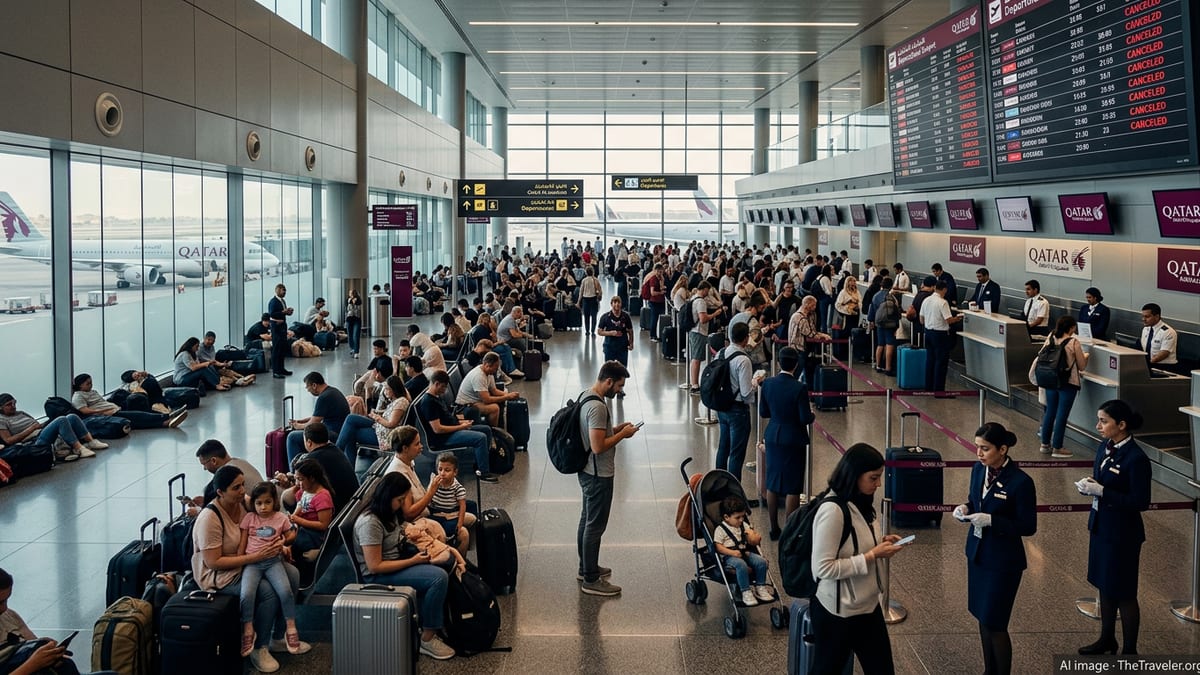
Regional War Paralyzes Key West Asia Travel Hubs
Air travel across West Asia remains severely disrupted after the rapid escalation of the Iran conflict at the end of February 2026, which prompted widespread airspace closures and missile and drone strikes near major hubs. Airports in Qatar, the United Arab Emirates and Saudi Arabia, normally among the world’s busiest transit points, have seen large parts of their operations suspended or sharply curtailed as authorities prioritize security and military traffic.
The sudden shutdown has had a cascading effect on global travel, cutting critical east–west corridors that funnel long-haul passengers between Europe, Africa and Asia. Aviation data show more than 20,000 flights canceled in just a few days and hundreds of thousands of passengers diverted or stranded as aircraft were rerouted around closed skies or forced to land at secondary airports far from their intended destinations.
As of March 3, Qatari airspace remains effectively closed to routine commercial traffic, leaving an estimated 8,000 transit passengers stuck in Doha alone, with thousands more marooned in Dubai, Abu Dhabi, Riyadh, Jeddah, Manama and Kuwait City. Many are tourists who had simply chosen Gulf hubs for a convenient connection, only to find themselves pulled into the epicenter of a regional conflict.
Beyond the Gulf, the crisis has rippled into Lebanon and Cyprus, both of which play strategic roles for regional connectivity and diplomacy. While their airports are not completely shut, heightened security alerts, sudden cancellations and the risk of spillover attacks have turned what were once straightforward short-haul trips into complicated, multi-stop journeys.
Qatar Extends Visa Validity as Governments Prioritize Evacuations
In response to mounting concern from travelers and foreign embassies, Qatar has moved to extend the validity of visas for foreign visitors who cannot depart because of the airspace closure and limited flight schedule. The temporary policy, quietly introduced this week, is designed to ensure that stranded tourists, business travelers and transit passengers are not penalized for overstaying while they wait for evacuation or commercial options to resume.
Qatar’s move mirrors or formalizes measures already announced by the United Arab Emirates, Saudi Arabia, Kuwait, Bahrain and Lebanon, which have each adjusted visa rules or waived overstay fines as the crisis deepens. Travel-industry outlets report that some neighboring destinations, including the Maldives and Jordan, have taken similar steps to accommodate visitors whose itineraries relied on now-suspended Gulf connections.
These visa relaxations are emerging as a critical part of the emergency toolkit. With no clear timeline for a full reopening of regional airspace, authorities are under pressure to prevent a secondary humanitarian issue in which law-abiding tourists suddenly find themselves in technical violation of immigration rules. For now, officials in Doha and other capitals are signaling that visitors who entered legally and remain in contact with their airlines and embassies will be given leeway.
At the same time, foreign governments are ramping up organized evacuations. European states, India and several Asian countries have begun dispatching special flights to Gulf gateways and nearby hubs such as Saudi Arabia and Oman to extract their citizens. Charter operations, including cruise-line repatriation flights via Dubai and Abu Dhabi, are adding another layer of complexity to an already congested and carefully controlled airspace.
Limited Safe Corridors and Patchwork Routes Out of the Region
With large swaths of airspace over Iran, Iraq, Qatar, Bahrain and parts of Saudi Arabia periodically closed or designated high risk, civilian aviation planners are scrambling to redraw the map of safe corridors. Airlines have sharply reduced or entirely halted flying over conflict zones, pushing traffic south over the Arabian Sea or north via Turkey, the Caucasus and parts of the eastern Mediterranean whenever those paths are deemed secure.
Qatar and the United Arab Emirates are cooperating to use an eastern Gulf corridor for limited evacuation flights toward India and Southeast Asia, according to industry reports. These flights, often operating on short-notice clearances, are primarily serving repatriation efforts coordinated with foreign ministries rather than regular ticket sales. Seats are scarce and frequently allocated to priority cases such as families, elderly travelers and those with urgent medical needs.
Elsewhere, Saudi Arabia has emerged as a vital but heavily burdened staging ground. While its airspace is subject to intermittent restrictions and security alerts, certain airports continue to receive special flights from Europe and Asia, functioning as waypoints where evacuees can transfer to onward services. Cyprus, sitting on the eastern edge of the Mediterranean, is also being discussed as a secondary evacuation hub, though capacity and military traffic constraints limit how many civilians can be processed.
For individual travelers, this patchwork of corridors translates into a confusing and constantly changing set of options. A route that is viable one day can be suspended the next following a new round of strikes or intelligence warnings. Travel advisers urge stranded visitors not to attempt overland border crossings without official guidance, stressing that the safest pathways out are currently those organized or endorsed by airlines and national embassies.
Stranded Tourists Face Uncertainty, Rising Costs and Confusing Advice
On the ground in Doha, Dubai, Abu Dhabi and other affected cities, the human impact of the crisis is playing out in hotel lobbies, airport terminals and temporary accommodation centers. Travelers report long queues at airline service desks, limited information about when flights might resume and difficulty reaching call centers overwhelmed by demand. Some passengers diverted to secondary airports such as Muscat or Larnaca have been waiting days for onward transportation.
The financial strain is mounting. While some airlines are covering basic accommodation and meal costs for passengers whose tickets fall under standard disruption rules, others argue that the conflict constitutes a force majeure event and are offering more limited support. Insurance coverage varies widely, with many standard travel policies excluding war-related disruptions, leaving tourists to pay out of pocket for extra nights in hotels, rebooked tickets or emergency flights home.
Families traveling with children and elderly relatives are particularly vulnerable, especially those who planned tightly budgeted trips and now face open-ended stays. Travel consultants say many stranded visitors are improvising, sharing rooms with fellow passengers, coordinating in online groups to swap information and, in some cases, seeking assistance from local expatriate communities to secure temporary housing.
Amid the uncertainty, one clear trend has emerged: direct communication from governments is often more reliable than fragmented social media updates. Several embassies in Qatar, the UAE, Saudi Arabia, Kuwait, Lebanon and Cyprus have activated 24-hour hotlines and messaging channels, urging citizens to register their presence and await specific evacuation or booking instructions rather than converging on airports without confirmed flights.
What Travelers Need to Know Right Now
For those currently stranded in Qatar, the Gulf or neighboring hotspots, the most immediate priority is to stay informed through official channels. Tourists are advised to register with their embassy or consulate, monitor government travel advisories and keep close contact with their airline via apps and email rather than relying solely on airport announcements, which can lag behind real-time changes in airspace status.
Understanding local visa rules is equally important. Qatar and several Gulf and Levant states have signaled that foreigners will not be penalized for unavoidable overstays while commercial traffic remains severely limited, but travelers should keep records of entry dates, canceled flights and any communication from airlines or authorities. This documentation may be crucial when regular border controls resume or if travelers seek reimbursement later.
Those planning future trips through West Asia are being urged to postpone nonessential travel, avoid booking itineraries that rely on tight connections through Gulf hubs and consider alternative routings via southern Europe, North Africa or South Asia where safe and available. Travel agents recommend buying flexible tickets and reviewing insurance fine print to ensure that at least some war- and disruption-related coverage is in place.
Even as some limited evacuation flights begin to move, officials and industry analysts warn that the region’s role as a seamless global crossroads has, for now, been upended. With the trajectory of the conflict still uncertain, mass tourism and business travel through Qatar, the UAE, Saudi Arabia, Bahrain, Kuwait, Lebanon, Cyprus and neighboring states is likely to remain constrained, and travelers should be prepared for a protracted period of caution, higher fares and circuitous routes.