

More news on this day
Qatar is stepping up coordination with partners in Europe, Asia and the Americas to steady global aviation networks, as fresh disruption sees more than 100 flights cancelled and over 3,400 delayed across key markets.
Get the latest news straight to your inbox!
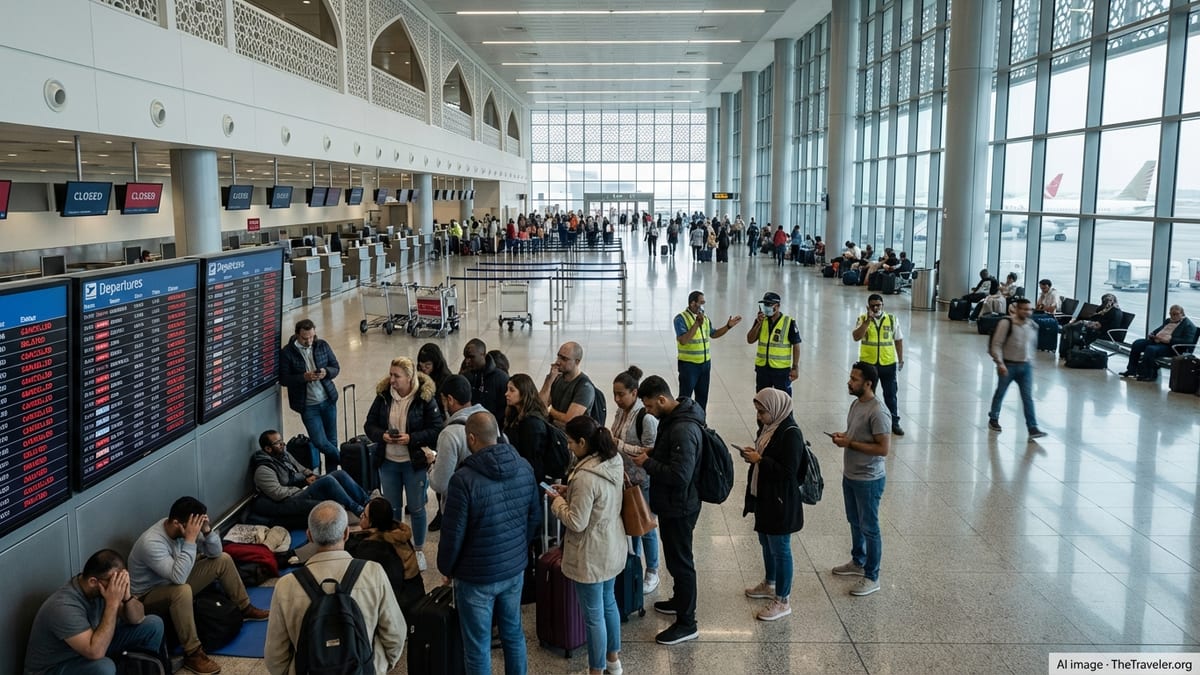
Coordinated Response Spans Three Continents
Publicly available information shows Qatar working alongside the United Kingdom, Spain, the Philippines, Bahrain, Brazil, Canada, Colombia and Malaysia within a wider group of states seeking to keep air corridors open and predictable. The cooperation ranges from shared airspace assessments to harmonized guidance for airlines and airports handling rerouted traffic from the Middle East and adjacent regions.
Reports indicate that regulators and transport ministries in these countries are aligning on temporary operating procedures, including contingency routings over safer airspace, revised crew duty-time rules and fast-track approvals for schedule changes. The goal is to avoid a repeat of the most acute disruption days earlier in the crisis, when regional hubs faced sudden shutdowns and widespread diversions.
While each government is publishing its own notices and advisories, analysts say the pattern points to a de facto coalition trying to preserve long-haul links between Europe, the Americas and Asia. For Doha, London, Madrid, Manila, Manama, Brasília, Ottawa, Bogotá and Kuala Lumpur, these links underpin critical flows of workers, tourists and cargo.
The emerging framework is not a formal treaty, but it reflects intensive coordination shaped by recent experience with airspace closures over the Gulf and surrounding regions. Travel industry observers note that carriers based in these partner countries are now adjusting schedules with a clearer view of shared risk assessments and preferred diversion gateways.
114 Cancellations and 3,400 Delays Highlight Fragile Networks
Latest operational tallies from flight-tracking and aviation data providers point to at least 114 flight cancellations and more than 3,400 delays tied to the latest wave of disruptions. These figures, covering a rolling 24-hour period, capture both long-haul and regional services adjusting to constrained airspace, altered routings and congestion at substitute hubs.
Disruptions have been particularly visible on corridors linking Europe and the Middle East to Southeast Asia and Australasia, where Qatar Airways and other Gulf-based carriers usually operate dense connecting banks. With parts of regional airspace operating under restrictions, aircraft have been forced onto longer flight paths, pushing some schedules beyond legal crew duty limits and triggering cancellations rather than manageable delays.
Airports in the United Kingdom and Spain have absorbed a noticeable share of diverted or re-timed services, according to industry dashboards, while Canadian and Brazilian gateways have reported knock-on delays on transatlantic and South American routes. In Asia, major hubs that connect with Qatar and its partners have similarly reported extended turnaround times as ground handlers manage off-schedule arrivals.
Analysts stress that, although the disruption is significant, the numbers remain below the most severe days seen at the height of recent Middle East airspace closures. The collaborative measures now being developed are intended to keep cancellation totals in the low hundreds rather than allowing rolling disruption to compound into thousands of grounded flights.
Role of Partner Countries in Rerouting and Capacity Management
The partner countries named in connection with Qatar’s aviation push each play a distinct role in the evolving response. The United Kingdom and Spain act as crucial western gateways for traffic between Europe, the Gulf and Latin America, making their airspace and slot policies central to any rerouting effort. Canada and Brazil are similarly important for absorbing delayed or diverted services on long-haul routes across the Atlantic.
In Asia, Malaysia and the Philippines provide alternative or supplementary connections for traffic that might otherwise have funneled through Gulf hubs alone. Kuala Lumpur and Manila can serve as waypoints for passengers traveling between South and Southeast Asia, Oceania, the Middle East and North America, helping to spread capacity more evenly when a single hub is constrained.
Bahrain’s geographic proximity to Qatar and its own hub operations mean coordination on approach paths, holding patterns and slot times can materially ease congestion in constrained airspace. Colombia’s inclusion reflects growing north–south connectivity across the Americas, where schedule changes in Europe or the Gulf can cascade into timing shifts in Bogotá and beyond.
Travel data specialists note that, despite the complexity, this distribution of roles helps airlines stitch together workable itineraries even as original routings become unavailable. By collaborating on clear priorities, such as protecting repatriation flights and essential cargo routes, states aim to keep the most critical links intact, even when commercial schedules must be trimmed.
Passenger Impact and Shifting Airline Strategies
For travelers, the immediate impact of the latest cancellations and delays is seen in longer journey times, missed connections and last-minute rebookings. Industry trackers describe a familiar pattern: initial rolling delays as airlines wait for clarity on airspace status, followed by clusters of cancellations once route viability becomes clearer.
Carriers connected to Qatar and its partner countries have been adjusting strategies in response. Public schedules show some airlines consolidating multiple lightly booked services into a single flight, while others temporarily reduce frequencies on secondary routes to preserve capacity on trunk links. Some long-haul sectors are now operating on altered departure waves, shifting key flights into windows when overflight permissions and air traffic control capacity are more predictable.
These tactical moves have consequences for connectivity. A single cancelled flight between a regional city and a major hub can strand passengers who were relying on precise banked connections. This is particularly acute for travelers heading to or from smaller markets in Latin America, Southeast Asia or secondary European cities, where alternatives are less frequent.
Travel advisors are encouraging passengers transiting through affected hubs to build in additional buffer time and to monitor airline apps and airport departure boards closely. With coordination efforts still evolving, same-day changes remain possible, even for flights that appear confirmed the night before departure.
Longer-Term Overhaul of Aviation Resilience
Beyond the immediate disruption, Qatar’s engagement with partners across Europe, the Americas and Asia points to a broader attempt to overhaul how commercial aviation prepares for regional crises. Reports describe discussions around more dynamic airspace risk modelling, shared data on missile and drone activity, and faster mechanisms for rerouting civil traffic away from newly emergent hotspots.
Industry observers suggest that one priority is to reduce the time lag between geopolitical events and operational responses. In recent crises, airlines have sometimes been forced into reactive cancellations as restrictions were imposed suddenly. A more coordinated framework, shared by states such as the United Kingdom, Spain, Bahrain, Canada and Malaysia, could help carriers anticipate chokepoints earlier and adjust schedules in a more orderly fashion.
Another strand of the overhaul relates to airport and ground-handling resilience. The experience of managing diverted flights has underlined the need for flexible staffing, surge gate capacity and contingency agreements between airports in different countries. For example, if a hub experiences sudden disruption, prearranged plans could see partner airports temporarily assume additional transit volumes without overwhelming local systems.
In the meantime, the current tally of 114 cancelled flights and more than 3,400 delays serves as a reminder of how interconnected and vulnerable global air travel remains. The success of Qatar’s multinational effort will be measured less by whether disruption disappears entirely, and more by whether future turbulence can be contained before it cascades across the world’s skies.